


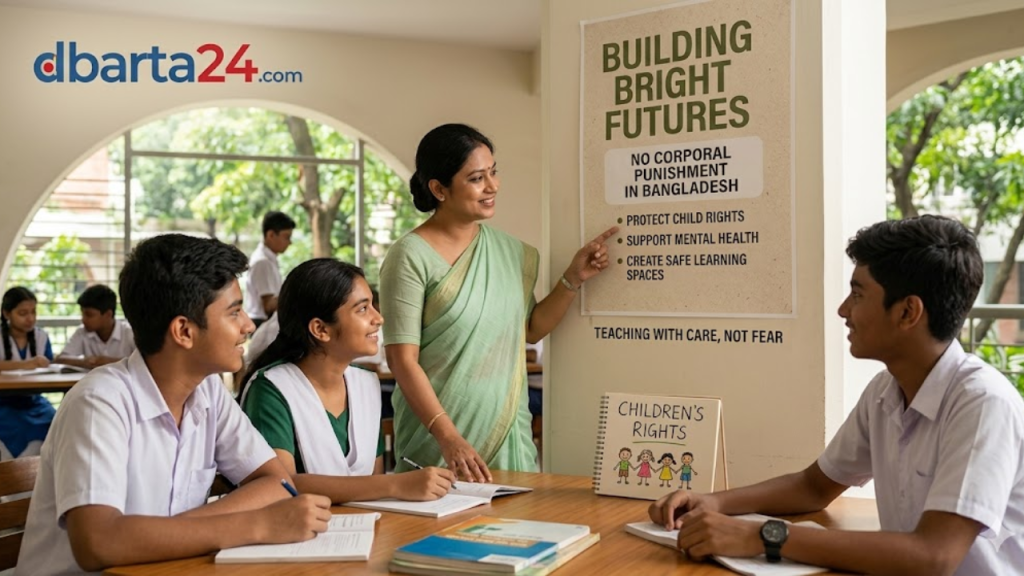
Muyabia Labony ; DHAKA – Despite a ban on corporal punishment in educational institutions issued 15 years ago, violence against children under the guise of “discipline” remains rampant in Bangladesh.
According to the preliminary report of the ‘Multiple Indicator Cluster Survey 2025’, conducted jointly by the Bangladesh Bureau of Statistics and UNICEF, 85.7% of children aged 1 to 14 face physical punishment.
The situation is even more dire for younger children, with the rate climbing to 89.8% for those aged 5 to 9. This data comes as Bangladesh observes World Day to End Corporal Punishment on April 30.
A Culture of Fear: The Case of Nahid
The harsh reality is mirrored in the story of Nahid, a Madrasa student who was brutally beaten with a cane by his teacher on April 22 for failing to recite a lesson.
His father, Mizanur Rahman, expressed his horror at the “inhumane” marks left on his son’s body, stating that even criminals are not treated with such cruelty.
The Adverse Effects of Punishment
Experts argue that the common belief—”there is no medicine like a beating”—is a dangerous misconception. Rather than teaching discipline, physical punishment has severe long-term consequences:
-
Developmental Delays: Research in low- and middle-income countries shows that punished children are 24% less likely to reach their full developmental potential compared to their peers.
-
Brain Structure: Extreme punishment (hitting the head, face, or ears) triggers hormonal reactions that can alter the structure and function of a child’s brain.
-
Mental Health: It leads to low self-esteem, anxiety, depression, and a higher risk of anti-social behavior or drug addiction in adulthood.
-
Violation of Rights: Child psychiatrists emphasize that punishment is a grave violation of human dignity.
Global Context and the Need for Law
While 70 countries have enacted laws banning corporal punishment in all settings—including homes, schools, and workplaces—Bangladesh is not yet on this list.
Although the Ministry of Education issued a circular in 2011 to ban punishment in schools, it is frequently ignored.
Laila Khandkar, convener of the organization ‘Shishurai Sob,’ noted that punishment often stems from the personal or professional frustrations of adults rather than a child’s behavior.
Child rights activists are now calling for a new, comprehensive law to legally prohibit all forms of physical punishment and are urging for better training for parents and teachers in positive parenting techniques.