


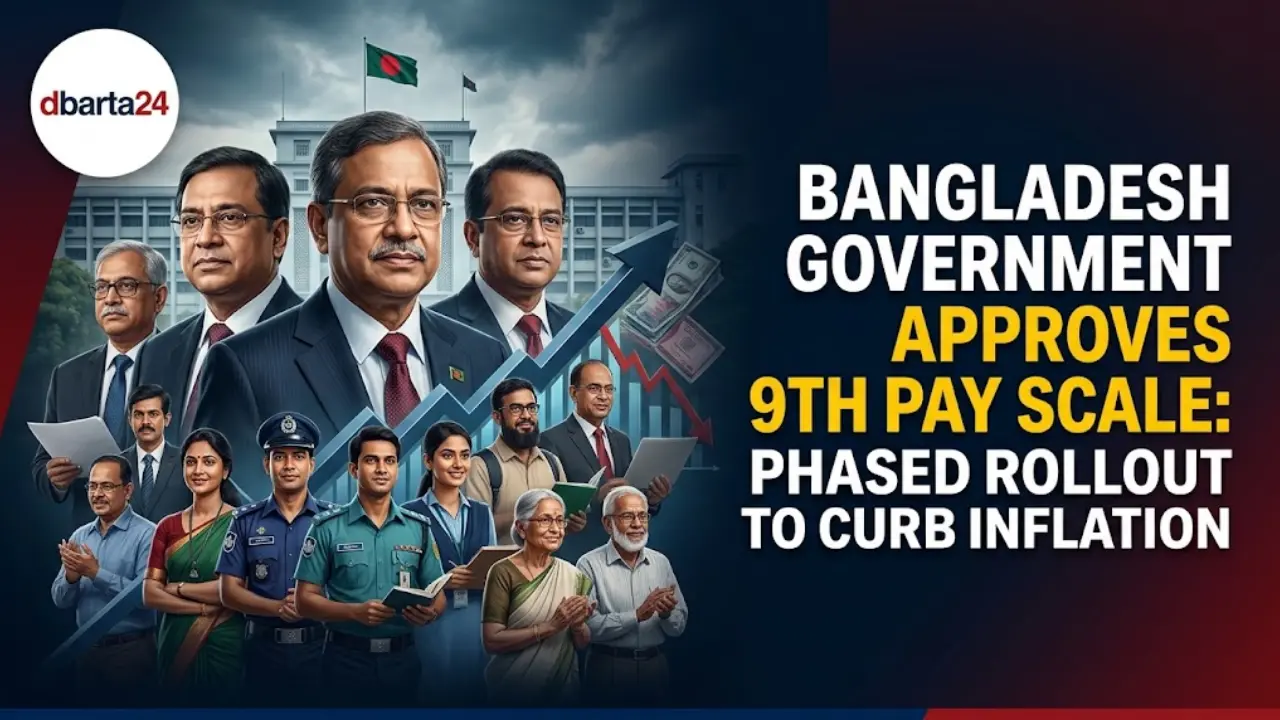
Dbarta24 Report — To balance economic stability with civil service welfare, the Cabinet has approved the 9th National Pay Scale for government employees, adopting a structured, three-phase implementation approach designed to mitigate inflationary pressure.
Under the approved framework, basic salaries will be adjusted in steps through July 2027, while full allowances will take effect starting January 2028.
The decision was finalized during a Cabinet meeting chaired by Prime Minister Tarique Rahman at the Bangladesh Secretariat on Monday.
Providing details during a subsequent press briefing at the Press Information Department (PID), Cabinet Secretary Nasimul Gani highlighted that an official gazette outlining the regulatory changes will be published this week. Principal Information Officer Syed Abdal Ahmad was also present at the briefing.
The enhanced structure will benefit approximately 2.4 million civilian and military personnel, alongside over 925,000 pensioners and eligible beneficiaries.
The total additional annual fiscal requirement is estimated at BDT 105,580 crore. To absorb this financial commitment without triggering market disruption, the government spread the execution across multiple fiscal cycles.
Inflation Mitigation Strategy
Addressing concerns over market liquidity and price volatility—especially after an 11-year interval since the last major pay revision—Cabinet Secretary Nasimul Gani underscored that controlling inflation was the central design parameter of the phased model.
“Managing inflation was strictly taken into consideration. Otherwise, the full financial disbursement would have been executed in a single payout,” Nasimul Gani stated.
According to the official Cabinet press release, basic salary increases will be executed across three stages between July 1, 2026, and July 1, 2027. Full integration of all associated allowances will follow on January 1, 2028.
Explaining the macroeconomic rationale behind injection of funds into the household sector, the Cabinet Secretary noted:
“An economy cannot remain vibrant if liquidity does not reach the public. Whether through direct support to farmers, family card distribution, or assistance to cultural workers, the objective is to keep market liquidity active. People buy goods when they have purchasing power, driving economic activity. This decision follows that principle to restore buying power for those struggling with increased living expenses.”Priority Focus on Lower-Tier Grades (10th to 20th)
The revised scale deliberately prioritizes lower-salaried staff in Grades 10 through 20 to address income disparities. Percentage increases at lower pay tiers significantly exceed those at executive levels.
-
20th Grade (Lowest Tier): Basic pay rises from BDT 8,250 to BDT 20,000.
-
1st Grade (Top Executive Tier): Fixed basic pay increases from BDT 78,000 to BDT 156,000.
The administration justified the disproportionate baseline increase for lower grades on the grounds that junior staff bear a heavier relative burden from standard living costs.
Major Restructuring of Pension Benefits
The government has outlined a substantial pension adjustment strategy. While immediate adoption of a “One Rank, One Pension” model was deferred, the Cabinet resolved to implement the principle incrementally by 2030.
In the interim, net pensions will see tiered percentage increases favoring lower-tier beneficiaries:
| Monthly Net Pension Bracket | Pension Increase Rate |
| Up to BDT 9,000 | 100% increase |
| BDT 9,001 – BDT 20,000 | 75% increase |
| BDT 20,001 – BDT 30,000 | 65% increase |
| BDT 30,001 – BDT 40,000 | 60% increase |
| BDT 40,001 and above | 55% increase |
New Allowance Initiatives and Budgetary Financing
The new policy introduces a monthly allowance of BDT 3,000 for government employees supporting children with special needs—a first for national pay structures. Additionally, mobile allowances, previously capped at Grade 5, have now been extended universally across all grades.
Regarding Time Scale and Selection Grade mechanisms, the Cabinet Secretary clarified that precise operational guidelines will be outlined in the forthcoming Statutory Regulatory Order (SRO).
Addressing the funding model for the BDT 1.05 trillion expenditure, the Cabinet Secretary confirmed that the financial impact is spread over a three-year window. The funds are already integrated within the Medium-Term Budget Framework (MTBF) across the respective fiscal years, avoiding sudden fiscal deficits.
A separate committee has been formed to formulate a dedicated pay structure for the Bangladesh Judicial Service. The judicial scale will be approved upon submission of the committee’s report, with retrospective financial effects aligned to July 1 applied in phases.