


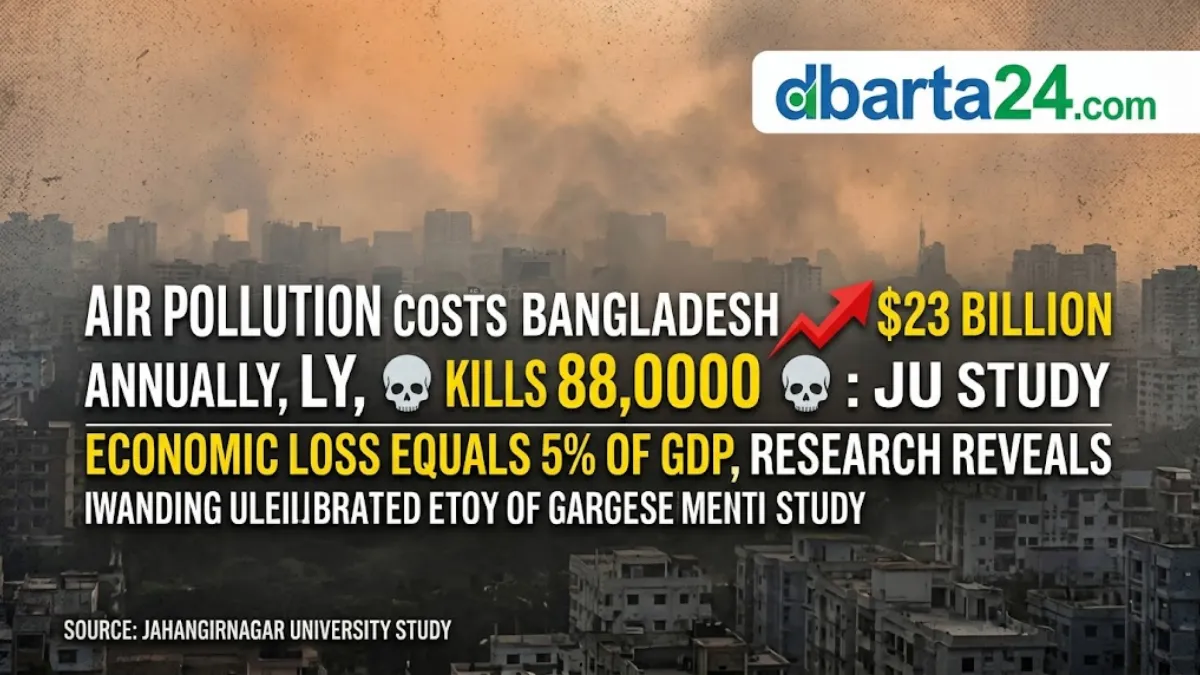
Khairul Alam – Air pollution has escalated into a severe public health crisis and a staggering economic burden for Bangladesh, draining approximately $23 billion (around Tk 2,80,600 crore) annually—equivalent to nearly 5 percent of the country’s Gross Domestic Product (GDP).
In addition to the crippling economic toll, toxic air accounts for an average of 242 deaths daily across the nation, resulting in roughly 88,240 premature deaths each year.
The alarming findings were presented on Wednesday during a press conference organized by the Department of Public Health and Informatics at Jahangirnagar University (JU).
The study, conducted by the university’s “Climate Change, Air Quality, and Health Research (C2AHR)” unit, was recently published in the internationally peer-reviewed journal Pollution.
Cardiovascular Diseases Top Death Toll
The research team analyzed health and environmental data spanning from 2013 to 2021 across six major metro areas: Dhaka, Chattogram, Rajshahi, Khulna, Sylhet, and Barishal.
Using the Concentration-Response Function (CRF) method—a widely accepted statistical model in epidemiology—the researchers measured the direct correlation between rising pollutant levels and adverse health outcomes.
The study revealed that cardiovascular disease is the leading cause of pollution-related fatalities, claiming 37,519 lives annually. Furthermore, chronic respiratory illnesses account for 8,344 deaths per year, while lung cancer causes 811 deaths.
Among the surveyed cities, the capital city of Dhaka bears the heaviest burden, recording an astounding 68,703 air pollution-related premature deaths annually.
It is followed by Chattogram with 11,202 deaths, Rajshahi with 2,827, Khulna with 2,625, Sylhet with 1,488, and Barishal with 1,395.
Data trends over the eight-year study period indicate a steady rise in mortality rates in all six cities, with Dhaka seeing an average increase of 3,484 additional deaths each year.
A Wake-Up Call for Policy Makers
Lead researcher and Associate Professor Md. Sakhawat Hossain, Chairman of JU’s Department of Public Health and Informatics, emphasized that air pollution can no longer be treated merely as an environmental inconvenience.
“We often view air pollution purely as an environmental issue. However, our findings show that it claims nearly 88,000 lives annually, with economic losses reaching almost 5 percent of our GDP. This should serve as a stark wake-up call for policy makers.”
— Md. Sakhawat Hossain, Lead Researcher & Associate Professor, JU
Urgent Action Needed
The research highlights that a significant portion of these fatal health complications and economic losses could be avoided if Bangladesh strictly aligns its air quality standards with the guidelines set by the World Health Organization (WHO).
To mitigate the escalating crisis, the authors recommend immediate policy interventions, including the aggressive reduction of fine particulate matter ($\text{PM}_{2.5}$) emissions, the implementation of robust pollution control policies, and the adoption of integrated urban air management systems across the country’s major urban centers.