


Dbarta24 Report – Air pollution levels in the capital city are on the rise despite recent seasonal rains typically keeping the atmosphere clear.
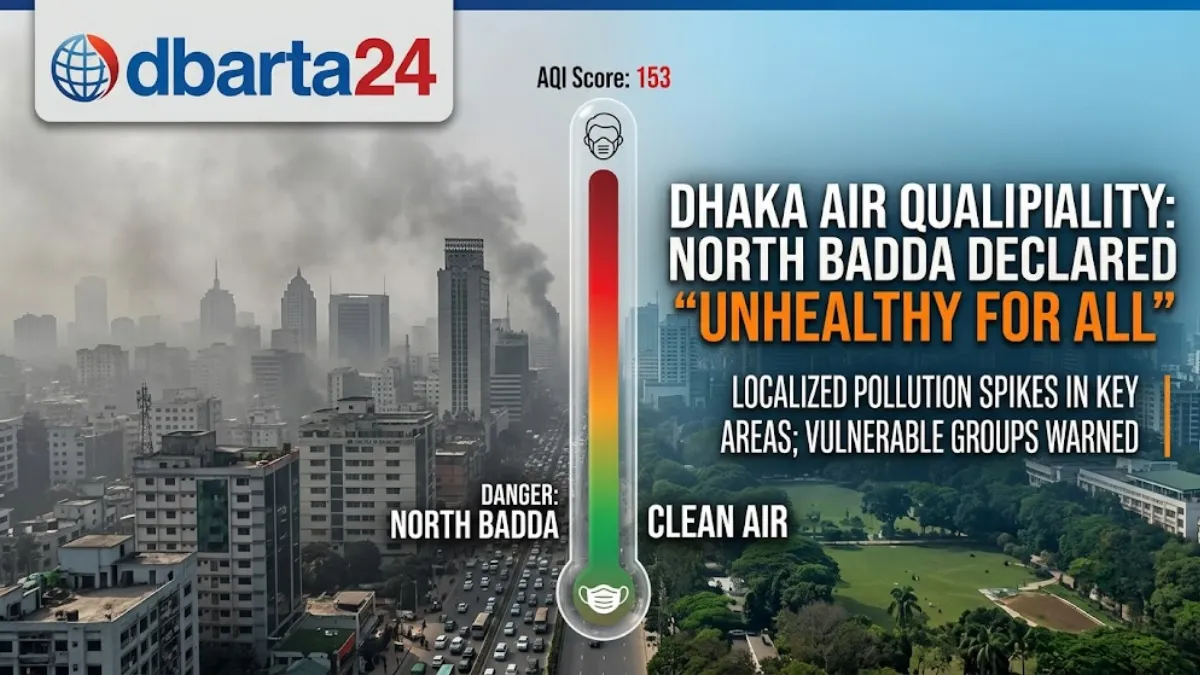
Leading the surge is Dhaka’s North Badda area, where the air quality index has deteriorated sharply, reaching levels officially classified as “unhealthy for everyone”.
While Dhaka’s overall average air quality remains within a moderate range globally, localized pockets across the city are experiencing alarming drops in breathable air safety.
According to the global air quality monitoring platform IQAir, Dhaka ranked 22nd on the list of the world’s most polluted cities on Thursday morning (July 23), climbing from 26th position the previous day.
The city’s overall Air Quality Index (AQI) score crept up to 82 from Wednesday’s score of 75.
While a score under 100 is broadly categorized as acceptable or moderate, real-time tracking across individual neighborhoods reveals a starkly different and more hazardous reality for urban residents.
Real-time data from local AQI stations highlighted North Badda as the most polluted zone in the capital, registering a concerning IQAir score of 153.
Under the global standard framework, any score between 151 and 200 signifies that the air is actively harmful to the general public, not just vulnerable groups.
Other notable neighborhoods appearing on the localized high-pollution monitoring list include:
-
Goran
-
Park Road, Baridhara
-
Becharam Dewri in Old Dhaka
-
Dhanmondi
-
Multiple points in Gulshan, including near Grace International School, Bay’s Edgewater, Gulshan Lake Park, and the Rob Bhaban area in Gulshan-2
-
The Bangladesh Institute of Development Studies (BIDS) zone
On the global stage, Kinshasa, the capital of the Democratic Republic of the Congo, topped the pollution charts with an unhealthy score of 157.
Rounding out the top five most polluted cities were Kampala (Uganda), Johannesburg (South Africa), Jerusalem (Israel), and Hanoi (Vietnam).
Health Implications and Recommendations:
The World Health Organization (WHO) warns that the combined effects of ambient and household air pollution are catastrophic, claiming an estimated 6.7 million lives globally each year.
With pollution levels spiking in key residential sectors of Dhaka, health experts advise the following precautionary measures:
-
Vulnerable Groups: Children, the elderly, and individuals suffering from respiratory or cardiovascular diseases should strictly avoid outdoor activities.
-
General Public: Healthy individuals should limit prolonged outdoor exposure and avoid heavy physical exertion outside.
-
Protection: Anyone stepping outdoors is strongly urged to wear effective anti-pollution face masks.
-
Indoor Care: Residents in high-risk zones are advised to keep windows closed to block polluted airflow and utilize air purifiers where available.
Dhaka’s rising pollution highlights how quickly localized air quality can turn hazardous, even during periods when the citywide average seems safe.
As areas like North Badda cross into dangerous territory, public awareness and individual health precautions become vital shields against the severe long-term impacts of urban smog.