


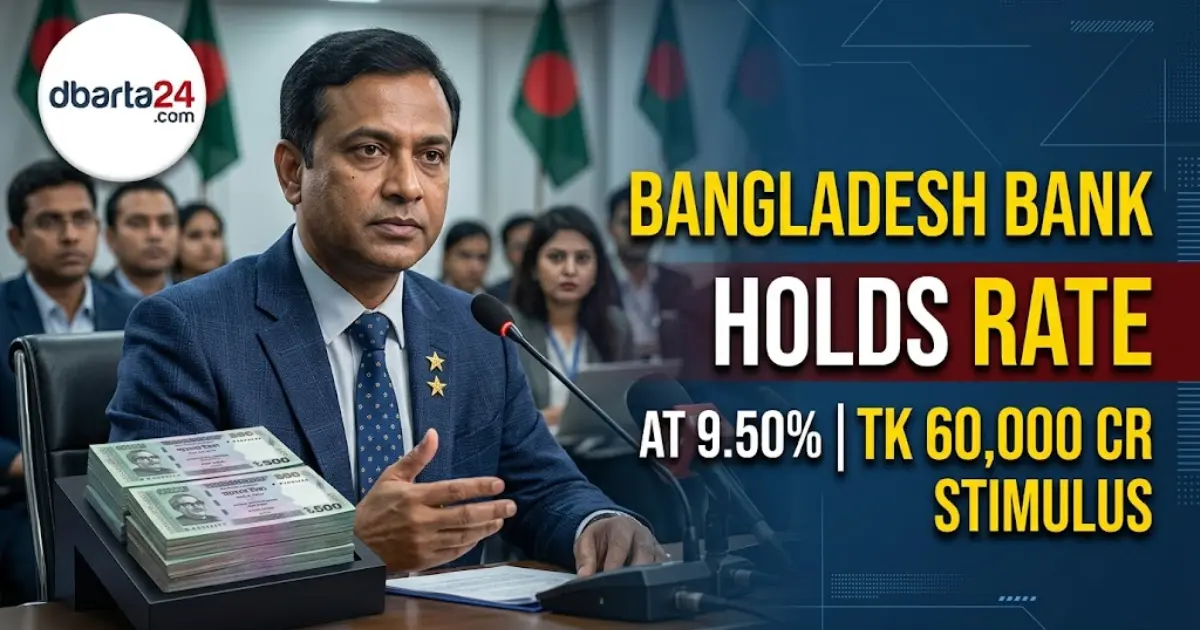
Md. Tarek; Dbarta24 — Bangladesh Bank has decided to maintain its benchmark policy interest rate at 9.50%, adopting a cautious stance amidst lingering underlying inflation concerns and international commodity market vulnerabilities.
The announcement was made on Wednesday during the unveiling of the central bank’s inaugural quarterly monetary policy statement at its headquarters in Dhaka.
The move marks a historic transition for the monetary authority, shifting from a traditional bi-annual policy cycle to a quarterly framework aimed at improving responsiveness to shifting macroeconomic conditions.
Presiding over the briefing, Deputy Governor Dr. Md. Habibur Rahman confirmed that key interest rate corridors would also remain fixed, preserving a cautious strategy to stabilize prices while fostering post-disruption economic recovery.
“The central bank is maintaining this cautious stance because underlying inflation risks persist,” Dr. Habibur Rahman stated. “Our overarching objective is to support a sustainable economic recovery while maintaining price stability, external sector balance, and financial system resilience.”
Inflation Pressures and Global Headwinds
While overall point-to-point inflation moderated from 9.16% in June to 8.26% in August, central bank officials highlighted that non-food inflation remains elevated at a elevated 9.32%.
The central bank pointed to several domestic and external vulnerabilities, including upcoming pay-scale revisions, fuel price adjustments, rising global fertilizer costs, and ongoing geopolitical tensions surrounding the Strait of Hormuz, all of which pose renewed upward risks to consumer prices.
In light of these pressures, the Monetary Policy Committee retained the Standing Lending Facility (SLF) rate at 11.00% and the Standing Deposit Facility (SDF) rate at 7.50%.
Economic growth forecasts for the 2026–27 fiscal year reflect these tight liquidity conditions, with the World Bank projecting GDP expansion at 4.6% and the International Monetary Fund revising its estimate to 3.5%.
Financial Sector Strains and Stimulus Interventions
The policy review laid bare significant structural strain within the domestic banking sector, where non-performing loans (NPLs) have swelled to 32.78%. Private sector credit growth stalled at a sluggish 4.75%, underscoring a prolonged investment freeze and sluggish business activity across key manufacturing sectors.
Offsetting these domestic headwinds, foreign exchange reserves have found stability thanks to an 18.90% surge in remittance inflows from overseas workers, providing crucial support for the Bangladeshi taka.
To reignite industrial production and revitalize closed factory units, Bangladesh Bank announced a major Tk 60,000 crore special stimulus package:
-
Tk 20,000 Crore: Allocated directly toward reopening closed manufacturing plants and factories.
-
Tk 40,000 Crore: Designated for agriculture, cottage, micro, small, and medium enterprises (CMSMEs), and export diversification initiatives.
“Managing economic activity without derailing the disinflation process is our primary challenge,” Dr. Rahman added. “Bangladesh Bank will closely monitor domestic and global developments, employing a data-driven strategy anchored in targeted credit support, structural reforms, financial sector reinforcement, and a disciplined yet flexible exchange rate regime.”
The central bank confirmed that detailed operational guidelines for distributing the Tk 60,000 crore incentive package will be issued shortly.