


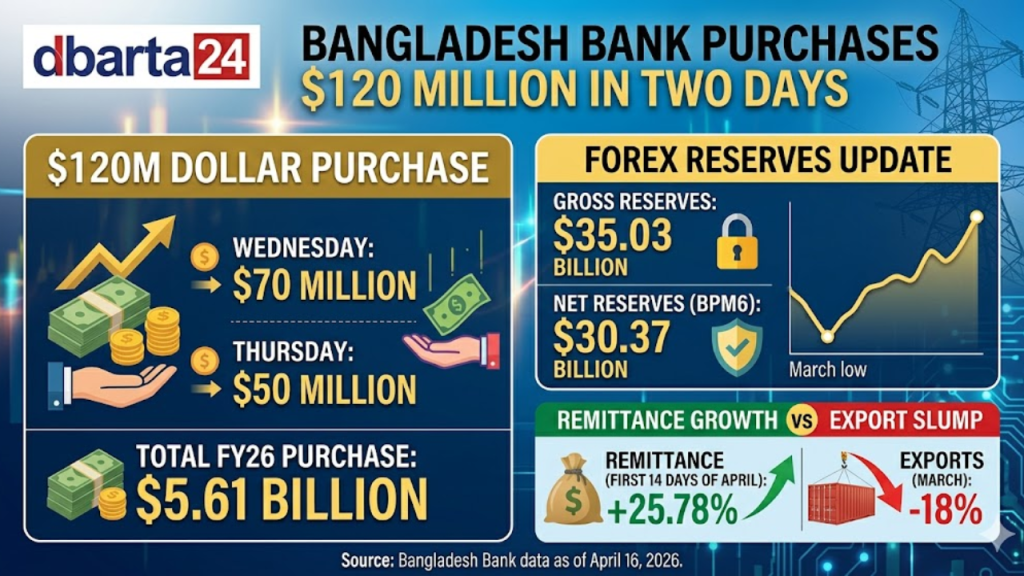
Muyabia labony; Dhaka- The Bangladesh Bank (BB) has resumed its dollar purchase initiative, buying $120 million from commercial banks over two consecutive days.
On Thursday, the central bank purchased $50 million from four commercial banks, following a $70 million purchase from another bank on Wednesday. Both transactions were executed at a rate of 122.75 BDT per dollar.
This marks the first significant dollar purchase in nearly 45 days, following a smaller $25 million buy on March 2. Total central bank dollar purchases for the current fiscal year (FY 2025-26) have now reached $5.61 billion.
Reserves Update
According to central bank sources, the gross foreign exchange reserves stood at $35.03 billion at the end of Thursday. However, according to the IMF’s BPM6 accounting method, the net reserves are recorded at $30.37 billion.
This shows a recovery after reserves dropped significantly in March following a $1.37 billion payment to the Asian Clearing Union (ACU).
Remittance Growth vs. Export Slump
Remittance remains a silver lining, with $1.61 billion arriving in the first 14 days of April—a 25.78% increase compared to the same period last year ($1.28 billion).
Conversely, export earnings have declined for eight consecutive months, with March figures showing an 18% year-on-year drop.
The government continues to navigate economic pressure caused by rising fuel costs and Middle Eastern geopolitical tensions by stabilizing the dollar market and seeking further loans from international lenders.
Reserves & Exchange Rate Summary
| Metric | Current Status (April 16, 2026) |
| Gross Reserves | $35.03 Billion |
| Reserves (BPM6) | $30.37 Billion |
| Dollar Buying Rate | 122.75 BDT |
| FY26 Total Purchase | $561 Crore ($5.61 Billion) |
| Remittance Growth | 25.78% (First 14 days of April) |
Market Insight
Key Driver: The central bank is aggressively building a “buffer” to manage the high cost of fuel imports, which has surged due to the ongoing conflict in the Middle East. While remittance is booming, the steady decline in export earnings remains a primary concern for the trade balance.