


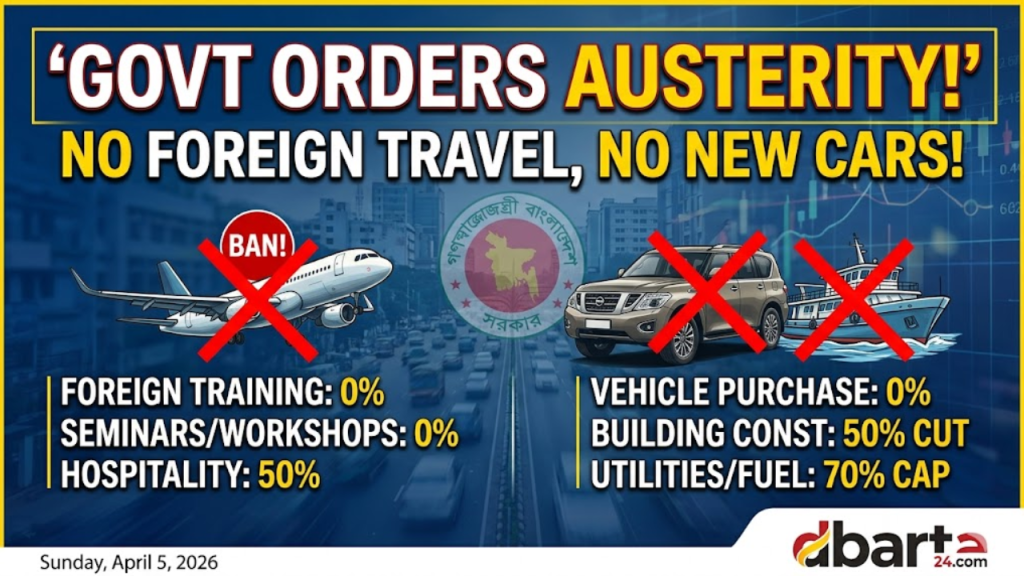
Special Correspondent ; DHAKA – In response to ongoing Middle East conflicts and global economic volatility, the Government of Bangladesh has implemented rigorous expenditure controls for the revised budget of the 2025-26 fiscal year. The Finance Division issued a circular on Sunday (April 5, 2026), outlining a series of austerity measures aimed at fiscal prudence.
Total Ban on Foreign Travel and Vehicle Procurement
Under the new directives, all government-funded foreign travel—including participation in overseas training, seminars, symposiums, and workshops—is strictly prohibited. Furthermore, the allocation for purchasing all types of vehicles (including watercraft and aircraft) has been suspended.
Capping Operational Expenses
The circular mandates significant cuts across various administrative sectors to conserve national resources:
-
Entertainment & Hospitality: Spending is capped at a maximum of 50% of the unused allocation.
-
Internal Training: Ministries and departments can spend only up to 50% of their budget for in-house training, though specialized government training institutes are exempt from this limit.
-
Utilities & Travel: Expenses for electricity, gas, and fuel must remain within 70% of the remaining allocation. The government warned that no claims for arrears will be considered if these limits are exceeded.
-
Seminars & Conferences: Overall spending is limited to 80%, while related hospitality costs must stay under 50%.
Infrastructure and Construction Slowdown
The government has also slashed the budget for building construction by half (50%). However, projects that have already completed at least 70% of their work may proceed with spending, provided they obtain specific prior approval from the Finance Division.
These measures come as the country navigates foreign exchange pressures and seeks to maintain a primary deficit of 2% of GDP amidst a deteriorating global economic outlook.