


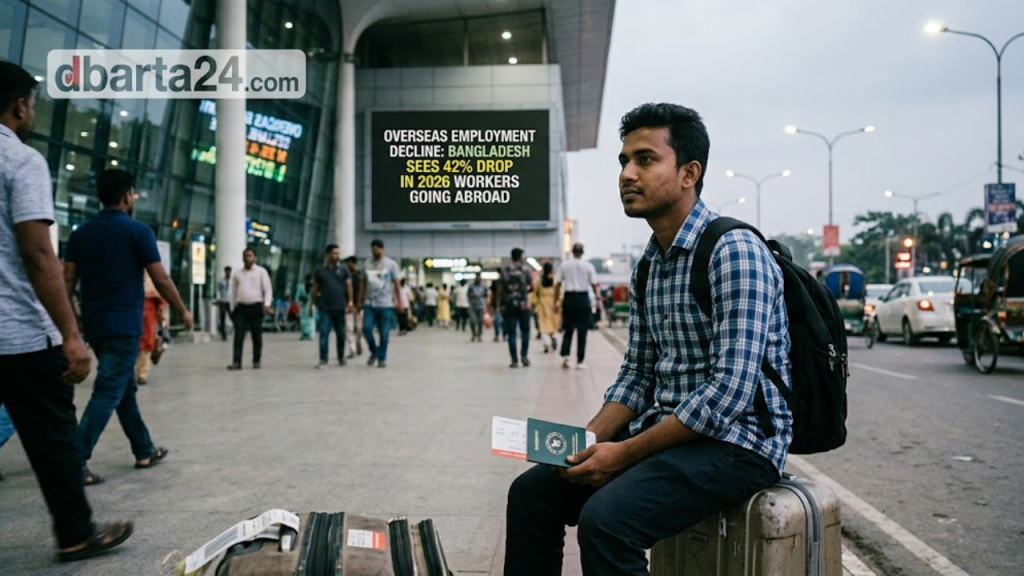
Khairul Alam ; DHAKA – Bangladesh has witnessed a drastic decline in overseas employment, with the number of workers going abroad dropping by 42.40% over the last two months.
This sharp downturn is largely attributed to the escalating geopolitical tensions following the U.S. and Israeli strikes on Iran, which have destabilized the primary labor markets for Bangladeshis.
The Numbers: A Steep Decline
According to recent data, between March 1 and April 26 this year, only 82,561 workers left Bangladesh for foreign jobs. In contrast, during the same period last year, the figure stood at 143,351. This represents a loss of over 60,790 job opportunities in just eight weeks.
Comparisons with 2024 show an even grimmer picture, where nearly double the amount of workers (160,014) were sent abroad during the same months.
Middle East Crisis Impacts GCC Markets
The conflict involving the U.S., Israel, and Iran has directly impacted the Gulf Cooperation Council (GCC) countries, which traditionally host about 78% of Bangladesh’s migrant workforce.
-
Saudi Arabia: Employment fell by 56%, dropping from 102,104 workers last year to just 44,876 this year.
-
Qatar: Witnessed a massive 69% decline.
-
Kuwait: Numbers dropped by 27%.
Interestingly, Jordan and the UAE saw slight increases in recruitment despite the regional instability, though the total numbers remain relatively low compared to Saudi Arabia.
Stagnation in High-Value Markets
The decline isn’t limited to the Middle East. High-income markets like Japan and South Korea are seeing no significant progress despite severe labor shortages in those countries.
-
Japan: Only 590 workers went in the first four months of 2026, compared to over 1,500 in 2025.
-
South Korea: Recruitment dropped to 484 workers, down from 2,436 in the previous year.
Challenges in Europe and Beyond
The European labor market is also tightening. Markets like Romania, Croatia, and Poland are effectively closing due to:
-
Visa Hurdles: Bangladeshis must travel to New Delhi for visas, which has become difficult following the July uprising and subsequent Indian visa restrictions.
-
Workplace Absconding: Many workers use these countries as transit points to enter Western Europe, leading employers to stop hiring Bangladeshis.
-
The Russia-Kyrgyzstan Factor: Markets in Kyrgyzstan and Russia have shrunk as workers are reportedly being diverted into war zones or hazardous conditions.
The Malaysia Hope
There is a glimmer of hope regarding Malaysia. Following a recent meeting between Overseas Employment Minister Ariful Haque Chowdhury and Malaysian PM Anwar Ibrahim, both nations committed to reopening the market. The goal is to establish a “fair, ethical, and transparent” recruitment process to avoid the “syndicate” corruption that previously inflated migration costs to 5.5 lakh BDT per worker.
Government Strategy
The Bangladesh government maintains that bilateral talks are ongoing to reopen closed markets. Officials are focusing on:
-
Improving linguistic and technical skills of workers.
-
Engaging in diplomatic maneuvers to stabilize Middle East deployment once the security situation improves.
-
Ensuring that future recruitment avoids the “syndicate” model to protect workers from financial exploitation.
Summary Table: Migration Stats (March 1 – April 26)
| Country | 2025 (Same Period) | 2026 (Same Period) | Percentage Change |
| Saudi Arabia | 102,104 | 44,876 | -56% |
| Qatar | 14,532 | 4,724 | -69% |
| Kuwait | 3,558 | 2,613 | -27% |
| Total (Global) | 143,351 | 82,561 | -42.4% |