


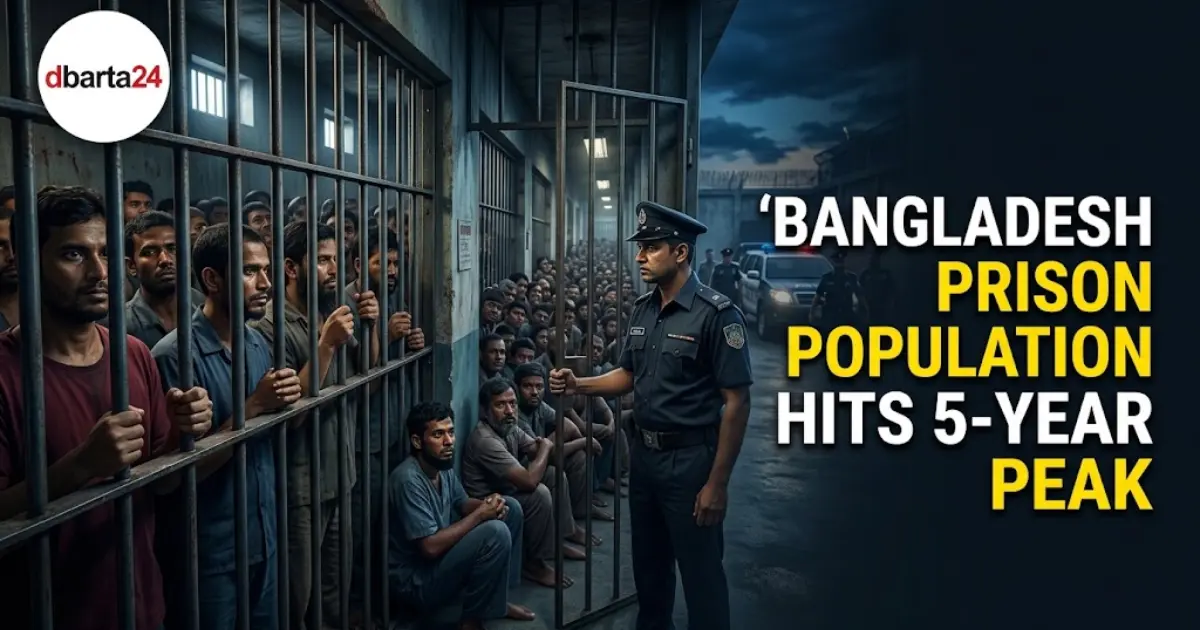
Dbarta24 Report — Bangladesh’s prison system has reached a critical tipping point, recording its highest inmate population in five years as aggressive nationwide law enforcement operations continue to funnel thousands of arrestees into correctional facilities daily.
Data from the Directorate of Prisons reveals that the country’s total prison population crossed 105,000 this month, reaching 104,617 across 76 facilities on September 15.
With an official combined capacity of just 45,186, prisons across Bangladesh are operating at nearly 2.5 times their intended limits, with individual facilities holding up to seven times their structural capacity.
Mass Crackdowns and Shifting Crime Profiles Drive Surge
The dramatic influx stems from a series of high-intensity law enforcement drives aimed at restoring public order and curbing organized crime.
Following the political shifts following the fall of the Awami League administration in 2024, security forces launched targeted crackdowns against political operatives accused of serious offenses, including murder, enforced disappearances, and physical attacks.
Simultaneously, specialized drives targeting extortion, illegal firearms, gang activity, and online gambling have intensified across key regions:
-
Special Operations: Major security operations—including “Operation Devil Hunt,” “Operation First Light” in the Padma shoals, and Chattogram’s “S-Drive”—have systematically rounded up criminal networks.
-
Countrywide Drives: A sweeping nationwide initiative launched on May 1 generated 53,518 arrests through late August alone.
-
Rising Narcotics Detainees: Authorities report a structural shift in inmate demographics, with drug-related offenders now accounting for nearly 32% of the prison population, up from 20–22% in previous years.
Critical Overcrowding Across Regional Facilities
While Dhaka Central Jail in Keraniganj holds the largest total number of prisoners—housing 13,987 inmates against a capacity of 4,590—regional jails are experiencing severe spatial strain:
-
Highest Strain: Sherpur District Jail faces the most acute pressure, holding 746 inmates in a facility built for just 100—nearly seven times its capacity.
-
Severe Overcapacity (5–6x): Facilities in Chapainawabganj (936 inmates / capacity 153), Bhola, Narayanganj, Sirajganj, Jhenaidah, Rajbari, and Chandpur are operating at five to six times their official limits.
-
Moderate Overcapacity (3–4x): Over 20 facilities, including Kashimpur High Security Central Jail and Kashimpur-3 Women’s Central Jail, operate at three to four times capacity.
-
Exceptions: Only a handful of facilities remain under capacity, including specialized holding sites for high-profile political figures and former officials.
Official Stance
Despite the mounting spatial strain, prison administrators maintain that institutional operations remain functional.
“As law enforcement works to maintain order, more offenders are being arrested. Additionally, the proportion of drug-related inmates is rising, increasing the overall pressure on prisons. However, this is not causing major operational issues for us, nor are inmates experiencing significant difficulties beyond physical living space.”— Colonel Mohammad Mostafa Kamal, Acting Inspector General of Prisons
As security forces maintain active operations throughout the country, the growing gap between facility capacity and detainee numbers poses an escalating logistical challenge for Bangladesh’s penal management system.