


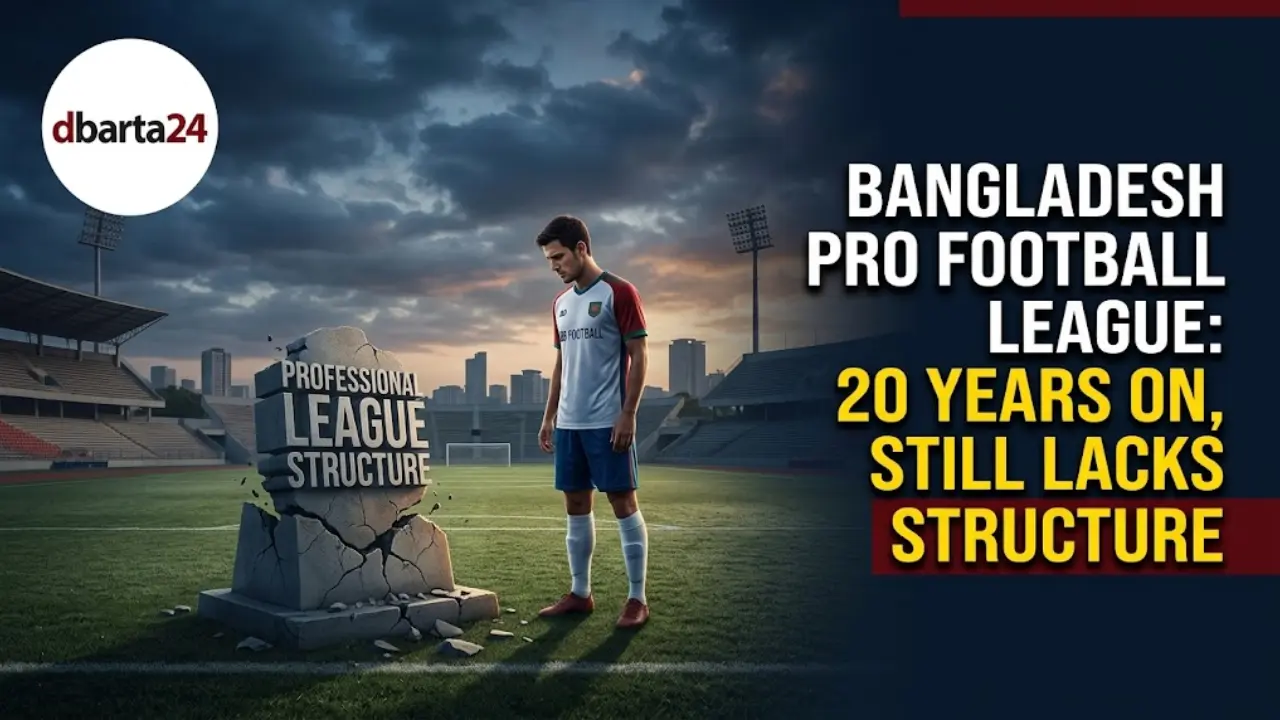
Khairul Alam; Dbarta24 — Two decades after ushering in a “professional” era intended to revolutionize domestic football, Bangladesh’s top-tier league continues to drift without a solid structural foundation.
As the country’s premier domestic tournament prepares to kick off a new season with 13 teams, the expansion highlights an ongoing structural instability rather than planned growth.
This marks the fifth time in history that the Bangladesh Premier League (BPL) will feature 13 teams—a decision born out of administrative fixes rather than strategic development.
       CHRONOLOGY OF BANGLADESH'S PROFESSIONAL LEAGUE

  2007 ────────► B-League launched to replace amateur era
  2009-10 ────► Expanded to 13 teams for the first time
  2010-18 ────► Frequent fluctuations (10, 11, & 12 teams)
  2019-20 ────► Abandoned mid-season due to COVID-19 pandemic
  Present ────► Abruptly expanded from 10 to 13 teams again
Decades of Instability and Missing Infrastructure
When the tournament debuted in 2007 as the “B-League,” it promised to end decades of amateur football and build a modern, sustainable ecosystem.
Yet, 20 years later, the top flight remains plagued by shifting team counts, inconsistent venues, and administrative ad-hocism.
Over the past two decades, 27 different clubs have made their top-flight debuts, with two more set to join this season. However, very few have survived long-term.
Beyond traditional giants Dhaka Abahani and Mohammedan SC, no other founding club from the inaugural 2007 season has managed to maintain a continuous presence in the top division.
Crucially, infrastructure remains a glaring failure:
-
Venue Deficit: Champion club Bashundhara Kings is the only team in the entire country with its own dedicated stadium.
-
Shared Venues: Powerhouses Abahani and Mohammedan are still forced to rent government or neutral venues to host home matches.
-
Unmet Criteria: FIFA’s fundamental requirement for professional clubs to own or operate dedicated home grounds remains largely ignored across the board.
Administrative Reflex Over Long-Term Vision
The sudden shift from 10 to 13 teams this season was triggered by administrative panic rather than strategic design.
Facing FIFA transfer bans on major clubs—including Abahani, Bashundhara Kings, and Fakirerpool Young Men’s Club—the Bangladesh Football Federation (BFF) feared a scenario where several top teams would be unable to register players, potentially causing the league to collapse.
As a protective measure, the BFF reinstated previously relegated clubs Arambagh KS and Fakirerpool Young Men’s Club, while granting top-flight promotion to Dhaka Wanderers Club following an appeal.
Even though all three banned clubs eventually cleared their FIFA sanctions, the expansion stood.
Mozthakur Rahman, Director of Sports at Mohammedan Sporting Club Limited, characterized the decision as a defensive move by the federation.
“BFF took more teams simply to protect themselves. It was purely self-defense. They worried that if the banned teams couldn’t clear their sanctions, they wouldn’t even be able to host the league. It wasn’t a decision made to improve the quality of the competition—BFF did it because they were in trouble.”— Mozthakur Rahman, Director of Sports, Mohammedan SC
Rahman noted that while additional matches will increase playing time, the sudden expansion forces rushed preparations on lower-tier clubs like Dhaka Wanderers, who barely had time to build a competitive squad after their recent promotion campaign.
Experts Voice Concern Over Quality and Ethics
Former national team icons and senior managers have criticized the sudden decision to alter league parameters and reinstate relegated clubs, warning that it compromises competitive integrity.
Former national coach Shafiqul Islam Manik questioned the logic of rewarding team quantity over squad quality.
“Expanding the number of teams only works if those teams are high quality. We must first ask whether we have enough quality players in the country. Instead of arbitrary additions, having established clubs like Sheikh Jamal, Sheikh Russel, Saif Sporting, or strong regional teams outside Dhaka would have truly benefited the league.”— Shafiqul Islam Manik, Former National Coach
Manik also highlighted the lack of player development, noting a heavy reliance on foreign talent from nations like Nepal.
“After more than a decade and a half, our professional league still hasn’t taken proper shape. BFF should either pressure or support clubs to build true professionalism. As long as officials focus primarily on holding power, local football will not improve.”— Shafiqul Islam Manik, Former National Coach
Former national striker Jahid Hasan Ameli expressed equal frustration, describing the current state of top-tier football as a burden rather than a asset.
“This league is damaged; it has become a thorn in BFF’s side. They run it just for the sake of running it. Reinstating teams that were rightfully relegated sets a dangerous precedent. What stops other clubs from taking advantage of this in the future?”— Jahid Hasan Ameli, Former National Striker
Ameli added that increasing the fixture schedule from 18 to 24 matches per club means little if squad depth remains shallow and structural standards are ignored.
The Challenge Ahead
While an expanded 13-team format naturally increases the overall number of matches and offers more game time for domestic players, it also places immense strain on participating clubs.
Moving forward, the BFF faces severe challenges regarding club financial sustainability, professional management, fixture congestion, and maintaining overall competitive quality.
Without strict licensing enforcement and infrastructural development, expanding the team count risks diluting the product rather than elevating Bangladeshi football.