


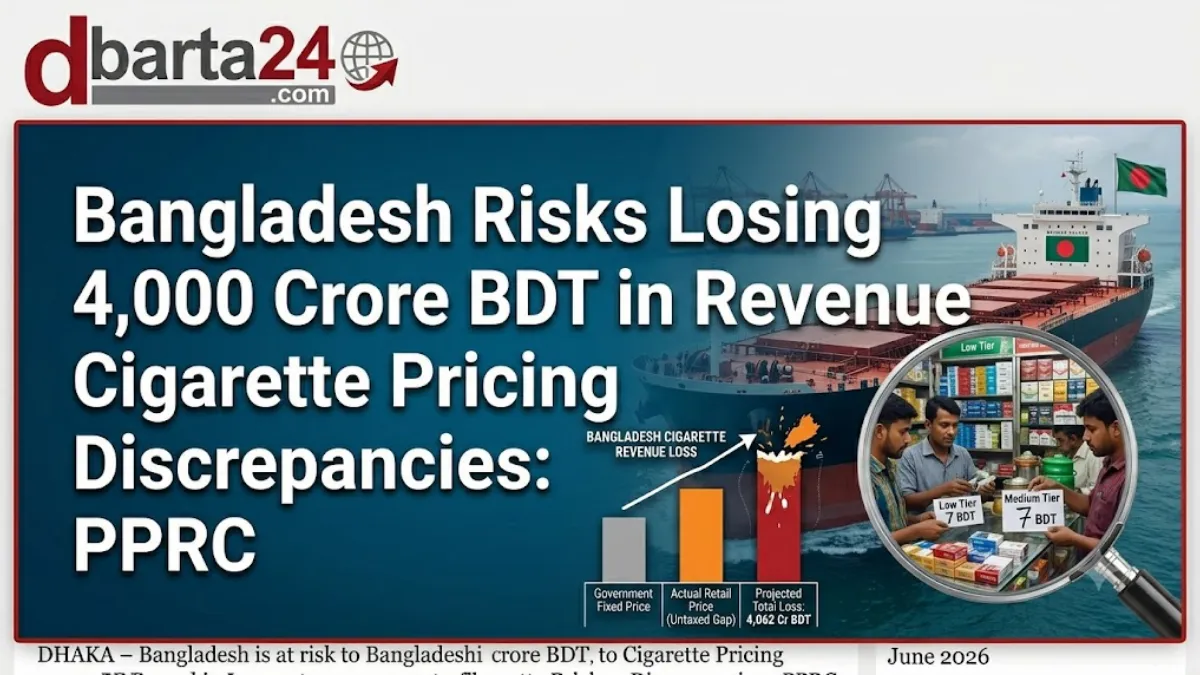
Muhammad Tareq; Dhaka – Bangladesh is at risk of losing an estimated 4,062 crore BDT in tobacco revenues due to a stark mismatch between government-fixed retail prices and the actual prices charged at the retail level.
The warning was issued by the prominent think tank, Power and Participation Research Center (PPRC), during a press conference on tobacco taxation and policy reform held at the National Press Club on Monday.
According to PPRC researchers, the fiscal leakages are particularly severe within the low and medium-tier cigarette markets. While consumers are paying significantly higher prices at retail points, the government fails to collect any tax on this under-the-table value addition.
The Mechanics of the Price Discrepancy
Presenting the keynote paper at the briefing, PPRC Senior Researcher Ihtisham Hassan detailed how the pricing discrepancy plays out on the ground.
The government has legally set the price of a 10-stick pack of low-tier cigarettes at 62 BDT, meaning an individual cigarette should cost 6.20 BDT. However, retailers are uniformly charging consumers 7.00 BDT per stick.
A similar trend is unfolding in the medium-tier bracket, where consumers are regularly forced to shell out an extra 80 poisha per cigarette stick above the government-mandated price.
Because this additional retail markup remains undocumented, it bypasses the National Board of Revenue’s (NBR) tax dragnet entirely, resulting in the multi-thousand-crore revenue hemorrhage.
Criticism of “Paper-Based” Policy Making
Dr. Hossain Zillur Rahman, Executive Chairman of PPRC and former caretaker government advisor, presided over the event and criticized regulatory oversights that ignore market dynamics.
“The government is facing severe revenue losses due to making paper-based decisions without considering the realities on the ground. Effective and urgent measures must be taken to curb this price gap and recover the lost revenue.”
— Dr. Hossain Zillur Rahman, Executive Chairman, PPRC
Dr. Rahman also heavily criticized the state’s loose regulatory stance on emerging tobacco trends, warning that the legal definitions governing e-cigarettes have been diluted. He raised alarms over what he described as backdoor attempts to legitimize nicotine pouch products, stating that such policy loopholes pose a significant health risk to the country’s youth.
PPRC’s Recommendations for Fiscal and Policy Realignment
To close the revenue gap and simultaneously discourage tobacco consumption, PPRC placed a series of policy demands before the government. The think tank recommended a formal upward revision of the baseline pricing tiers. Specifically, they advised raising the price of a low-tier 10-stick pack from 62 BDT to 70 BDT, and elevating the medium-tier pack from 92 BDT to 100 BDT.
The PPRC findings illuminate a critical vulnerability in Bangladesh’s excise taxation framework, where lax retail enforcement directly converts into massive state losses. As the government seeks avenues to bolster internal revenue mobilization, bridging the gap between “paper policies” and market realities in the high-volume tobacco sector will be essential.
Failing to tighten retail monitoring will not only continue to starve the national exchequer of vital funds but will also undermine public health goals by letting tobacco companies and retailers pocket untaxed windfalls.