


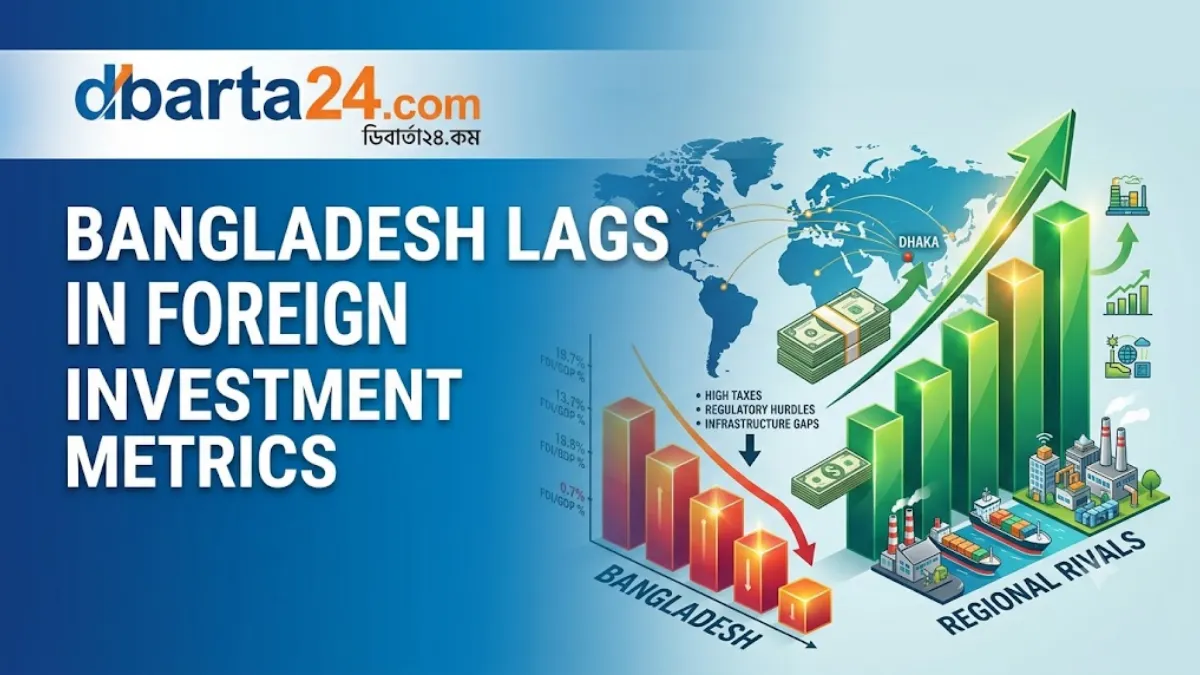
Special Correspondent ; Dbarta24 — Direct foreign investment remains the most powerful catalyst for economic transformation, yet Bangladesh continues to lag significantly behind its regional competitors across major investment readiness metrics.
According to the “FDI Report-2026” released by the Foreign Investors’ Chamber of Commerce and Industry (FICCI), Bangladesh struggles with weak infrastructure, high effective tax burdens, and outdated regulatory frameworks.
The report was officially unveiled on Thursday at the FICCI FDI Conference held at the Bangladesh-China Friendship Conference Center, where Prime Minister Tarique Rahman attended as the chief guest.
Despite current hurdles, FICCI projects that Bangladesh has the potential to attract $15 billion in annual Foreign Direct Investment (FDI) by 2030.
Currently, annual inflows remain under $2 billion, representing a negligible FDI-to-GDP ratio of just 0.36%.
The chamber envisions raising this ratio to 2.5% within the decade to tackle post-Least Developed Country (LDC) graduation challenges and support high-tech, sustainable growth.
Behind Regional Rivals in 5 Out of 6 Indicators
The report presents a comparative evaluation between Bangladesh and regional peers such as India, Vietnam, Indonesia, and Cambodia.
Out of six core investment indicators—logistics, investor protection, industrial policy, trade integration, tax structure, and economic zone capacity—Bangladesh ranks “weak” in five.
| Indicator / Metric | Bangladesh Position | Regional Leaders | Comparative Highlights |
| Logistics & Trade Facilitation | Weak | India & Vietnam (Strong) | Bangladesh ranks 88th on the Logistics Performance Index; India is 38th and Vietnam 43rd. |
| Trade Openness | Weak | Vietnam (Strong) | Vietnam ranks 13th globally in trade openness, while Bangladesh sits far behind at 155th. |
| Investor Protection & Governance | Weak | Vietnam & India (Strong) | Bangladesh relies on the outdated Foreign Private Investment Act of 1980, whereas Vietnam updated its framework in 2020. |
| Industrial Policy & Tech Adoption | Weak | Vietnam (Strong) | Lags significantly behind India and Vietnam in high-tech industrial integration. |
| Tax Systems & Incentives | Weak | India, Vietnam & Indonesia (Moderate) | Statutory corporate tax is 27.5%, but the actual effective tax rate reaches 43%–48%. |
| Economic Zone Capability | Moderate | India, Vietnam & Indonesia (Strong) | Bangladesh operates 10 active zones (matching Cambodia), compared to Vietnam’s 44 and India’s 276. |
FDI as a Catalyst for Economic Shift
FICCI emphasized that expanding FDI is vital not merely for capital inflow, but for driving technology transfer, boosting industrial productivity, and strengthening foreign exchange reserves.
“Attracting FDI will serve as a powerful tool to diversify Bangladesh’s industrial base, reducing over-reliance on the ready-made garment (RMG) sector while building capacity in high-value manufacturing,” the report noted.
Furthermore, direct investment offers a sustainable alternative to debt-financed development, shielding the economy from fiscal vulnerabilities while instilling global management standards across local enterprises.
Key Potential Sectors and Investment Sources
Beyond traditional ready-made garments, the report highlights massive untapped opportunities in high-growth sectors, including:
-
Pharmaceuticals & Healthcare
-
IT and Digital Services
-
Renewables & Clean Energy
-
Light Engineering & Electronics
-
Agro-processing & Leather Goods
While major capital sources currently include the Netherlands, the United Kingdom, China, Singapore, India, and South Korea, future momentum is expected to shift toward ASEAN nations and Japan.
Strategic developments such as the Japanese Economic Zone and expanding South Korean operations are projected to unlock new avenues for sustainable foreign investment in Bangladesh.