


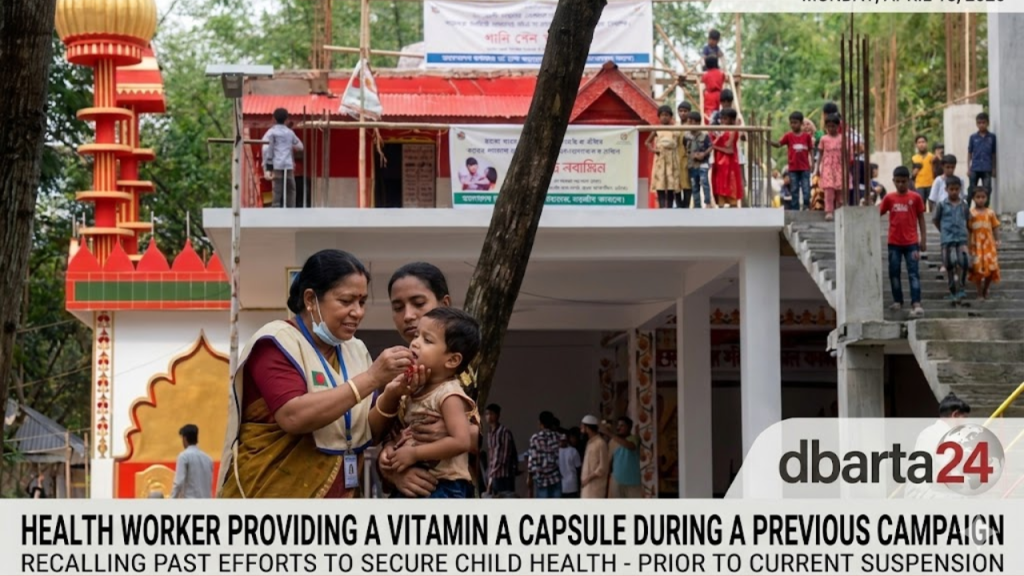
Khairul Alam; DHAKA – The national Vitamin ‘A’ Plus campaign, a critical initiative for child health in Bangladesh, has been effectively suspended for over a year.
While the program is designed to run twice annually to prevent childhood blindness and boost immunity, administrative hurdles and budget complexities have left millions of children without this essential supplement.
Administrative Gridlock
According to sources within the Directorate General of Health Services (DGHS), the procurement and distribution of Vitamin ‘A’ capsules were previously managed under a five-year Operational Plan (OP).
The fourth sector program ended in June 2024. Since then, a proposed 1.06 trillion BDT fifth sector program failed to receive approval, leading to a transition toward the revenue budget that has been marred by delays.
The last campaign held in March 2025 utilized leftover stock from previous years. Since those supplies were exhausted, no new capsules have been purchased.
The Procurement Struggle
Dr. Mohammad Yunus Ali, Director of the Institute of Public Health Nutrition (IPHN), explained that the transition to the revenue budget faced unexpected obstacles. “Two tender processes were canceled because bidders quoted unusually high prices.
A third tender is now awaiting administrative approval from the Ministry. Once the Central Medical Stores Depot (CMSD) supplies the capsules, we can resume the campaign,” he stated.
Expert Warnings: A Hidden Health Crisis
Public health and nutrition experts are raising alarms over the long-term impact of this hiatus. Vitamin ‘A’ is fat-soluble and remains in the body for four to six months.
Because the human body cannot produce it, supplements every six months are vital for children aged 6–59 months, especially those with poor diets.
Dr. Manzur Al Morshed Chowdhury warned, “While the damage may not be visible immediately, a lack of Vitamin ‘A’ weakens the immune system and increases the risk of malnutrition and infectious diseases. The current rise in measles cases could be an early warning sign of reduced immunity among children.”
Historical Context
Bangladesh began Vitamin ‘A’ distribution in 1973 to combat night blindness. Over the decades, it evolved into the “National Vitamin ‘A’ Plus Campaign,” reaching an average of 22.5 million children per round.
Experts emphasize that the campaign is also linked to deworming efforts, as intestinal worms prevent the absorption of the vitamin. However, regular deworming weeks have also been inconsistent over the last two years.
With the World Health Organization (WHO) warning that 190 million preschool-age children globally are at risk of Vitamin ‘A’ deficiency, the continued delay in Bangladesh poses a significant threat to the nation’s progress in child survival and health.