


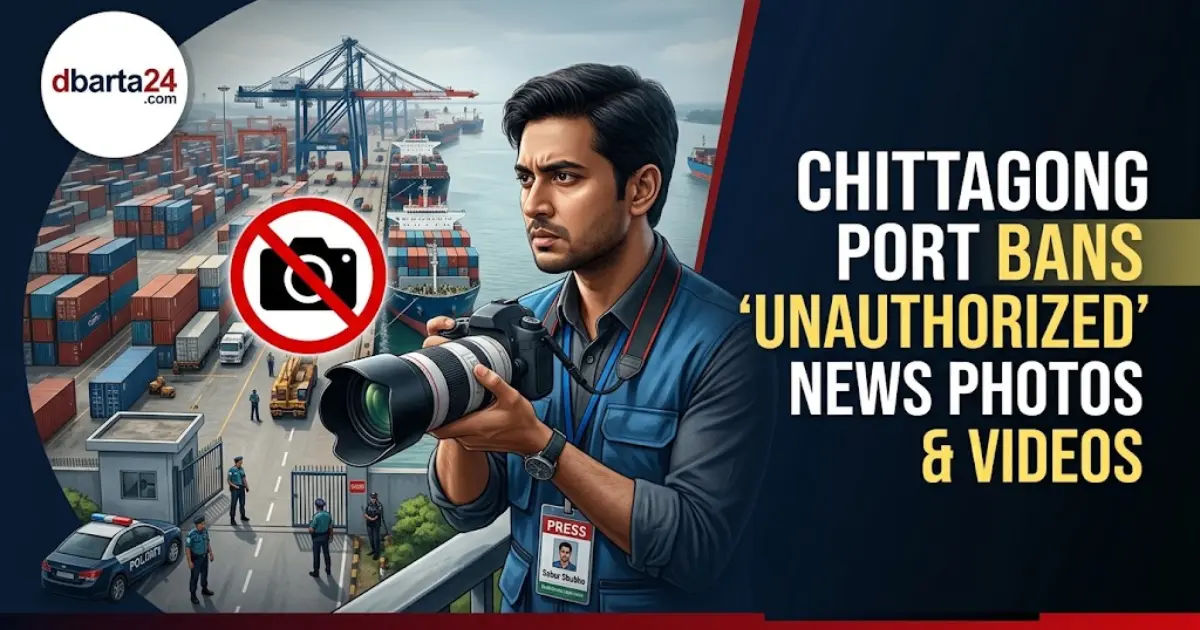
Chattogram Correspondent; Dbarta24 – The Chittagong Port Authority (CPA) has issued a strict directive restricting the unauthorized publication and broadcasting of port security details, sensitive installations, and “operational data” across social media, online platforms, and mainstream news outlets.
The notification, signed by the port secretary on Tuesday, classifies unauthorized disclosures as unwanted and unacceptable.
Under the new rules, prior approval is mandatory before capturing or sharing images, videos, sketches, or visual information concerning security arrangements, restricted areas, surveillance capabilities, infrastructure layouts, vessel and cargo management, and communication systems.
Ambiguity Surrounding ‘Operational Data’ Sparks Industry Concerns
While the directive aims to bolster physical and digital security, stakeholders have raised concerns over the vague definition of “operational data.” The circular does not specify whether routine port information—such as vessel arrival schedules, container handling statistics, cargo clearance status, port congestion updates, or terminal handling efficiency—falls under these restrictions.
The port authority cited the maritime hub’s status as a Class-A Key Point Installation (KPI) as the primary justification for the move. Port Secretary Syed Refayet Hamim stated that recent incidents involving unauthorized filming and live broadcasting from restricted areas triggered security concerns, prompting the protective directive.
Legal References and Ongoing Port Protests
The notice references Section 12 of the Chittagong Port Authority Act 2022 alongside the Official Secrets Act 1923. However, Section 12 of the CPA Act primarily governs physical access control to port premises rather than broad bans on sharing general operational statistics.
The timing of the restriction coincides with growing labor unrest at the port. On October 5, the Port Protection Committee held a sit-in demonstration opposing plans to hand over operations of the New Mooring Container Terminal (NCT)—the port’s largest container facility—to a foreign operator, threatening a complete shutdown if the deal moves forward.
Journalistic Access and Media Reaction
Addressing concerns over press freedom, Port Secretary Syed Refayet Hamim assured that legitimate media organizations should face no obstacles, as journalists typically obtain permission before entering restricted zones to shoot footage.
However, media representatives expressed skepticism. Sabur Shubho, General Secretary of the Chittagong Journalists’ Union, criticized the directive as a strategic move to curtail investigative reporting, arguing that security concerns are being used as a pretext to restrict press access to crucial public information.