


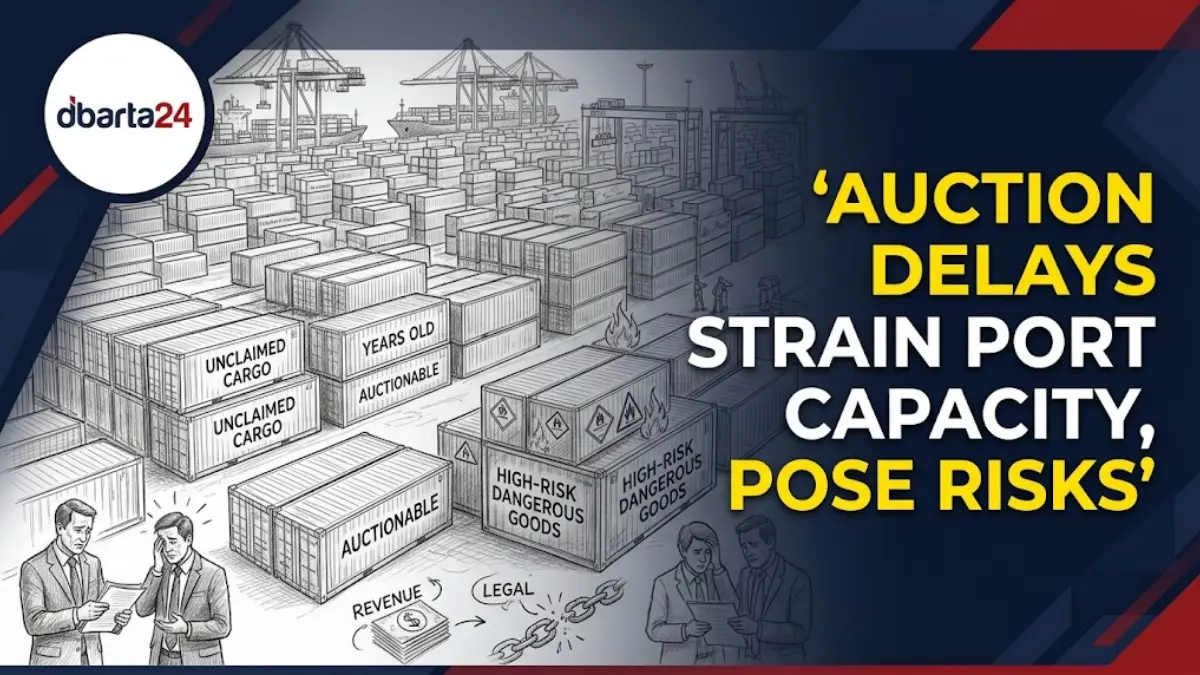
Shamchul Islam; Chattogram — Protracted delays in the auctioning of long-unclaimed goods have pushed Chittagong Port—the prime maritime gateway of Bangladesh—into a critical space crunch, increasing operational bottlenecks, revenue losses, and severe safety hazards.
As of June 30, nearly 9,330 TEUs (Twenty-Foot Equivalent Units) of auctionable containers were taking up valuable space in the port yards, alongside approximately 130,000 packages of LCL (Less than Container Load) cargo waiting in sheds.
Together, these unclaimed shipments occupy nearly 22 percent of the port’s total yard capacity, straining vessel operations and delaying cargo discharge.
Operational Strain and Economic Impact
The backlog is withholding an estimated Tk 8,000 crore to Tk 10,000 crore in uncollected government revenue. Taking shipping agent charges and container demurrage costs into account, private sector losses are estimated to be substantially higher.
Clearing the congestion could provide a massive boost to handling capacity without requiring new physical infrastructure. Addressing the situation, Acting Secretary of Chittagong Port, Md. Nasir Uddin, noted:
“Simply removing the auctionable goods would allow the port to handle nearly 40 percent more goods and containers using existing facilities without building new infrastructure.”
Businesses are also facing severe supply chain disruptions due to customs valuation delays. Mohammad Amirul Haq, President of the Chittagong Chamber of Commerce and Industry (CCCI), highlighted the financial impact on importers:
“Customs assessment takes 8 to 10 days, while demurrage charges kick in just four days after cargo arrival. This increases business costs, ties up capital, and disrupts the supply of raw materials and essential goods.”Mounting Safety Hazards
Beyond operational inefficiencies, the prolonged storage of unattended containers poses severe safety risks. Out of the lingering inventory, 330 containers hold flammable chemicals, 44 of which have been classified by port authorities as high-risk hazards.
Some containers have remained at the port for as long as 22 to 23 years, leaving contents degraded and unusable.
Syed Refayet Hamim, Secretary of the Chittagong Port Authority, highlighted the heightened risk environment:
“The long-term presence of dangerous chemicals and flammable goods has significantly increased the risks of fire, explosion, and environmental hazards while severely disrupting daily port operations.”
To mitigate these risks, the port authority sent an official letter to the Chairman of the National Board of Revenue (NBR) on July 2, urging immediate action to expedite auctions and destroy cargo that has cleared legal obligations.
The letter warned that space constraints are increasing ship turnaround times and forcing vessels to wait longer at outer anchorages, damaging the port’s international standing.
Legal Hurdles and Customs Response
Customs officials state that auction speeds have improved recently. In 2025, 493 containers were auctioned, whereas 661 containers were successfully processed in the first seven months of the current year alone.
However, systemic and legal hurdles continue to slow down the overall process. Md. Abu Sufian, Assistant Commissioner of the Auction Branch at Chittagong Custom House, explained the constraint:
“Many goods are tied up in litigation and other legal complications, making swift auctions impossible even if desired. Items are put up for auction only after all legal requirements are completed.”
Chittagong Port requires urgent coordination between the National Board of Revenue, Customs, and judicial authorities to streamline legal clearances and clear the persistent backlog.
Without swift procedural reforms, Bangladesh’s primary trade hub risks further compounding supply chain delays, safety hazards, and lost trade potential.