


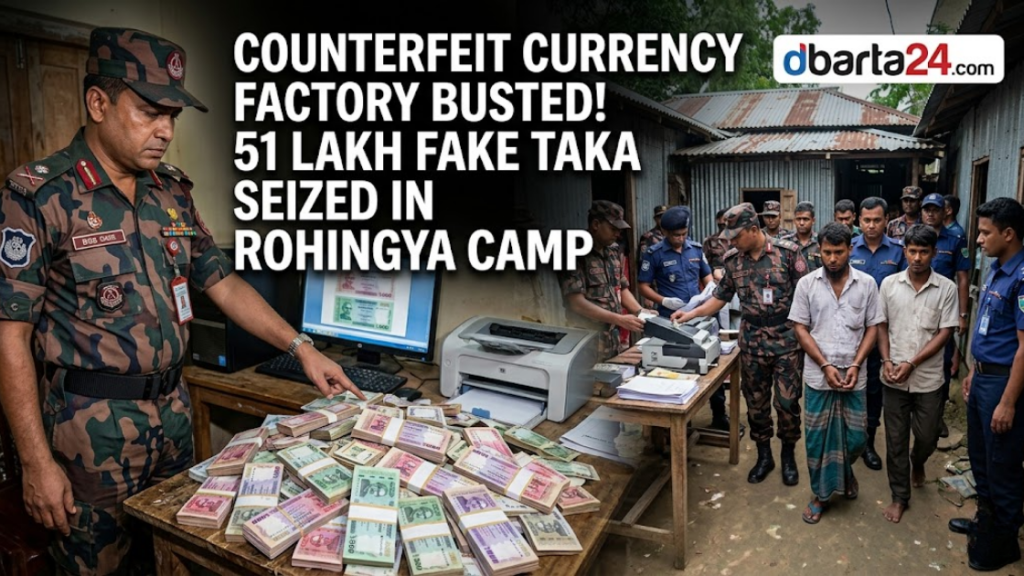
Shamchul Chowdhury ;Cox’s Bazar – Inside a small, unassuming room sat a computer setup with monitors, scanners, printers, special paper, ink, and chemicals.
At the push of a button, crisp counterfeit notes of 200, 500, and 1,000 Taka emerged. To evade detection, the counterfeiters topped these fake bundles with genuine Bangladeshi currency notes.
However, their illicit operation finally hit a dead end. On May 24, three teams of the Border Guard Bangladesh (BGB) launched a coordinated raid on a rented house adjacent to the Jadimura Rohingya refugee camp in Teknaf, Cox’s Bazar.
During the operation, a massive cache of fake currency, manufacturing equipment, two computers, and a laptop were seized. Authorities arrested Najmul, who operated under the guise of a peddler, and Azizur Rahman, a Rohingya tom-tom (three-wheeler) driver, for their direct involvement in the counterfeit ring.
Many residents across the 33 Rohingya camps in Cox’s Bazar are unfamiliar with Bangladeshi currency, making it incredibly difficult for them to distinguish between real and fake notes. Exploiting this vulnerability, counterfeiters have been profiting illegally for a long time.
Investigations reveal that counterfeit currency has become a primary “medium of exchange” inside the camps for heinous crimes like human trafficking, gold smuggling, illicit hundi operations, and the yaba drug trade.
The usage of fake notes is highest in yaba transactions. Organized syndicates have set up miniature counterfeit factories in secret rooms inside and around the camp perimeters.
Producing high-quality fake notes requires skilled graphic designers, a role heavily aided by a few local Bangladeshi nationals. Among them is 20-year-old Najmul, hailing from Terakanda village in Sarail upazila, Brahmanbaria. Investigators revealed that Najmul arrived in Cox’s Bazar three years ago and quickly became entangled in the counterfeit ring.
Disguised as a roaming vendor, he distributed fake notes to various camp shops under a contract yielding him 10,000 Taka daily. To evade law enforcement, he never stayed in a single camp area for more than a month. On May 22, he moved into Rashid Ahmed’s house near Jadimura Bazar, where the hidden factory was established.
How the Fake Note Factory Was Busted
Acting on intelligence regarding counterfeit smuggling, three BGB teams took up strategic positions along the Cox’s Bazar-Teknaf highway.
A temporary checkpoint was set up on Muchoni Road to search passing vehicles. When a Jadimura-bound tom-tom was ordered to stop, it attempted to flee. A BGB motorcycle team chased down and intercepted the vehicle.
A search of a black bag inside the vehicle uncovered 12 lakh Taka in counterfeit notes packed into 12 bundles, alongside 5,000 Taka in genuine currency. Najmul and Azizur Rahman were detained on the spot and later handed over to Teknaf Police Station.
Following interrogations and digital tracking, BGB executed a follow-up raid on a tin-shed rented house east of Jadimura Bazar. Sensing the raid, the ringleaders fled, leaving the house locked. BGB forces broke open the door to find an extensive counterfeit operation.
According to the Officer-in-Charge (OC), the BGB handed over one laptop, one desktop computer, two color printers, a cutting machine, an autorickshaw, and a staggering 51,34,100 Taka in counterfeit notes, along with raw materials to the police station.
During interrogation, Najmul claimed innocence, stating, “I worked as a peddler. A Rohingya named Taher hired me for 10,000 Taka a day to deliver money to various camps. I didn’t know if they were real or fake.”
The driver, Azizur Rahman, stated he was simply hired for a daily rent of 1,000 Taka to transport them around the camps. Meanwhile, the homeowner, Rashid Ahmed, denied involvement, admitting he failed to collect national ID cards before renting out the property.
Cox’s Bazar Additional Superintendent of Police, Ohidur Rahman, assured that law enforcement agencies are maintaining strict vigilance over counterfeit operations inside the Rohingya camps. Multiple agencies are working in unison to track down and arrest the masterminds behind the racket.