


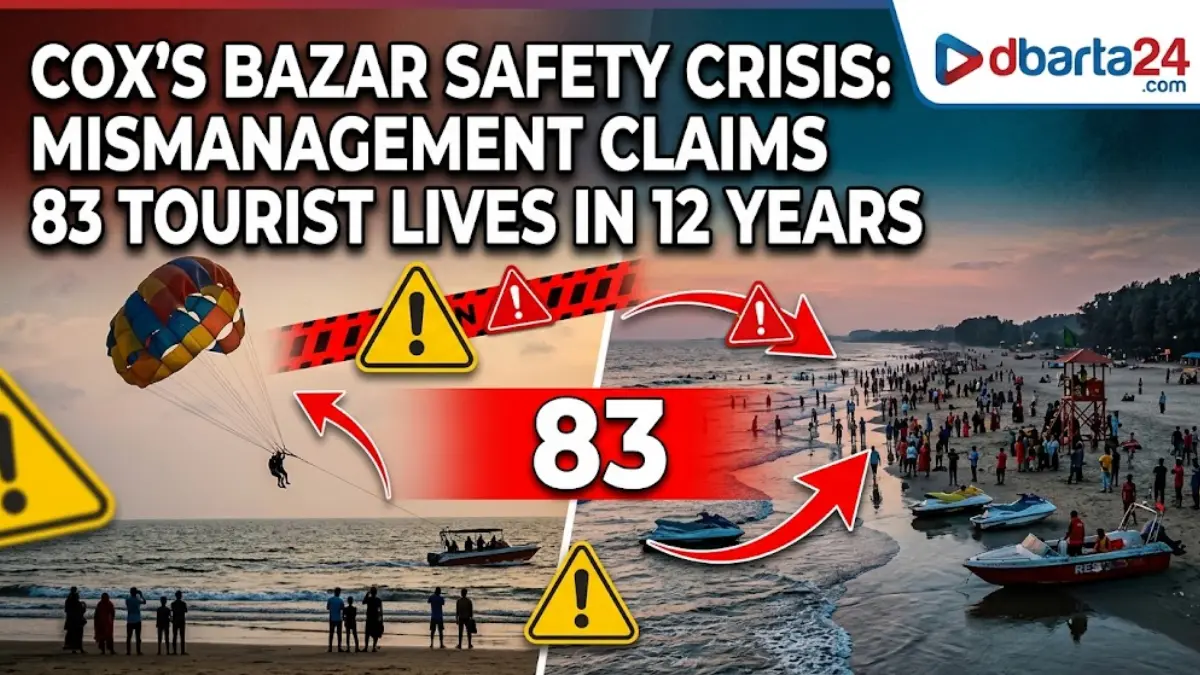
COX’S BAZAR Correspondent; Dbarta24 – The tragic death of a 31-year-old tourist following a parasailing accident on Saturday has once again cast a harsh spotlight on the systemic mismanagement, lack of regulatory oversight, and administrative coordination failures plaguing Bangladesh’s premier tourist destination, Cox’s Bazar.
Over the past 12 years, fatal accidents resulting from unregulated beach activities, drowning, and speeding watercraft have claimed at least 83 tourist lives, raising serious alarms about visitor safety.
Fatal Parasailing Accident Exposes Administrative Blindspots
The latest casualty was identified as Akshoy Souvik Roy, 31, a resident of the Sir Iqbal Road area in Khulna City Corporation. According to law enforcement and eyewitnesses, Roy was part of an eight-member travel group that arrived in the coastal city last week.
On Saturday afternoon, Roy engaged in a privately operated parasailing activity in the Dariyanagar area along Marine Drive. Due to apparent safety malfunctions, he slipped from the harness and plunged into the sea.
Compounding the tragedy, the operational site lacked any emergency rescue vessels, divers, or basic medical assistance. It took over an hour and a half to transport the critically injured tourist to the hospital, where he was pronounced dead.
In the wake of the incident, Cox’s Bazar District Commissioner Md. A. Mannan made a startling revelation regarding the legality of these operations. “Parasailing operations do not have any valid approval in Cox’s Bazar,” Mannan stated. “Legal action will be taken regarding the tourist’s death. Furthermore, initiatives have been taken to immediately reactivate the beach’s defunct ambulance.”
Additional Superintendent of Tourist Police, Ajmal Hossain, confirmed that five parasailing businesses have been operating commercially in the Dariyanagar area for an extended period without proper permits.
A History of Unheeded Warnings
This is not the first time parasailing operators have faced scrutiny. On May 20, 2025, a tourist was severely injured after falling into the sea during a parasailing flight.
Months later, on August 30, 2025, a female tourist was thrown into a nearby tamarisk (Jhau) forest and remained trapped atop the trees for hours.
Although the District Administration temporarily suspended parasailing activities following that incident, operations resumed without permanent safety updates. Earlier this year on June 16, another tourist fell into the ocean after a parasailing rope snapped, surviving a harrowing 22-minute ordeal before being rescued.
Nazrul Islam, Member Secretary of the Cox’s Bazar Citizens’ Movement, criticized authorities for allowing these risks to persist. “Parasailing businesses have been operating without adhering to standard safety protocols for years.
Most of these establishments lack trained operators, rescue boats, or emergency medical setups. All such activities must remain suspended until foolproof security is guaranteed,” Islam argued.
Drowning and Substandard Equipment Compound the Danger
The peril extends far beyond parasailing. Data from the Sea-Safe Lifeguard organization indicates an alarming trend: over the past 12 years, 78 tourists have drowned while bathing in the sea, while 1,024 individuals were successfully rescued from near-fatal situations.
The latest missing person, Helal Uddin, disappeared under the waves at Kalatoli Beach on July 24, and his body has yet to be recovered.
Exacerbating the safety crisis is the proliferation of low-quality flotation tubes and reckless jet ski operations. Corrupt syndicates reportedly lease substandard safety tubes instead of the officially approved ones.
In June 2025, a father and son from Rajshahi lost their lives at Saymon Point after slipping out of an unapproved tube.
Furthermore, high-speed jet skis regularly operate dangerously close to swimming zones. Jet ski collisions and falls have claimed multiple lives and left several tourists severely injured over the last few years, including a fatal fall at Seagull Point in late 2024.
Despite hundreds of thousands of tourists flocking to popular hubs like Sugandha, Laboni, and Kalatoli points, the Sea-Safe Lifeguard team manages safety with a mere 27 members.
The team faces severe equipment shortages, and the beach’s sole dedicated emergency ambulance has been out of service for nearly two years.
Rising Threats: Unregulated Rentals, Nuisances, and Crime
Tourists face safety threats on land as well. The rapid growth of unregulated rental bike services on Marine Drive has resulted in at least five tourist deaths and numerous injuries over the past year.
On the beach, over 50 unauthorized horses roam the sand, causing hygiene issues and safety hazards, highlighted by an incident on June 15 where a child was severely bitten by a horse at Sugandha Point.
Furthermore, visitors have reported an increase in muggings and harassment after dark by criminal gangs, pickpockets, and organized syndicates.
While the Tourist Police reported that they arrested 55 floating offenders and 15 muggers this year, local vendors and visitors state that darkness still brings significant vulnerability to unguarded stretches of the beach.
Calls for Institutional Coordination
Industry leaders warn that the lack of unified governance is destroying the reputation of the country’s top tourism asset. Karim Ullah Kalim, General Secretary of the Cox’s Bazar Hotel-Motel Guest House Officers’ Association, emphasized the need for systemic accountability.
“The tourism sector is suffering heavily due to a lack of coordination among public agencies. If the relevant authorities do not fulfill their duties responsibly, we will lose consumer trust entirely.”
For tourists like Mostafizur Rahman, who traveled from Satkhira, the institutional failures are obvious. “Cox’s Bazar offers plenty of entertainment, but the gaps in safety infrastructure and the blatant mismanagement among various government agencies are impossible to ignore.”