


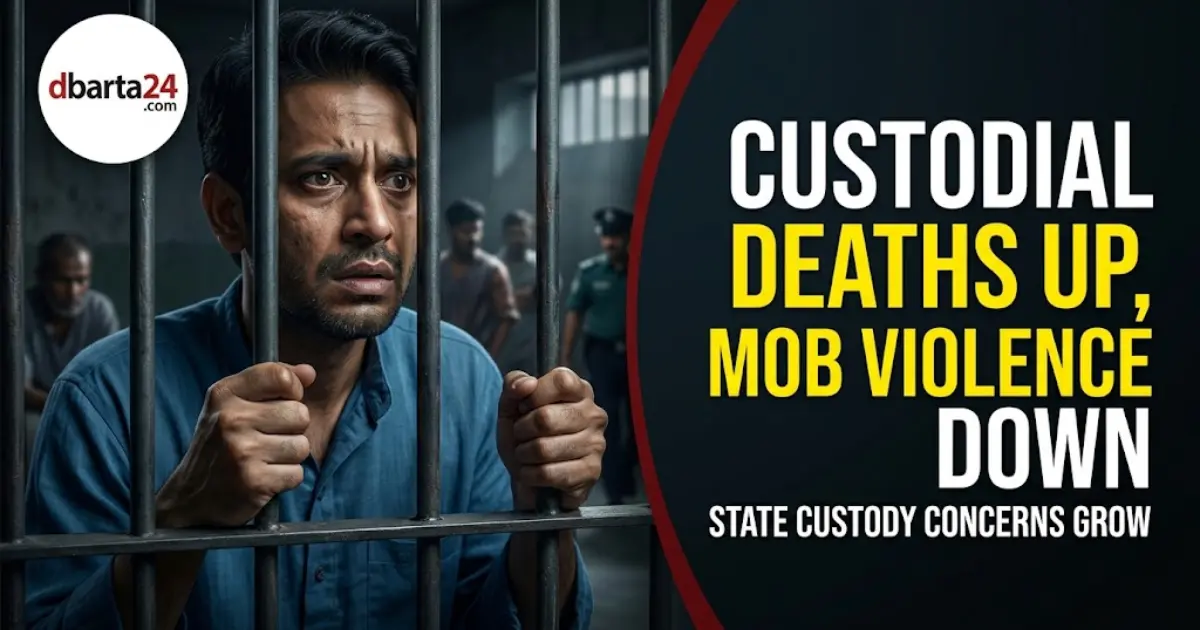
M K Alam; Dbarta24 — While mob violence in Bangladesh saw a noticeable reduction in September compared to the previous month, deaths in judicial custody surged dramatically, according to the latest monthly observation report by the Human Rights Cultural Foundation (MSF).
The rights monitoring group released its monthly findings in a press release on Wednesday (September 30), highlighting that while public acts of violence have eased in certain areas, state custody, political clashes, and digital surveillance remain deeply troubling domains for human rights in the country.
Surge in Custodial Fatalities Against Falling Mob Incidents
According to MSF data, incidents of mob violence dropped from 35 cases in August to 23 in September. Despite the decrease, vigilante justice remains a grave concern, with at least 65 instances of mob activity recorded in September that resulted in 23 deaths and 74 injuries.
Conversely, fatalities inside prisons and law enforcement custody spiked sharply. In August, 9 custodial deaths were recorded nationwide; by September, that figure nearly tripled to 24 deaths, all involving male undertrial detainees or convicted prisoners.
Escalating Political Violence and Unidentified Bodies
The report underscored a concerning escalation in internal political friction and targeted violence. Political clashes left at least 384 people injured and one person dead in September, alongside seven fatalities resulting from unidentified attacks.
The foundation noted that internal feuds and inter-party conflicts are driving instability and worsening civil security.
Furthermore, authorities recovered 71 unidentified bodies from various parts of the country during September—comprising 55 men, 15 women, and one individual whose age and gender could not be determined—adding to mounting public safety concerns.
Press Freedom, Cyber Laws, and Minority Safety
Media professionals continue to face systemic pressure. While direct physical assaults on journalists decreased slightly—with 28 journalists assaulted or harassed in September—legal harassment expanded.
Cases under the Cyber Security/Digital Security framework rose from 3 in August to 8 in September, while arrests under the same laws jumped from 3 to 8.
The survey also documented ten incidents of idol vandalism targeting religious minorities and one reported case of ethnic persecution during the month.
A Complex Human Rights Landscape
Reflecting on the overall environment, MSF emphasized that the human rights situation cannot be neatly classified as simply “improving” or “deteriorating,” but rather as evolving into new areas of concern.
While public manifestations of violence and physical attacks on journalists have slowed, deeper risks have emerged surrounding state custody, political stability, digital freedom, and minority security.
The foundation concluded that protecting human rights requires far more than mere crime control—it demands strict institutional accountability, robust legal protections, and the preservation of civil liberties.