


Muhammad Tareq ; Dhaka – The long-standing structural weakness of Bangladesh’s banking sector—default loans—has worsened significantly in the first quarter of 2026.
Despite loan rescheduling, special facilities, and policy support, classified loans remain completely out of control. In just three months, classified loans surged by nearly BDT 31,500 crore.
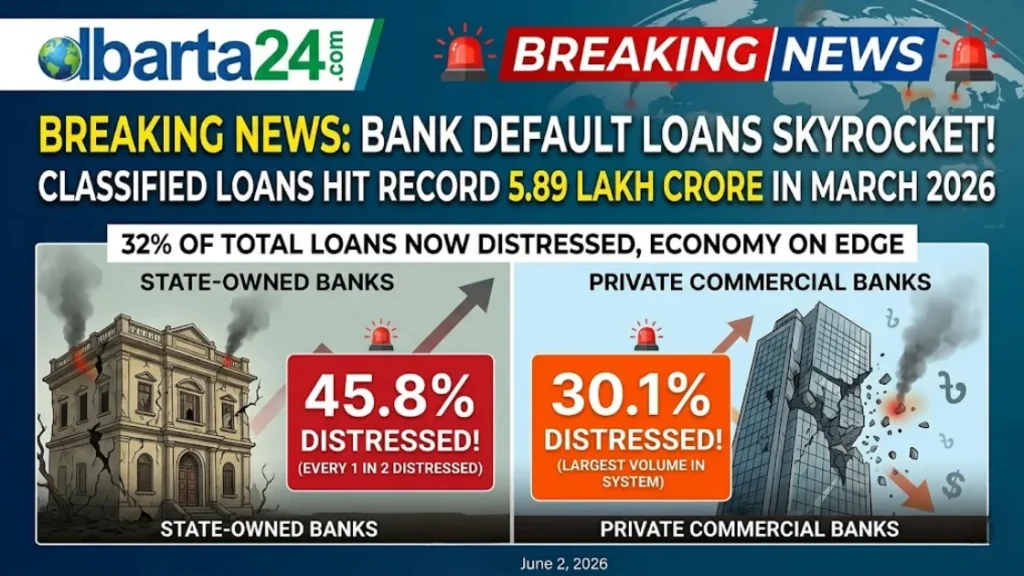
This pushes the total amount of classified and default loans in the country’s banking system to an all-time high of approximately BDT 5.89 lakh crore.
According to the March 2026 classified loan report released by Bangladesh Bank, the total outstanding loans and advances across 61 scheduled banks stand at BDT 18,24,668 crore.
Out of this amount, BDT 5,88,704 crore is now officially classified. This means an alarming 32.26%—or nearly one-third—of all disbursed loans are currently distressed and problematic.
Just three months earlier, at the end of December 2025, classified loans stood at BDT 5,57,217 crore (30.60% of total loans). Within a single quarter, classified loans jumped by BDT 31,487 crore, reflecting a 1.66 percentage point increase.
Even more concerning, the classified loan rate was 24.13% in March 2025, marking a staggering 8.13 percentage point increase over the course of just one year.
One-Third of Total Bank Funds Are At High Risk
Current statistical analysis indicates that for every BDT 100 disbursed by banks, more than BDT 32 is classified. Economists warn that this serves as a massive red alert for the entire economy. When a vast portion of capital becomes trapped, banks lose their core capacity to disburse new credits, foster business investments, and generate employment opportunities.
Real Default Figures and the Threat of “Bad Loans”
-
Actual Default Loans: The specific default loan amount reached BDT 5,64,106 crore by the end of March 2026, growing by BDT 19,274 crore from December 2025’s figure of BDT 5,44,832 crore. The default loan rate now sits at 30.92%. Compared to March 2025, default loans have risen by BDT 2.06 lakh crore in one year.
-
Prevalence of Bad Debt: Alarmingly, 93.69% of these classified assets—amounting to BDT 5,51,555 crore—have decayed into the “Bad or Loss” category, leaving almost zero chance of recovery.
-
Potential Risks (SMA): Loans under the Special Mention Account (SMA)—which signal imminent defaults—rose sharply by BDT 28,746 crore in three months, reaching BDT 1,32,120 crore.
Massive Provision Shortfalls Draining Capital
To cushion against potential asset losses, banks must maintain a specific safety reserve called provisioning. By the end of March 2026, the required provisioning hit BDT 4,61,714 crore.
However, banks have only managed to preserve BDT 2,56,049 crore, causing a massive provision shortfall of BDT 2,05,665 crore. This shortfall grew by BDT 14,224 crore in three months, severely undercutting the capital adequacy and fundamental health of multiple institutions.
State-Owned vs. Private and Foreign Banks
-
State-Owned Commercial Banks (SCBs): SCBs remain the most vulnerable. Out of BDT 3,26,685 crore in total loans, BDT 1,49,785 crore is classified. Their classified loan rate stands at an astonishing 45.85%, meaning nearly BDT 46 out of every BDT 100 lent out is distressed.
-
Private Commercial Banks (PCBs): In terms of absolute volume, private banks hold the largest chunk of default loans. Out of BDT 13,83,269 crore in total advances, BDT 4,16,482 crore is classified (30.11%), jumping up from 28.25% in the previous quarter.
-
Foreign Banks: Foreign institutions remain significantly safer and better managed. With total loans of BDT 67,628 crore, only BDT 3,26,303 crore is classified (4.82%), proving that their corporate governance, risk assessment, and tracking systems are highly effective.
-
Specialized Banks: Specialized sectors (like agricultural lending) are also deeply unstable, registering a 40.72% classified loan rate out of BDT 47,086 crore in total loans.
Root Causes Behind the Crisis
Financial experts and bankers outline several critical drivers fueling this persistent trend:
-
Long-term deficiencies in credit evaluation alongside political interference in loan disbursements.
-
Ongoing macroeconomic pressures, high interest rate structures, and general business slowdowns hindering timely repayments.
-
The expiration of previous rescheduling packages and special moratorium benefits, forcing hidden bad debts back into classified columns.
-
Deep internal governance loopholes and weak risk mitigation frameworks within banking entities.
Without urgent financial sector overhauls, absolute transparency, strict recovery policies, and a banking ecosystem free from political bias, the structural risks plaguing Bangladesh’s economy will only intensify.
(Data Source: Bangladesh Bank Classified Loan and Provisioning Report, March 2026)