


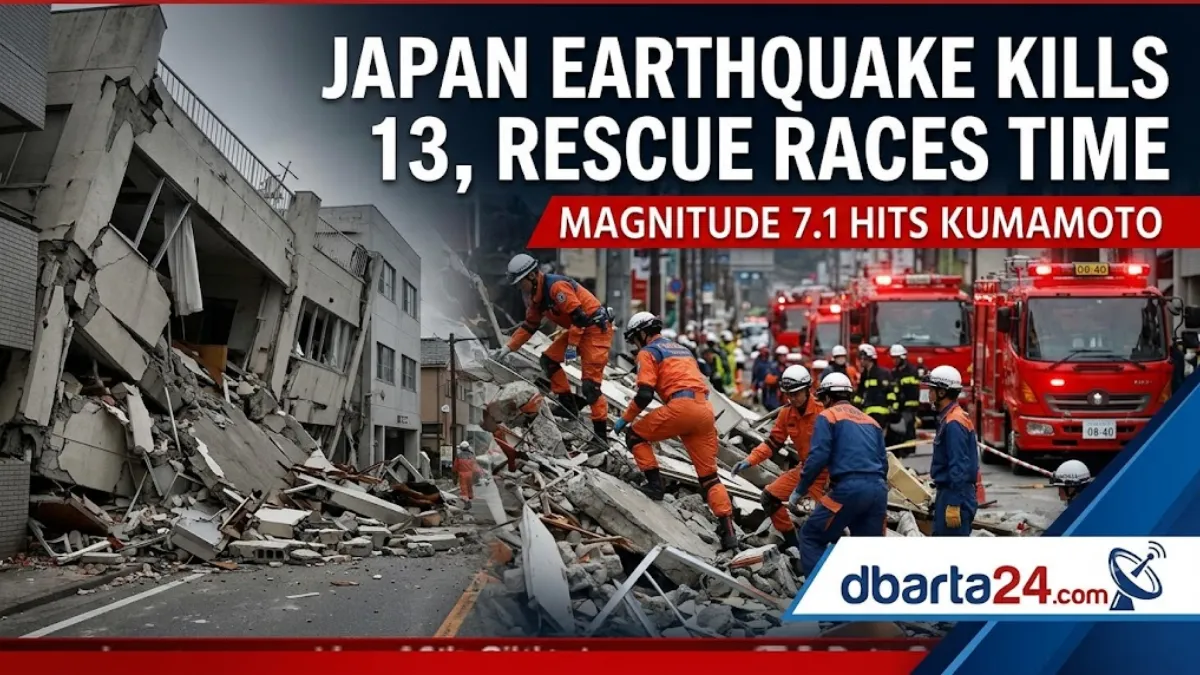
International Desk ; Dbarta24 — A powerful 7.1 magnitude earthquake devastated southwestern Japan’s Kumamoto region, leaving at least 13 people dead and scores of residents feared trapped under collapsed buildings and rubble.
Emergency response teams and military personnel have initiated massive search-and-rescue operations across the impacted zones, braving severe structural damage to reach survivors.
Japanese Prime Minister Sanae Takaichi confirmed the rising death toll during a press conference in Tokyo, warning that the casualties could climb as rescue workers continue searching through flattened structures.
“Initially, three fatalities were confirmed, but the death toll has now risen to 13,” Prime Minister Takaichi stated. “Many people are still waiting for rescue under the rubble. This is a race against time, and we are mobilizing every available resource to save as many lives as possible.”
Epicenter and Structural Fallout
The powerful tremor struck on Tuesday, July 28, centered roughly 20 kilometers south of Kumamoto City on Kyushu Island.
The shockwaves halted transport networks, disrupted industrial supply chains, and knocked out key utilities across Kumamoto and neighboring Nagasaki Prefectures.
Authorities have ordered the evacuation of approximately 260,000 residents across the affected prefectures.
Officials issued strong warnings regarding potential high-magnitude aftershocks and severe landslides over the coming week, urging citizens to remain in designated safety shelters.
Economic Impact and Regional Context
Major global corporations have temporarily shut down regional industrial operations due to safety concerns and infrastructure damage.
Semiconductor giant Tokyo Electron and automotive leader Honda Motor Co. suspended manufacturing at their local plants.
Situated along the seismically volatile Pacific “Ring of Fire,” Japan accounts for nearly 20 percent of the world’s major earthquakes.
This recent catastrophe echoes the tragic 2016 Kumamoto earthquake, which claimed 275 lives and caused catastrophic structural damage, including severe destruction to the landmark 17th-century Kumamoto Castle.
Emergency authorities continue to evaluate the full scope of property damage, while relief efforts prioritize clearing debris and establishing emergency shelter networks for displaced families.