


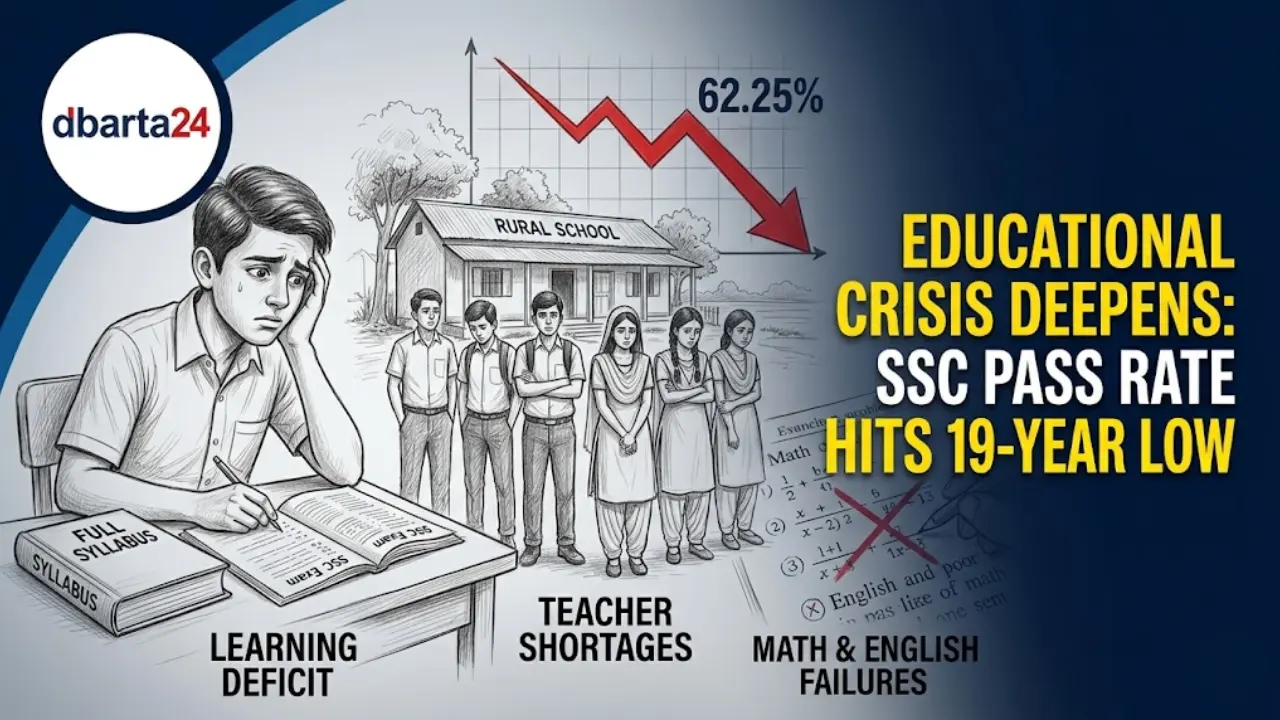
Mustafa Islam; Dbarta24 — The pass rate for Bangladesh’s Secondary School Certificate (SSC) and equivalent examinations has dropped to 62.25%, marking the lowest success rate in 19 years since 2007.
According to statistics released by the education boards on Monday, the pass rate plummeted by 6.20 percentage points compared to last year’s 68.45%.
Additionally, the number of top-tier GPA-5 achievers fell by 22,356, leaving nearly 700,000 students unsuccessful across the country.
Education officials attributed the decline to a return to a full syllabus and stricter, standardized script evaluation.
However, prominent educationists warn that the results expose severe systemic vulnerabilities in secondary education, including chronic learning deficits, subject-specific teacher shortages—particularly in rural schools—and inadequate classroom instruction.
Key Highlights & Performance Indicators
-
Overall Results: Out of 1,829,485 candidates across 11 education boards, 1,138,877 passed, while 690,608 failed.
-
GPA-5 Achievers: Totaled 116,676 students down from 139,032 in the previous year.
-
Absenteeism: 38,129 registered students skipped the examinations, with the Madrasa Education Board recording the highest absence count at 10,105 candidates.
-
Institutional Decline: The number of schools with a 100% pass rate collapsed from 2,968 last year to just 669. Conversely, institutions with a zero percent pass rate rose sharply to 312.
Humanities Stream Suffers Major Setback
A breakdown of academic streams reveals a stark disparity in performance. The Humanities group registered a disastrous pass rate of 48.74%, meaning more than half of the 617,885 examinees failed.
| Stream / Board | Pass Rate (%) | Key Trend / Indicator |
| Science Stream | 80.64% | Highest-performing stream across general boards |
| Business Studies | 64.29% | Moderate performance, impacted by Mathematics |
| Humanities Stream | 48.74% | Major failure driven by English and Mathematics |
| Madrasa Board (Dakhil) | 55.49% | Down nearly 13% from 68.09% last year |
| Technical Board (Vocational) | 58.20% | Down over 15% from 73.62% last year |
English and Mathematics Remain Core Obstacles
Subject-wise analysis shows that poor performance in English and Mathematics heavily dragged down overall success rates. Average pass rates across all boards hovered around 75.48% in English and 76.42% in Mathematics.
The crisis was most severe in regional boards like Mymensingh, where the pass rate dropped to 66.64% in English and 69.61% in Mathematics.
Conversely, Information and Communication Technology (ICT) recorded the highest success rates among students nationwide.
Female candidates once again outperformed their male counterparts across general boards. Girls achieved a 67.91% pass rate compared to 59.73% for boys, while also securing 58,705 GPA-5s against 47,304 obtained by boys.
Board Authorities vs. Education Minister Views
Education board officials maintained that the results accurately reflect genuine student capability under standardized assessment conditions.
“English and Mathematics, as in previous years, pulled down the overall pass rate. The situation worsened because a massive portion of Humanities students failed these two core subjects.”— Prof. Dr. Syed Akteruzzaman, Chairman, Dhaka Education Board & Inter-Education Board Coordination Committee
“This year, true examination took place. Students were evaluated strictly on merit. This is not a bad result; rather, it represents a standardized and authentic outcome.”— Prof. Shamim Ara Chowdhury, Chairwoman, Rajshahi Education Board
“Nearly 37% of examinees failed in English and Math alone. The shortage of qualified teachers in these subjects, especially in rural institutions, has exacerbated the issue.”— Prof. Md. Ahsan Parvez, Chairman, Comilla Education Board
Addressing public concerns, Education Minister Dr. A. N. M. Ehsanul Hoque Milan offered a different assessment, asserting that the results were not disappointing.
“The results are not bad; rather, they are fair and standard. Students received marks according to what they wrote in their answer scripts. Anyone with grievances can apply for re-scrutiny under official procedures.”— Dr. A. N. M. Ehsanul Hoque Milan, Minister of EducationExperts Demand Immediate Reforms
Academic experts emphasize that blaming students alone overlooks foundational flaws in the schooling system.
Prof. Dr. Mohammad Ali Jinnah of Dhaka University’s Institute of Education and Research noted that cumulative learning gaps, excessive smartphone distraction, irregular attendance, and weak foundational skills in key subjects converged to produce these results.
He called for nationwide remedial classes, structured support learning, and specialized teacher training programs.
Echoing these concerns, former Dhaka University Professor Dr. Siddiqur Rahman Khan remarked that when a student passes school test examinations but fails the national board assessment three months later, it reflects severe deficiencies in classroom teaching, teacher accountability, and curriculum implementation.
Educationists agree that the nation must move away from evaluating educational quality solely through high pass rates, focusing instead on subject mastery, institutional supervision, and equitable teacher deployment across rural schools.