


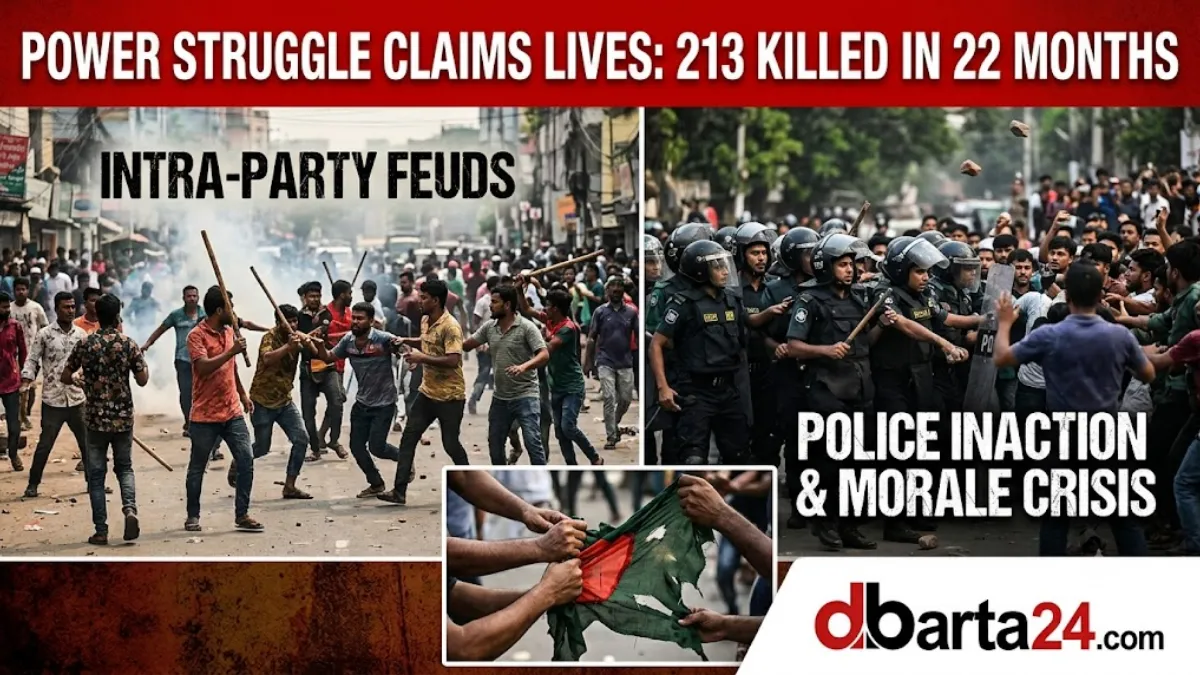
Dbarta24 Special Report— Far from ushering in a peaceful political landscape, the period following the August 2024 mass uprising in Bangladesh has been marked by a alarming rise in political violence.
Driven primarily by fierce internal power struggles, territorial control, and financial rivalries, political clashes have claimed at least 213 lives and injured nearly 10,000 people over a 22-month period.
Data compiled by the human rights organization Ain o Salish Centre (ASK) reveals that between August 2024 and May 2026, Bangladesh recorded 949 incidents of political violence, resulting in 213 deaths and 9,795 injuries.
Surprisingly, the vast majority of these casualties stem not from opposition-versus-ruling-party conflicts, but from intra-party feuds within individual political organizations.
Internal Rifts Account for Majority of Casualties
According to the ASK statistics, internal feuds within the Bangladesh Nationalist Party (BNP) and its associate wings accounted for more than half of all reported incidents:
| Conflict Type | Incidents | Injured | Fatalities |
| BNP Internal Feuds | 494 | 5,581 | 118 |
| BNP vs. Jamaat-e-Islami | 164 | 1,525 | 12 |
| BNP vs. Awami League | 111 | 1,106 | 41 |
| Awami League Internal Feuds | 19 | 238 | 11 |
| BNP vs. National Citizen Party (NCP) | 15 | 197 | 0 |
| Other Political Clashes | 146 | 1,148 | 31 |
Recent tragic events highlight this trend. In January 2026, clashes between BNP and Jamaat-e-Islami supporters in Sherpur’s Jhenaigati left Jamaat leader Maulana Rezaul Karim dead.
Meanwhile, localized turf wars, extortion rivalries, and battles over tender controls have triggered deadly shootouts and violent brawls across districts including Narayanganj, Comilla, Chittagong, and Kishoreganj.
Expert Analysis: Why Is Violence Spiking?
Human rights activists and political analysts point to a collapse in internal party discipline, combined with demoralized law enforcement, as the primary drivers behind the escalating casualties.
Advocate Saidur Rahman, Chief Executive of the Human Rights Support Society (MSF), noted that grassroots political workers are locked in intense competition over economic opportunities and local influence following prolonged political shifts.
“There is a distinct lack of effort or mechanism within political leadership to restrain their own grassroots cadres,” said Rahman. “Additionally, law enforcement agencies are often acting as silent spectators due to a severe crisis of morale caused by past unpunished attacks on police personnel.”
Political analyst Mohiuddin Khan Mohan emphasized that current conflicts lack any ideological foundation, representing pure commercialization of political influence.
“These clashes aren’t about political ideology; they are about extortion, local dominance, and dividing up lucrative tenders,” Mohan observed. “When the party in power or holding influence cannot discipline its own ranks, police find it incredibly difficult to intervene effectively.”
Police Response and Law Enforcement Morale
Addressing concerns regarding police inaction, Assistant Inspector General (Media & PR) of Police Headquarters, AHM Shahadat Hossain, stated that law enforcement continues to operate within international standards of proportional force while working to restore order.
“In every incident where police officers have been targeted or laws breached, cases have been filed and arrests are actively being made,” Hossain stated. “Public cooperation and adherence to the law are vital for long-term stability and individual safety.”
Without decisive action from central political leadership to instill cadre discipline and empower law enforcement, experts warn that Bangladesh’s political culture risks remaining trapped in a destructive cycle of localized violence.