


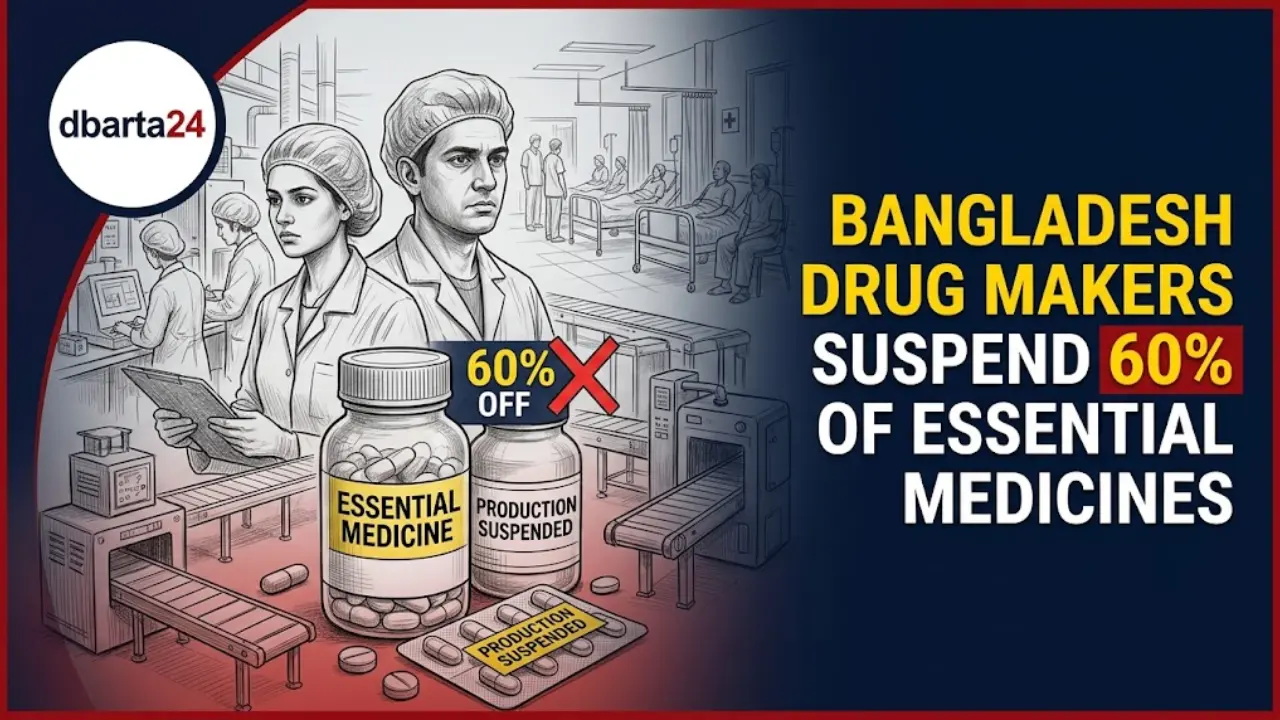
Labonnya Liza; Dbarta24 — Production has grinded to a halt for nearly 60 percent of essential medicines in Bangladesh as pharmaceutical companies struggle to cope with soaring production expenses, surging inflation, and outdated pricing frameworks.
The revelation came during an exchange meeting titled “Progress of Pharmaceutical Industry: Challenges and Prospects,” organized by the Bangladesh Association of Pharmaceutical Industries (BAPI) at its office in Tejgaon, Dhaka.
Industry leaders warned that the suspension is forcing patients to buy expensive alternative drugs, significantly inflating healthcare expenses across the nation.
+-------------------------------------------------------------------------+
|                ESSENTIAL MEDICINE CRISIS: AT A GLANCE                   |
+-------------------------------------------------------------------------+
| • Essential List Status  : 117 total listed | 98 registered for production|
| • Current Operation      : ~60% of production suspended                 |
| • Key Cost Drivers       : High dollar rates, inflation, gas/power crisis|
| • Root Policy Problem    : Price controls based on outdated 1994 policy   |
+-------------------------------------------------------------------------+
Outdated Pricing Models and Cost Pressures
BAPI representatives pointed out that medicine prices in Bangladesh are still determined using a framework established back in 1994.
Despite an initial plan to adjust prices by an average of 8 percent annually, rates have only been adjusted twice in the past 32 years.
During this timeframe, the currency exchange rate for the US dollar has spiked, labor wages have climbed, and general inflation has pushed manufacturing costs to unsustainable levels.
“If the pharmaceutical industry is viewed purely from a price-control perspective, long-term production and investment will suffer,” stated Dr. Zakir Hossain, former BAPI secretary general and Managing Director of Delta Pharma Limited. “Expecting private manufacturers to produce low-cost medicines indefinitely without any subsidies is simply unrealistic.”
Dr. Hossain also cautioned against comparing private companies to the state-owned Essential Drugs Company Limited (EDCL), noting that EDCL operates with guaranteed government purchase orders and minimal marketing expenditures.
He suggested that if affordable pricing remains a priority, the government could utilize subsidies or leverage EDCL to distribute free or discounted medicines at public hospitals.
Energy Crises Amplifying Production Costs
Adding to the financial strain, severe disruptions in gas and electricity supplies are heavily increasing operational expenditures across manufacturing facilities.
Muhammad Halimuzzaman, Secretary General of BAPI, explained that pharmaceutical production relies on continuous, uninterrupted processes that cannot be paused mid-cycle without destroying entire batches of medicine.
To avoid catastrophic production losses, factories are forced to rely constantly on diesel-powered generators and industrial UPS systems.
With gas shortages restricting generator operation, companies are compelled to buy expensive diesel on short notice, further driving up overheads.
Industry Demands for Policy Reform
BAPI leaders emphasized that manufacturers do not oppose updating the nation’s essential drug list—originally containing 117 drugs, of which 98 were actively registered for production—provided the process is handled transparently.
Key Industry Recommendations:
-
Automatic Price Adjustment Mechanism: Implement a flexible pricing framework that periodically adjusts to inflation and operational costs.
-
Expert Consultation: Involve medical and technical experts when revising the essential medicines list.
-
Energy Security: Provide reliable power and gas supplies to pharmaceutical manufacturing plants to mitigate reliance on costly backup fuels.
BAPI Vice President Mosaddek Hossain noted that while the 1994 policy originally laid the foundation for Bangladesh’s thriving pharmaceutical sector, keeping essential drug prices fixed below cost has made their production financially impossible for private enterprises.
Without prompt policy adjustments and a sustainable pricing mechanism, industry insiders fear the supply gap for critical life-saving medications could widen further, placing an even heavier burden on everyday consumers.