


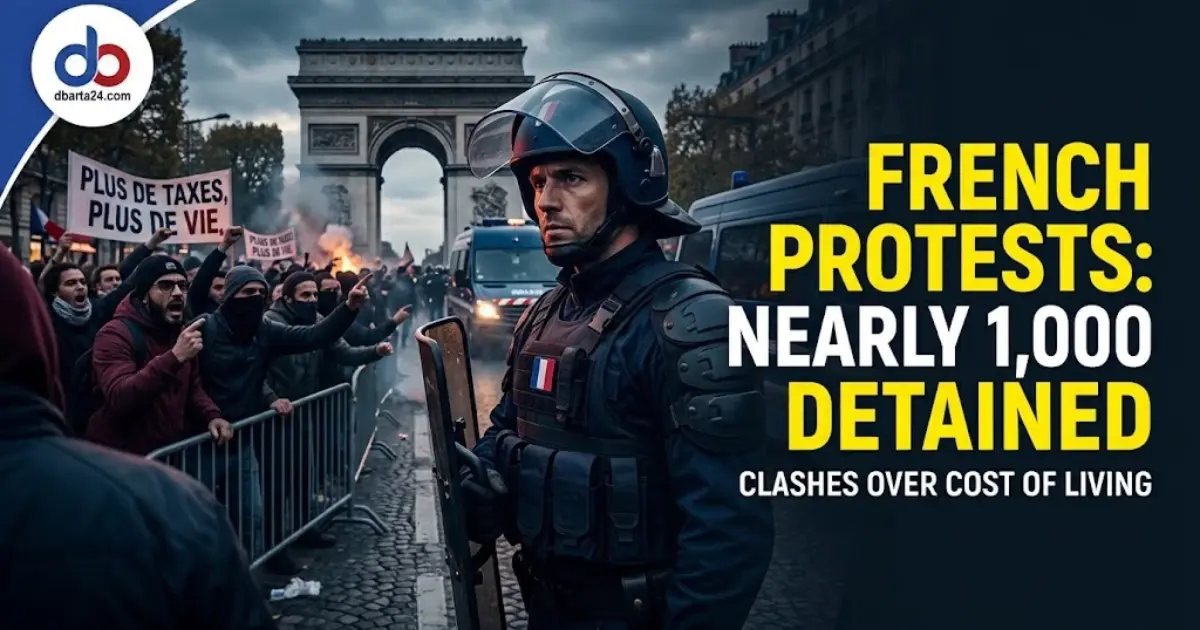
Dbarta24 International Desk — Tensions boiled over across France on Saturday as tens of thousands took to the streets to protest the escalating cost of living, rising fuel prices, and deteriorating conditions in public schools.
While authorities managed to prevent the widespread looting and rioting seen in previous weeks, violent clashes between demonstrators and riot police still erupted in major urban centers, resulting in nearly 1,000 arrests nationwide.
Heavy Security Deployment and Crackdown
According to figures from the French Interior Ministry, roughly 410,000 people participated in demonstrations across the country on Saturday, whereas labor union representatives estimated the turnout closer to 800,000.
To maintain order and prevent vandalism, the government deployed approximately 70,000 police officers nationwide. Earlier in the week, President Emmanuel Macron issued directives restricting official demonstration permits strictly to recognized trade unions.
In recent days, fast-track judicial procedures have already handed down prison sentences to hundreds of individuals accused of arson, vandalism, and looting.
Despite the security measures, peaceful marches descended into chaos during their final hours. In Paris, a rally stretching from Porte d’Italie to Porte de Vincennes remained orderly until rogue elements clashed with riot police near the route’s end.
Law enforcement responded with tear gas and water cannons, backed by specialized anti-organized crime and counter-terrorism tactical units.
Authorities reported that small groups of masked youths built improvised barricades, threw projectiles at police lines, and smashed showroom windows, prompting batons-charge responses from law enforcement.
Laurent Nuñez, an official from the Ministry of the Interior, stated that thousands of radical activists had assembled at the tail end of the Paris march, with around 500 individuals identified specifically as rioters.
At the end of the day, Nuñez confirmed that nearly 1,000 arrests had been made across the country—a figure expected to rise—and noted that at least two individuals sustained severe injuries during clashes in Toulouse and Clermont-Ferrand.
Unrest Spreads to Major Cities
Similar scenes played out across several major French regional hubs:
-
Marseille: Protesters set trash containers ablaze and deployed metal sheets to block thoroughfares. Security vehicles were forced to navigate through burning street barricades.
-
Bordeaux: Masked demonstrators clad in black tore wooden planks from a local building to construct road blockades.
-
Lyon: Police fired tear gas canisters to disperse crowds gathered in unauthorized zones. A high school student participating in the demonstration recounted: “There were about 150 of us in our group, mostly high school and university students. Suddenly tear gas was fired out of nowhere, completely blinding the street.”
-
Orléans: In contrast to the violent disruptions elsewhere, a anti-extreme-right rally directed against the National Rally party drew an estimated 13,000 participants and concluded without incident.
Public Frustration and Discontent
Interviews with demonstrators reflect deep-seated economic hardship and systemic frustration with the current administration.
Zelly, a 26-year-old Paris resident, shared her grievances:
“People are genuinely desperate, which is why they are out on the streets. Ever since Macron came to power, people have been going through immense hardship. They silence us. They take our money, impose heavy taxes on us, yet we have no say. We took to the streets today because too much time has passed, and we simply cannot tolerate it anymore.”
Other younger participants echoed feelings of marginalization, citing extreme disappointment and a feeling of total abandonment by government leadership. Commenting on the violent spillover, one protester remarked:
“I don’t believe looting is right at all, but this chaos stems directly from poverty and police violence. These demonstrations will continue until our demands are addressed. We genuinely want change in France.”
European Ripple Effects and Economic Fallout
The wave of unrest is not isolated to France. Across Europe, economic distress triggered synchronized demonstrations over the weekend:
-
Barcelona, Spain: A student rally turned violent, leading authorities to condemn the “unprovoked violence” and arrest over 100 people.
-
Tirana, Albania: Riot police used tear gas to break up thousands of anti-government protesters.
-
Brussels, Belgium & Milan, Italy: Clashes were reported in Brussels, while heavy joint operations by Italian police and military forces restricted mass gatherings in Milan following severe vandalism and store ransacking last week.
The economic toll of the French protests is already severe. Last weekend’s mobilization drew over 550,000 participants, culminating in the arrest of more than 2,500 people. Over 2,000 shops and commercial establishments were damaged across the country, with the French Chamber of Commerce and Industry (CCI) estimating total damages in the hundreds of millions of euros.
Additionally, one protester suffered a severe hand injury from a crowd-control grenade, and nearly 1,000 police officers have been injured since the unrest began.
Political Standoff Ahead of Elections
With France’s presidential election slated to take place in six months, the ongoing unrest has dramatically intensified the nation’s political turmoil.
Opposition candidates across the political spectrum have placed the blame squarely on President Macron and his cabinet, accusing the government of mismanaging the economy and failing to address the public’s mounting financial strain.