


Special Correspondent — The International Monetary Fund (IMF) has noted that Bangladesh’s economy is slowly steering toward stability, breaking away from its previous cycle of crisis.
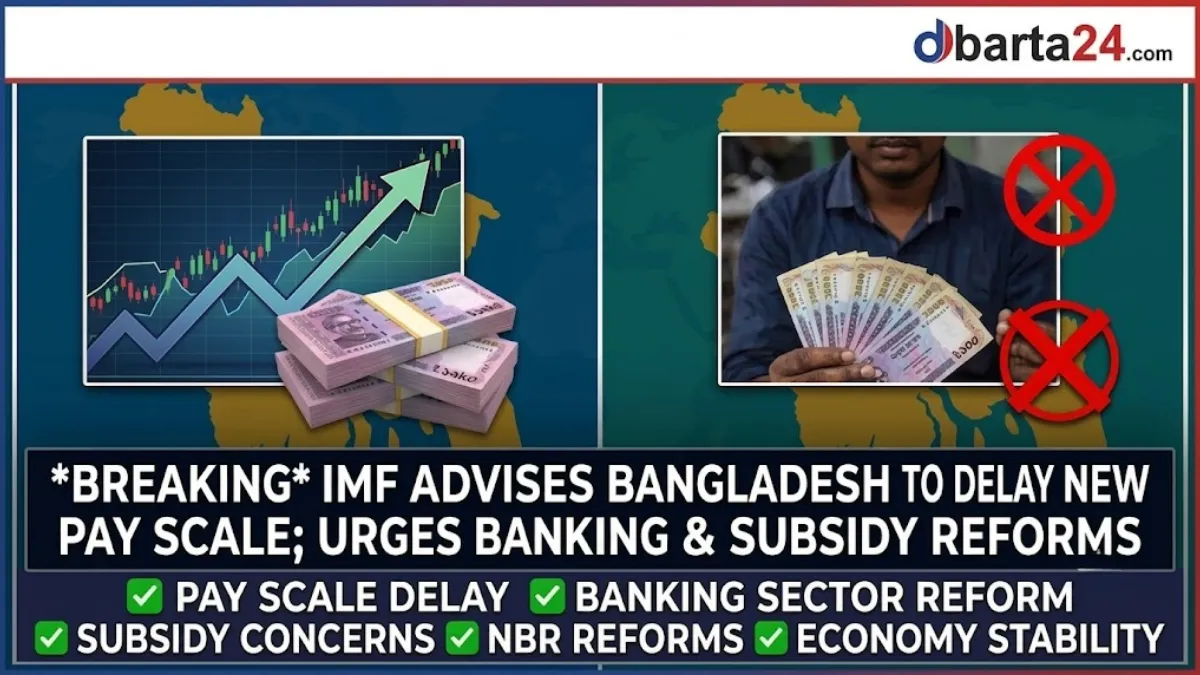
However, the global lender has voiced deep concern over structural reform paces, explicitly advising the government to delay the implementation of a new public sector pay scale due to inadequate revenue generation.
A 12-member IMF delegation is currently visiting Dhaka to assess the feasibility of a potential new $4.5 billion loan package.
The delegation held critical meetings yesterday with officials from various ministries, Bangladesh Bank, the National Revenue Board (NBR), and private sector leaders to review economic progress and negotiate the proposed program’s framework.
Gradual Reforms and Political Reality
Following a meeting at the Secretariat with Chris Walker, the IMF Mission Chief for Bangladesh, Finance Minister Amir Khasru Mahmud Chowdhury urged patience.
“Overnight macro-changes are impossible,” the Finance Minister told reporters. “Long-standing structural issues must be resolved step by step. We will push forward with economic reforms keeping local realities in mind, and the IMF agrees with this approach.”
Chowdhury highlighted that the IMF expressed a positive outlook on the measures taken by the current government during its four-month tenure, particularly regarding financial sectors, capital markets, and NBR tax-to-GDP expansion plans.
He added that the IMF looked favorably upon the social and welfare responsibilities of a political government.
Four Areas of Major Concern
Despite noting silver linings, the IMF highlighted a dissatisfying pace in structural reforms across four critical areas:
-
The New Pay Scale Caution: With revenue collections underperforming and budget deficits persisting, the IMF warned that a massive salary hike could trigger massive public expenditure. They noted that injecting additional cash into the market would inflate consumer spending, adding new pressure on inflation. Consequently, they advised pushing the timeline back.
-
Deep Worry Over the Banking Sector: The banking sector remains the lender’s biggest headache. The IMF remarked that steps taken to curb Non-Performing Loans (NPLs) have failed to yield results. Capital shortfalls, weak governance, and hidden balance-sheet risks remain high, prompting demands for transparent NPL reporting and restructuring of weak banks.
-
Subsidy Mismanagement: The IMF expressed dissatisfaction with subsidy management, pointing out that allocations for subsidies increased in the latest budget despite prior agreements to phase them out. The delegation recommended cutting unnecessary subsidies and expanding targeted social safety nets.
-
Sluggish NBR Reforms: Slow modernization of tax administration has drawn criticism from the global lender, which warned that failing to improve efficiency will stall revenue growth. Furthermore, the IMF suggested strengthening the role of the National Parliament and parliamentary committees to ensure accountability in public financial management.
Credibility Over Cash
Local analysts believe that while a new $5 billion program is highly significant—especially considering Bangladesh has paid over $4 billion in foreign debt servicing over the past year—the IMF’s validation matters more than the actual cash injection.
Dr. A.K.M. Waresul Karim, Dean of the Business School at North South University, emphasized this sentiment:
“The IMF’s evaluation carries more weight than its money. A positive nod from the IMF sends a powerful message of confidence to other development partners like the World Bank, ADB, JICA, and AIIB.”
Dr. Karim added that while Bangladesh’s position in export earnings, remittances, and debt-repayment capacity has strengthened, failing to reform banking and subsidies could send a negative signal to international markets.
Positive Signals
On a brighter note, the IMF acknowledged that Bangladesh’s foreign exchange reserves have improved, volatility in the dollar market has eased, and inflation is showing a gradual downward trend.
Sustained growth in export earnings and remittances further indicates that the economy is transitioning toward stability.
The final assessment of this review will determine the path forward for future loan programs, dictating investor confidence and international climate financing channels for Bangladesh.