


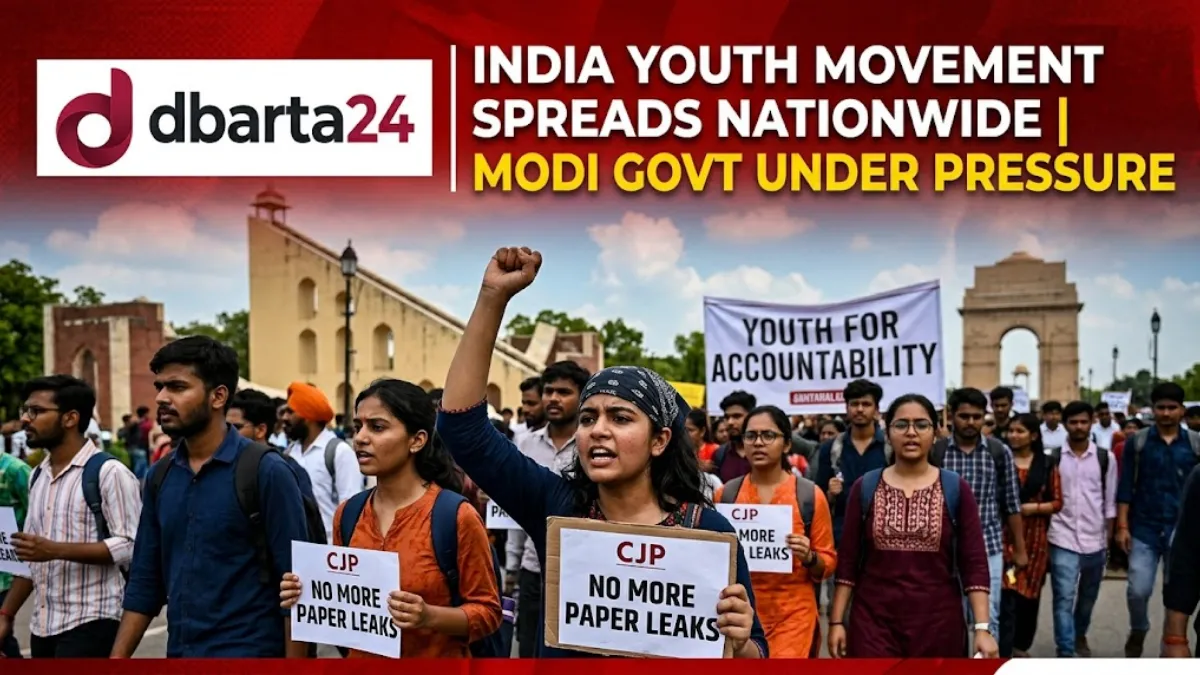
Amitav Roy ; New Delhi — A youth-led mass movement demanding the resignation of India’s Education Minister over chronic exam paper leaks and rising unemployment has rapidly escalated across multiple states.
Posing an unprecedented political challenge to the government of Prime Minister Narendra Modi, the protests—organized under the banner of the Cockroach Janata Party (CJP)—have breached political, regional, and religious divides to unite students across the country.
What initially began in New Delhi has now metastasized nationwide. Demonstrations erupted in major urban centers, including Mumbai (Maharashtra), Bengaluru (Karnataka), Patna (Bihar), and Mizoram. In Patna, law enforcement deployed tear gas and water cannons to disperse marching students.
Despite police crackdowns, determined protesters continue to occupy New Delhi’s historic demonstration site, Jantar Mantar.
The movement centers around widespread frustration among over 20 million job seekers and students whose futures have been impacted by recurring recruitment exam paper leaks.
POLITICAL BACKLASH & QUOTES:
The political opposition has rallied strongly behind the student movement. Opposition Leader Rahul Gandhi, wearing black attire in Parliament following a brief detention by police, launched a blistering attack on the administration.
“Over the last decade, there have been 154 instances of paper leaks, yet no one has been punished,” Rahul Gandhi stated, demanding accountability. “Prime Minister Narendra Modi should apologize to the students.” Gandhi further demanded the immediate resignation of Union Education Minister Dharmendra Pradhan.
Amid mounting unrest, Union Home Minister Amit Shah offered to hold talks with CJP representatives. However, the youth collective firmly rejected any behind-the-scenes negotiations in government offices or residences.
“We will not go to any minister’s office or residence,” said Sourav Das, CJP’s chief spokesperson. “Any dialogue must take place at a neutral venue like Jantar Mantar.”
WANGCHUK’S CONDITIONAL FAST:
Prominent activist Sonam Wangchuk, who is currently undergoing medical treatment during a hunger strike, expressed willingness to end his fast under specific guarantees.
Wangchuk conveyed through a letter that he would consider breaking his fast if the government issues a written assurance that it will positively evaluate the Education Minister’s resignation and guarantee no legal retaliation against peaceful protesters.
Meanwhile, legal challenges against alleged police brutality have reached the judiciary.
The Delhi High Court issued notices seeking responses from the Union Government and Delhi Police regarding petitions filed over student beatings, scheduling the next hearing for September 11.
Political analysts note that unlike previous localized or identity-driven agitations faced by the Modi administration since 2014, this youth movement spans cross-demographic lines, making it significantly harder to dismiss or marginalize politically.
Political analyst Nilanjan Mukhopadhyay noted that while removing the Education Minister might signal weakness to Modi’s political image, ignoring the movement risks further alienating millions of young voters.
Despite detentions and harsh police action, protesters remain resolute. The Cockroach Janata Party was founded by 30-year-old Abhijit Deep in May following controversial remarks by India’s Chief Justice.
The term “cockroach” has since been embraced by the youth as a striking metaphor for resilience, survival, and relentless resistance against systemic injustice.