


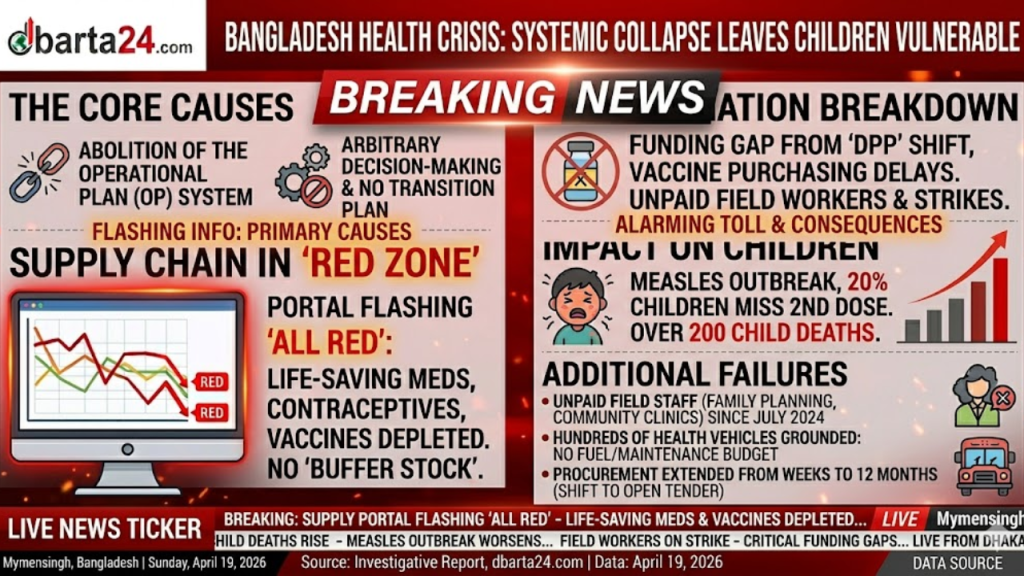
Khairul Alam; DHAKA – A deep-dive investigation into the recent surge of child mortality and the resurgence of the measles epidemic in Bangladesh has uncovered a trail of administrative negligence.
Evidence suggests that the crisis is the direct result of “arbitrary” decisions made by the former interim government’s health administration, specifically involving the abolition of the long-standing Operational Plan (OP) structure.
The ‘One-Man Army’ Syndrome
At the heart of the controversy is Professor Dr. Sayedur Rahman, the former Special Assistant to the Chief Adviser. While the Health Adviser, Nurjahan Begum, was reportedly seen as an ineffective choice for the role, Dr. Rahman assumed “absolute authority” over the sector.
According to leaked minutes from high-level meetings held in February and March 2025, Dr. Rahman overrode repeated warnings from veteran health officials. These officials cautioned that dismantling the Sector Program without a transition plan would lead to:
-
A total halt in field-level salaries.
-
A collapse of the national vaccine supply chain.
-
A complete breakdown of logistics, including fuel for emergency vehicles.
The “All Red” Supply Chain Collapse
Dr. Monjur Ahmed, Focal Person for MCH Services, provided explosive testimony regarding the state of medical supplies. He revealed that since the transition from the 26-year-old OP system to a project-based DPP (Development Project Proforma) system, the supply chain has entered a “death spiral.”
“If you look at the Supply Chain Management Portal today, it is ‘All Red’,” Dr. Ahmed stated. “There is a zero-buffer stock for birth control pills, injections, and IUDs. In our sector, a one-month disruption in supply translates to a 14-fold loss in investment value.”
EPI Crisis: Measles on the Rise
The Expanded Programme on Immunization (EPI) is currently facing its most significant threat in decades. Dr. Rajib Sarkar, Deputy Program Manager of EPI, explained that the sudden shift in how vaccines are procured—moving away from international collaborative funding to independent government purchasing—created a massive “funding gap.”
-
Contagion Risk: Measles, the world’s most contagious disease (where one child can infect up to 18 others), is spreading because 20% of children are missing their second dose.
-
Worker Strikes: Field workers and health assistants have gone on strike three times recently due to unpaid salaries and grading disputes, leaving the grassroots vaccination network paralyzed.
Financial Warnings Ignored
The investigation also highlighted warnings from the World Bank, which was in the process of approving hundreds of millions of dollars for the 5th Health Sector Program. The Bank warned that failing to approve the program on time would restart the entire funding cycle, causing long-term delays. These warnings were reportedly brushed aside in favor of a “hasty exit” from the existing framework.
Current Status: A Sector in Silence
When contacted, the figures at the center of the crisis remained silent. Former Adviser Nurjahan Begum claimed she had “forgotten” the details due to illness, while Dr. Sayedur Rahman has not responded to multiple calls. Sources close to the former administration suggest they are preparing a “rejoinder” to defend their actions, claiming that central stocks are adequate and that the move was intended to reduce “duplication” in the sector.
However, for the families of over 200 children who have already fallen victim to these policy shifts, the “administrative cleanup” has come at an unbearable price.
Key Data Points for Infographics
-
The 1:14 Rule: Every $1 lost in supply chain efficiency results in a $14 loss in health investment.
-
Vaccine Gap: 20% of children are currently missing the crucial 2nd dose of the Measles vaccine.
-
Unpaid Workforce: 14,000+ Community Clinic staff and thousands of Family Planning workers are facing salary arrears.
-
Procurement Delay: The shift to “Open Tender” has increased the time to acquire emergency medicines from weeks to 12 months.