


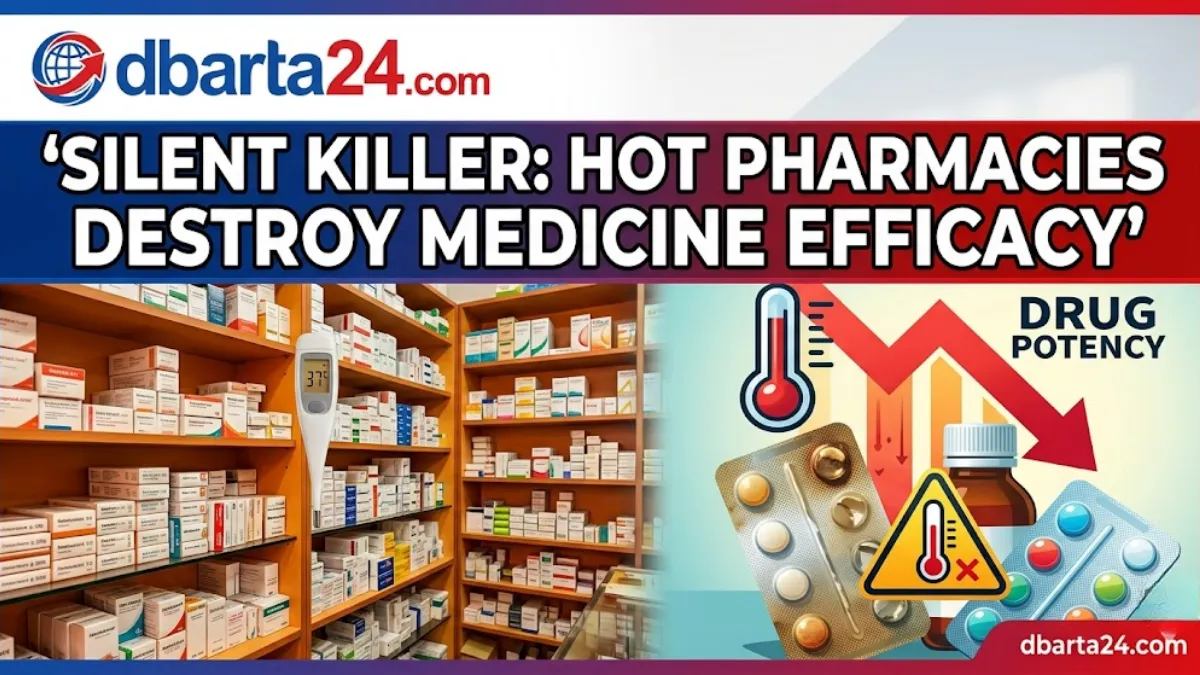
Labonnya Liza ; Health Desk – While people eagerly resort to air conditioners, fans, and various cooling methods to escape the scorching summer heat, the same care is glaringly absent for life-saving medicines across most retail pharmacies in Bangladesh.
Due to a severe lack of proper storage management, the quality and efficacy of crucial drugs are rapidly deteriorating, leaving patients without the desired therapeutic results.
According to data from the Directorate General of Drug Administration (DGDA), there are over 225,000 licensed pharmacies across the country.
However, the regulatory body lacks specific data on how many of these dispensaries actually maintain the mandatory storage temperatures.
Private organizations and pharmaceutical experts note that a staggering majority of these pharmacies completely disregard temperature guidelines.
A recent on-the-ground investigation across various districts—including Kawran Bazar, Kalabagan, and Mohakhali in the capital, alongside Pirojpur Sadar Hospital Road, Club Road, and Comilla’s Kotbari and Kandirpar areas—revealed a grim reality.
Out of 50 randomly monitored pharmacies, 46 did not have any air conditioning system installed.
The Critical Temperature Gap
Storage Rules at a Glance:
90% of market medicines must be stored between 15°C and 25°C in a cool, dry, and dark place.
The Reality: Most local pharmacies lack ACs, rendering climate control impossible during summer when temperatures often cross 40°C.
The Impact: Sustained high temperatures alter chemical compositions, causing drugs to lose potency and leaving patients vulnerable.
Professor Dr. Syed Sabbir Haidar from the Department of Pharmaceutical Technology at Dhaka University explained the science behind it:
“The shelf life printed on a medicine package is strictly conditional. Its quality will only last until the expiration date if it is stored under the specified temperature and environmental conditions.”
Experts warn that even minor temperature fluctuations can destroy a drug’s efficacy. Under World Health Organization (WHO) ‘Good Storage Practice’ guidelines, medicine storage is divided into four main categories: room temperature (20-25°C), cool conditions (8-15°C), cold/refrigerated (2-8°C), and freezing (minus 4 to 2°C).
While standard room-temperature drugs can briefly tolerate temperatures between 15-30°C, continuous exposure to anything above 30°C causes active pharmaceutical ingredients (APIs) to break down.
For protein-based medicines like insulin or vaccines, exposure outside the strict 2-8°C range causes permanent coagulation, rendering them completely useless.
Regulatory Loopholes and Market Statistics
According to the DGDA’s annual report, Bangladesh hosts 251 allopathic, 254 Unani, 166 Ayurvedic, 54 homeopathic, and 44 herbal medicine manufacturing companies. Currently, there are 41,158 registered brands across 3,599 generics of allopathic drugs in the local market, most of which require storage under 25°C.
+---------------------------+-----------------------+-----------------------+
| Pharmacy Category         | Minimum Space Req.    | AC & Cold Chain Req.  |
+---------------------------+-----------------------+-----------------------+
| Model Pharmacy            | 300 sq. ft.           | Mandatory AC & Fridge |
| Model Medicine Shop       | 120 sq. ft.           | Mandatory Fridge      |
| General Retail Pharmacy   | Varies                | Frequently Violated   |
+---------------------------+-----------------------+-----------------------+
Out of the country’s total 235,521 registered pharmacies, the DGDA has successfully upgraded around 1,000 into “Model Pharmacies” and nearly 100,000 into “Model Medicine Shops”.
While Model Pharmacies strictly enforce air conditioning to keep indoor climates below the ideal 20-25°C mark, general retail stores slip through the cracks.
What the Authorities Say
When confronted with these findings, DGDA Director Dr. Md. Aktar Hossain acknowledged the infrastructure gaps.
“According to pharmacological rules, the majority of medicines must stay below 25°C, and sensitive ones between 2-8°C. It is true that all licensed pharmacies in the country do not have ACs.
Because of this, we heavily advise the retail tier to keep low inventory and ensure quick turnover and consumption of drugs,” Hossain told reporters. He added that mobile courts and drug tribunals regularly fine and sue dispensaries that completely violate standard guidelines.
Nevertheless, industry consultants argue that while factories face stringent zero-tolerance mandates regarding climate control, letting retail points off the hook creates a broken chain.
Experts are now calling for independent third-party research to assess the nationwide depth of this silent pharmaceutical crisis.