


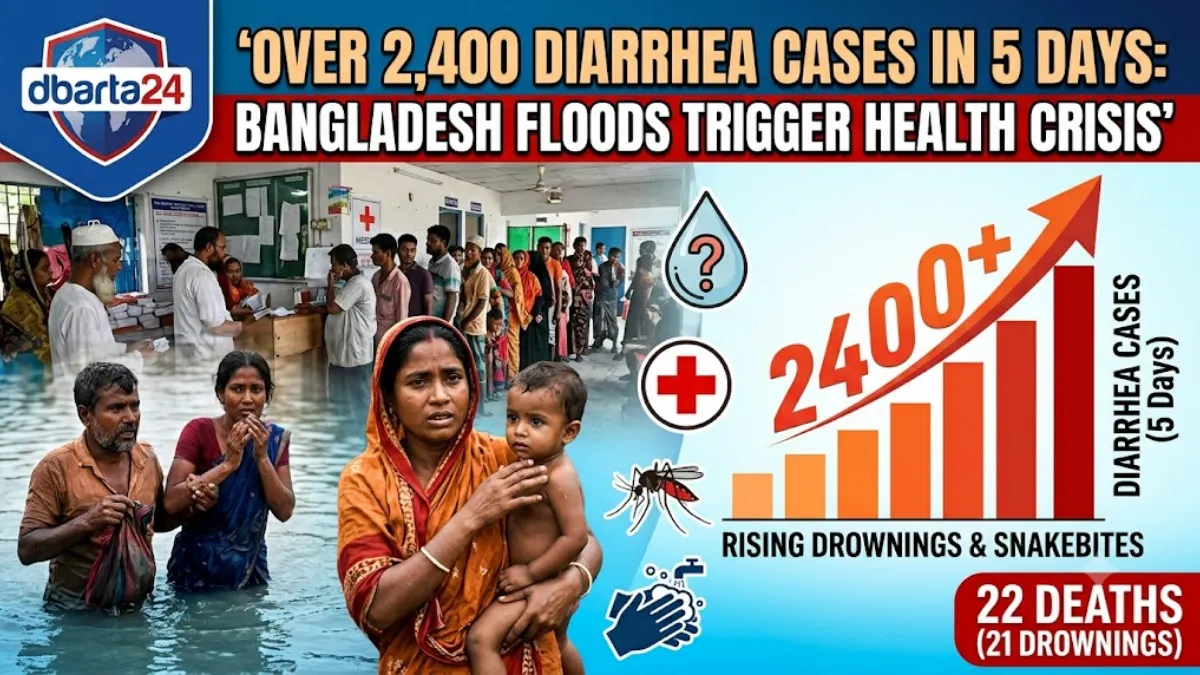
Muyabia Labony — The ongoing flood situation across 160 unions in 28 sub-districts (upazilas) of Bangladesh has rapidly transformed from a humanitarian emergency into a critical public health crisis.
According to data released by the Health Emergency Operation Center and Control Room under the Directorate General of Health Services (DGHS), the waterlogged regions are witnessing a massive surge in waterborne diseases and related fatalities.
In the last 24 hours alone, 667 new cases of diarrhea were recorded in the flood-affected areas. During the same period, six individuals suffered snakebites, and three people tragically drowned.
Rising Casualties and Outbreak Numbers
Official health status reports issued since July 10 reveal that 2,630 individuals sought hospital treatment in flood-hit zones within just five days. Out of these admissions, a staggering 2,462 patients were treated for diarrhea.
The worsening situation has also led to a spike in other environmental hazards, with 123 recorded snakebite incidents and 21 drowning deaths within the same five-day window.
The total death toll for this brief period stands at 22, with 21 of the fatalities caused by drowning—almost all of which occurred within the Chittagong division.
Experts Warn of Escalating Health Hazards
Public health specialists warn that the true extent of the health crisis will likely manifest as floodwaters begin to recede.
The combination of contaminated environments, acute shortages of drinking water, overcrowding in flood shelters, and stagnant pools of water exposes citizens to at least seven distinct health risks.
These include cholera, dengue, pneumonia, skin infections, typhoid, and hepatitis-A, alongside snakebites and drowning.
Highlighting the immediate vulnerabilities, public health expert Dr. Mushtaq Hussain noted:
“The biggest crisis during a flood is the lack of safe water and sanitation. Consuming contaminated water causes diarrhea, cholera, typhoid, and hepatitis-A to spread rapidly. At the same time, respiratory infections rise due to overcrowding in shelters.”
Dr. Hussain additionally emphasized the critical need to secure specialized healthcare services for pregnant women, children, and the elderly.
Elaborating on the post-flood challenges, fellow public health expert Dr. Lelin Choudhury added:
“Once the floodwaters recede, Aedes mosquitoes breed in the remaining stagnant water, increasing the risk of dengue and chikungunya. Prolonged exposure to damp environments also leads to various skin infections.”
Dr. Choudhury strongly advised residents to only consume water that has been thoroughly boiled or treated with water purification tablets.
Government Mobilization and Emergency Response
Public health experts maintain that unless relief distribution is paired with systematic water purification, sanitation improvements, mosquito control, and emergency medical access, the country faces a secondary disaster driven by infectious diseases.
In response to the escalating situation, the government has operationalized 3,067 flood shelters and deployed 3,117 medical teams to deliver essential healthcare services across the affected regions.
According to DGHS logistics data, emergency medical stockpiles currently include:
-
Approximately 22,000 vials of anti-snake venom, with an additional 25,000 vials scheduled for distribution within the next 15 days.
-
Around 7.5 million Oral Rehydration Salts (ORS) packets.
-
Nearly 400,000 bags of cholera saline.
-
More than 3.6 million water purification tablets.
Director General of the DGHS, Professor Dr. Prabhat Chandra Biswas, assured that medical teams are actively working in every affected upazila.
He reiterated that the health management strategy prioritizes pregnant women, newborns, and children, with emergency swift-transfer mechanisms established for cases requiring urgent hospitalization.