


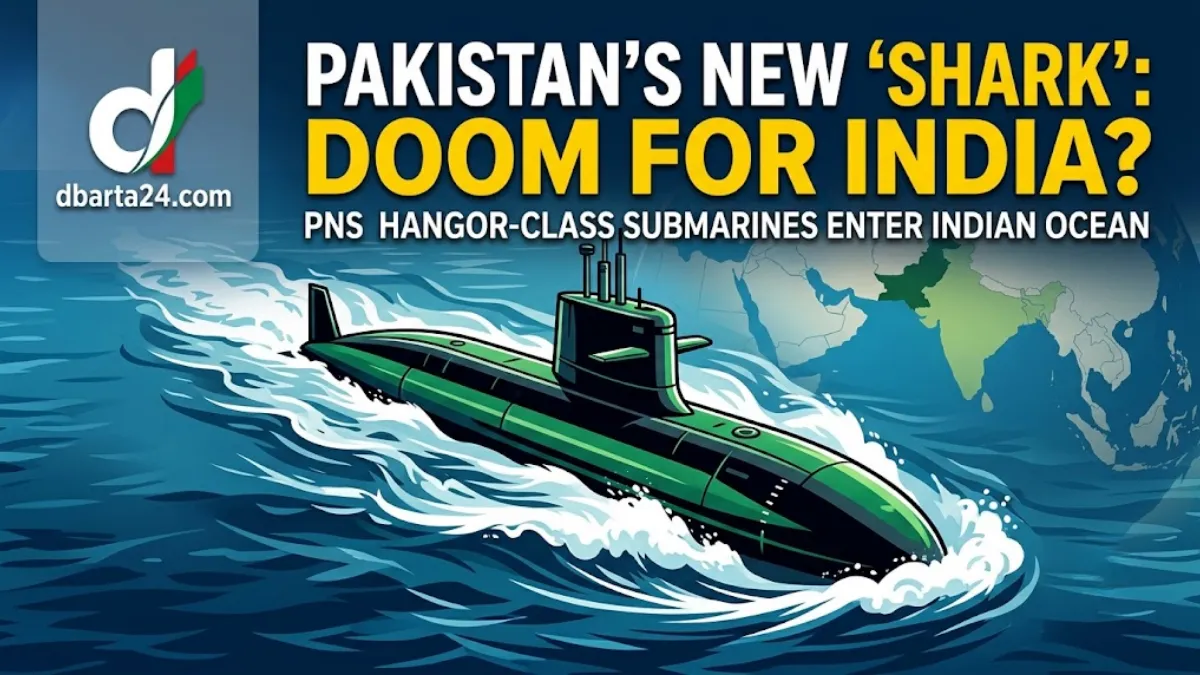
International Desk – More than half a century after losing its submarine foothold in the Bay of Bengal during the 1971 war, Pakistan is making a formidable return to the strategically crucial waters of the Indian Ocean.
The induction of its latest attack submarine, the PNS Hangor, marks the beginning of a major naval upgrade that experts warn could fundamentally disrupt India’s strategic calculations.
The PNS Hangor, which arrived at Karachi port on June 11 amid celebratory fanfare, is the first of eight advanced stealth submarines Pakistan is acquiring from China.
Designed to bolster Islamabad’s underwater warfare capabilities, the fleet is being touted by military officials as a definitive turning point for the region’s naval balance.
“This advanced submarine capability will act as a ‘game-changer’ in shifting the balance of power,” said Commodore Omar Farooq, Mission Commander of the new submarine fleet. “It will significantly extend the operational reach of the Pakistan Navy far beyond our coastal waters, allowing for a prolonged presence in the eastern Indian Ocean.”
The Anatomy of the Game-Changer
The PNS Hangor is visually and technologically distinct from its predecessors. Featuring a sleek, teardrop-shaped hull, the vessel measures 76 meters in length and 8.4 meters in width, making it noticeably larger than conventional submarines currently operating in South Asian waters.
The crown jewel of its engineering is the Air-Independent Propulsion (AIP) system. This technology allows the submarine to remain submerged for weeks at a time without needing to surface for oxygen, exponentially enhancing its stealth capabilities and making it incredibly difficult for rival radars to detect.
During the official handover ceremony in Hainan Province, China, Pakistani President Asif Ali Zardari confirmed that the Hangor-class fleet will be fully equipped with modern weaponry and cutting-edge navigation systems to maintain maritime order and stability. The acquisition will allow Pakistan to phase out its aging, French-built ‘Agosta’ submarines.
Redefining the Naval Disparity
While India maintains a massive numerical advantage with 19 submarines—including three nuclear-powered vessels—compared to Pakistan’s modest fleet, naval experts argue that numbers do not tell the whole story.
According to retired Pakistani Rear Admiral Syed Faisal Ali Shah, the new fleet shatters the traditional narrative of military asymmetry between the two neighbors. Reflecting on recent border skirmishes, Shah noted that naval deterrence is already working effectively.
“The conflict wasn’t limited to the skies; the Indian Navy maintained a cautious stance in the sea, staying 400 to 500 nautical miles away from Karachi,” Shah told The Independent. “In future conflicts, these submarines will multiply our underwater capabilities. This should undoubtedly be a cause for concern for the Indian military leadership.”
Shah added that even a single undetected submarine poses an existential threat to an enemy fleet. “At sea, the threat of one submarine is nearly equal to the threat of ten. Until you can pinpoint its exact location, it is impossible for any warship to navigate those waters safely.”
The Sino-Pakistani Axis and India’s Response
Under the bilateral agreement, four of the eight submarines are being built in China, while the remaining four will be constructed in Pakistan under a technology transfer program expected to run until 2032.
Dinakar Peri, a security research fellow at Carnegie India, views this development as a double-edged sword that ultimately benefits Beijing. While China frames the deal as routine military cooperation, Peri notes it serves China’s broader geopolitical ambitions to contain India. However, he maintains that India’s overall maritime warfare infrastructure remains superior.
India has actively reinforced its anti-submarine warfare capabilities by deploying long-range P-8I surveillance aircraft and MH-60R multi-role helicopters. Yet, Peri concedes that India could face short-term pressure due to delays in modernizing its aging submarine fleet.
“The new submarines will definitely enhance Pakistan’s sea-denial capabilities in the Arabian Sea,” Peri observed, adding that Indian military planners will have to re-evaluate their strategies if regional tensions spike again.
A Global Domino Effect
The naval buildup in South Asia is part of a larger, interconnected global arms race. Admiral Shah pointed out that the regional friction cannot be viewed in isolation, citing Western alliances like AUKUS (the military pact between Australia, the UK, and the US to build nuclear-powered submarines) as catalysts.
“If this is an arms race, it is driven by a domino effect triggered by external powers,” Shah argued.
As China continues its unprecedented naval expansion and Pakistan integrates its new stealth assets, the Indian Ocean is rapidly transforming into one of the most contested and militarized bodies of water in the world.
For India, the arrival of the PNS Hangor means the underwater silence of the Indian Ocean is about to get a lot louder.