


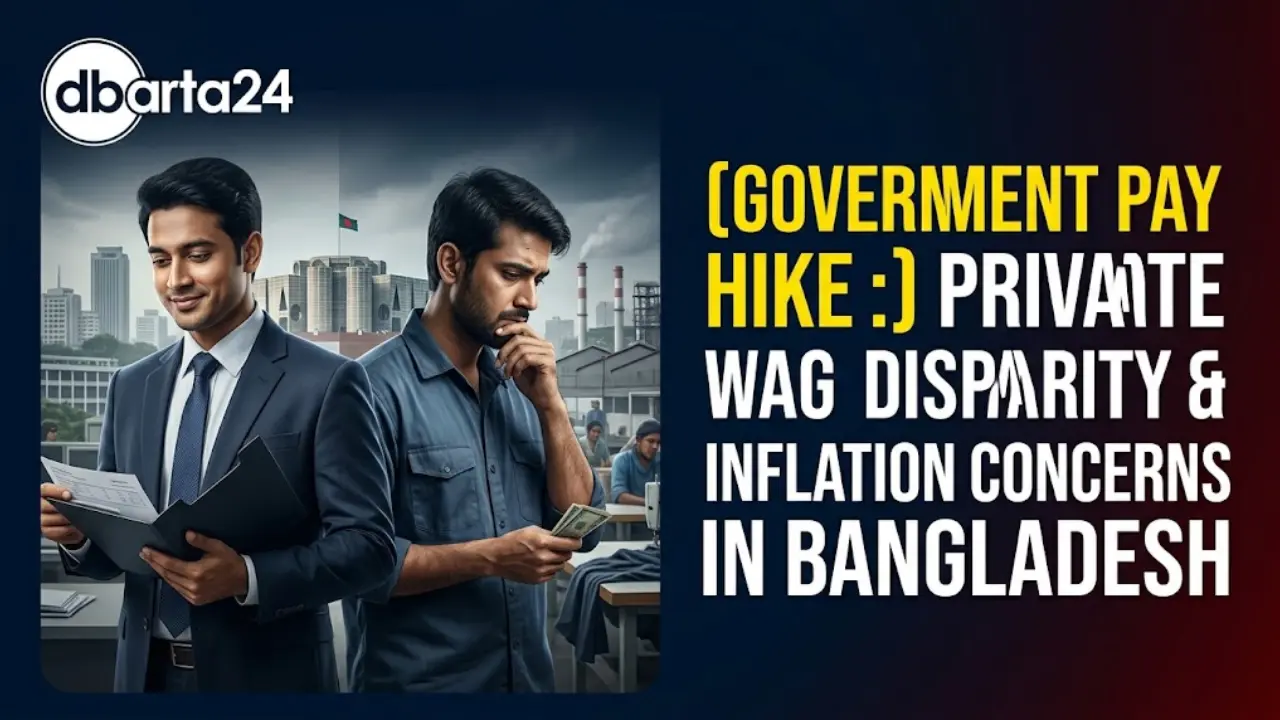
Dbarta24 Report — The Bangladesh government’s decision to increase public sector salaries by up to 142 percent has sparked widespread debate over its ripple effects on the national labor market.
While the move brings financial relief to roughly 2.4 million government employees, economists, business leaders, and consumer rights advocates warn that it could drive up the cost of living, exacerbate income inequality, and place unprecedented financial strain on the country’s private sector.
A Fiscal Burden and Economic Strain
Implementing the new pay scale will require an additional BDT 105,580 crore. Once all allowances take effect in full, the government’s annual expenditure on salaries and benefits is projected to reach nearly BDT 200,000 crore—an amount equivalent to roughly half of the total revenue collected in the previous fiscal year.
Economists express grave concern over funding this massive deficit under current economic conditions.
To generate the required revenue, the government will likely need to rely heavily on tax collection from the private sector, indirectly passing the financial burden onto private businesses and non-government workers.
The Private Sector Dilemma: Retention vs. Inflation
Unlike the public sector, the private sector operates without a unified pay structure, leading to inconsistent wage adjustments across industries.
A study by the Centre for Policy Dialogue (CPD) following the 2015 pay scale implementation revealed that while high-income private employees managed to negotiate salary increases, lower-income workers were left behind, widening disparity within the private sector itself.
The sharp rise in public sector compensation threatens private enterprises in two major ways:
-
Talent Drain: Public jobs become significantly more attractive not only due to base pay, but also because of non-wage benefits like pensions, provident funds, medical care, and job security. Retaining skilled talent in the private sector is becoming increasingly difficult.
-
Cost of Living Pressures: Employees face rising market prices without guaranteed salary adjustments, prompting demands for wage hikes that many struggling companies cannot afford.
Fazlee Shamim Ehsan, President of the Bangladesh Employers’ Federation (BEF), noted that public pay scale adjustments do not directly mandate private sector restructuring.
He highlighted that garment sector wages have grown by 136 percent over the last 11 years. However, consumer advocates argue that overall market inflation will hit the majority of the workforce unfairly.
“While financial security is ensured for public servants, this pay scale will create additional pressure on the living standards of private sector employees who form the vast majority of the labor market. Rising costs without income growth risk breeding social inequality and discontent.”— S.M. Nazer Hossain, Vice President, Consumers Association of Bangladesh (CAB)Industry Leaders Warn of Severe Impact
For small and medium enterprises (SMEs) as well as manufacturing units already grappling with energy shortages and stagnant investment, matching public sector wage growth remains unrealistic.
“Private sector factories are already passing through severe crises. Over the past three years, many units have closed, and many more are on the verge of shutting down. Under these conditions, imposing further wage burdens is simply unsustainable for factory owners.”— Mohammad Hatem, President, Bangladesh Knitwear Manufacturers and Exporters Association (BKMEA)Uncertainty Surrounding MPO Teachers
The pay hike has also raised immediate questions regarding Non-MPO and MPO (Monthly Pay Order) educational institutions.
Following initial confusion and growing discontent among nearly 625,000 MPO-enlisted teachers and staff, Education Minister Ehsanul Haq Milan clarified via social media that MPO teachers and employees will indeed be included under the new pay structure.
However, the exact timeline and notification details remain awaited.
Looking Ahead
While large corporations in banking, telecommunications, and pharmaceuticals may adjust compensation to retain talent, medium and small-scale employers face a widening labor market divide.
Without targeted measures to curb market inflation and support business productivity, the historic public sector pay raise risks sharpening the divide between government workers and the broader private workforce.