


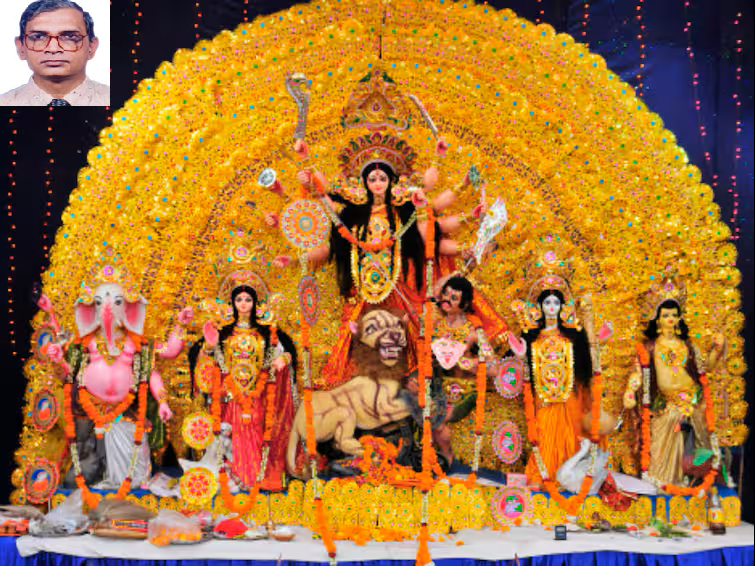
Sharadiya Durga Puja is one of the most significant festivals for Bengalis, combining religion, culture, economy, and social values. Rooted in ancient goddess worship, it honors Durga’s victory over evil and reflects unity through traditions like Kumari Puja and Sandhi Puja. Beyond its spiritual importance, the festival inspires literature, art, and cultural performances, making it a creative and social celebration. It has grown from zamindar households to community events, now celebrated globally by Bengalis. Economically, it boosts trade, small businesses, artisans, and services. Durga Puja symbolizes harmony, universality, and the eternal triumph of good over evil.
Among the Hindu community worldwide, Durga Puja is one of the most important festivals. In the Indian subcontinent, it is considered the main religious festival of Hindus. In India, the week-long celebration brings together people of all ages in joy and unity. Rituals and sacrifices take place around the decorated pandals. The sound of bells and the beat of the drums fill the festival atmosphere with excitement.
The exact time, place, and beginning of Durga Puja are not clearly known. In ancient Dravidian matriarchal society, the worship of the Mother Goddess was common. In Aryan civilization, male gods were given more importance, but in non-Aryan civilizations, goddesses were worshipped as symbols of power (Shakti).
History and Stories
Worship of the goddess in motherly form in the Indian subcontinent is very old. Historians believe that the worship of the goddess began about 22,000 years ago in India. In mother-centered families, the mother was seen as the main strength, which led to the belief in Mother Goddess.
According to the Mahabharata, Durga is another form of Kali. She is also worshipped as Shiva’s consort and the universal mother. In the Krittivasi Ramayana, it is written that Ramachandra worshipped Durga with 101 blue lotuses during autumn before his battle with the powerful demon king Ravana. With Durga’s blessing, Rama achieved victory.
There are different opinions about the origin of Durga Puja. The Markandeya Purana states that King Surath of the Chedi dynasty started Durga Puja in Kalinga (present-day Odisha) about 300 years before the birth of Christ. Another opinion says the Zamindar of Dinajpur started the puja in the late 1500s. Some say Raja Kansanarayan of Taherpur, Rajshahi, first performed it in the 16th century. Others believe Bhabananda Majumdar of Nadia started it in 1606.
In Rameshwarpur, Odisha, Durga Puja has been held in the same place for about 400 years. Historically, the puja was first performed in the houses of zamindars. In 1790, twelve friends in Guptipara, Hooghly, West Bengal, collected money together and held the first community Durga Puja, called Baroari Puja. Later in 1832, Raja Harinath of Cossimbazar introduced this puja in Kolkata. By the early 20th century, community pujas became more popular across Bengal.
Durga in the Mahabharata
In the Mahabharata, before the Kurukshetra war, Arjuna prayed to Goddess Durga on Krishna’s advice. Ancient texts describe a fierce battle between the gods and demons that lasted many years. When the gods were defeated and oppressed, they prayed to Brahma, Vishnu, and Shiva. Their combined energy created a powerful woman—Durga. She fought and killed the demon Mahishasura. Her victory is celebrated as a symbol of good defeating evil.
In Satya Yuga, King Surath is believed to have organized the first Durga Puja. In Treta Yuga, Rama worshipped Durga to defeat Ravana—this is called Akal Bodhan (untimely worship). In Dwapar Yuga, Arjuna and the Pandavas also prayed to her. Thus, for thousands of years, Durga Puja has remained the most beloved festival of Bengalis.
The Goddess in Bengali Belief
For Bengali Hindus, Durga is the wife of Shiva and the mother of Ganesh, Kartik, Lakshmi, and Saraswati. She lives in Kailash with her husband but comes to earth in three seasons: Sharad (autumn), Hemanta (late autumn), and Basanta (spring). Of these, the Sharadiya Puja (autumn festival) is the most popular today. Every year in the month of Ashwin, she comes with her children for five days and then returns to Kailash.
Durga is armed with ten weapons—trident, sword, chakra, bow, arrow, shield, mace, spear, club, and axe—to destroy evil and protect the world. The mode of transport she uses each year (lion, horse, elephant, or boat) is believed to bring either good fortune or hardship for mankind.
Tradition
After India’s independence, Durga Puja gained more recognition as a major festival of Hindus. It is usually celebrated for five days—Shashthi, Saptami, Ashtami, Navami, and Dashami—known together as Devi Paksha. The day of Mahalaya marks the beginning of Devi Paksha, and Lakshmi Puja marks its end.
One special ritual of the festival is Kumari Puja, where a young unmarried girl, symbolizing the goddess, is worshipped. This tradition was first introduced by Swami Vivekananda at Belur Math in 1901 to honor women, at a time when they faced many injustices like child marriage and oppression.
Another important ritual is Sandhi Puja, performed at the junction of Ashtami and Navami, lasting for 48 minutes. During this time, Durga is worshipped in her fierce form, Chamunda.
In South Asia, the autumn Durga Puja is also called Sharadiya Utsav. When it is performed in spring, it is known as Basanti Puja. Over time, the festival has become more popular across Assam, Bihar, Jharkhand, Odisha, and West Bengal.
Culture
Durga Puja is not only a religious festival, it is also a cultural festival. During these days, people wear new clothes, visit pandals, enjoy music, dance, plays, and recitations. Famous poets, writers, singers, and artists have all drawn inspiration from this festival. In Bengali literature, Rabindranath Tagore, Kazi Nazrul Islam, and many other poets have written about Durga Puja.
Artisans make beautiful idols and pandals, often with themes from history, culture, or current events. This has made Durga Puja a celebration of creativity. Modern pujas also arrange for blood donation, charity, and social work. Thus, the festival connects art, music, literature, and social responsibility together.
Universality
Though it is a Hindu religious festival, Durga Puja today has crossed the limits of religion. People of all faiths, classes, and communities take part in the joy of puja. In Bangladesh, Durga Puja is celebrated widely, and Muslim neighbors also join in the festivities with respect and friendship. The puja creates a bond of harmony and togetherness.
In West Bengal, Assam, Odisha, Tripura, and other Indian states, people of every community enjoy the festival. Outside South Asia, Durga Puja is also celebrated in the United States, Canada, the United Kingdom, Australia, and many other countries where Bengalis live. It has become a festival of cultural identity for Bengalis around the world.
Economy
Durga Puja has a big impact on the economy. In India and Bangladesh, it is a season of huge spending. People buy new clothes, ornaments, gifts, and home decorations. Small businesses, tailors, transport workers, and street vendors earn a lot during this time.
According to studies in India, Durga Puja contributes billions of rupees to the economy every year. In Bangladesh too, thousands of artisans, idol makers, decorators, and workers depend on this season for their income. Hotels, restaurants, and transport services also get more business.
Thus, beyond religion and culture, Durga Puja also plays an important role in supporting livelihoods and boosting trade.
Conclusion
Durga Puja is not just a festival of worship, but also a festival of life. It carries the history, tradition, and identity of Bengalis. It brings together religion, culture, economy, and social values. The worship of Durga is the victory of good over evil, light over darkness, and hope over despair. For this reason, Durga Puja has become one of the greatest festivals not only for Hindus but for all who love peace, unity, and humanity.
Writer:
Dr. Mihir Kumar Roy, Researcher, Economic Analyst, Professor and Former Dean, Faculty of Business Administration, City University, Dhaka. Mobile: 01700662932