


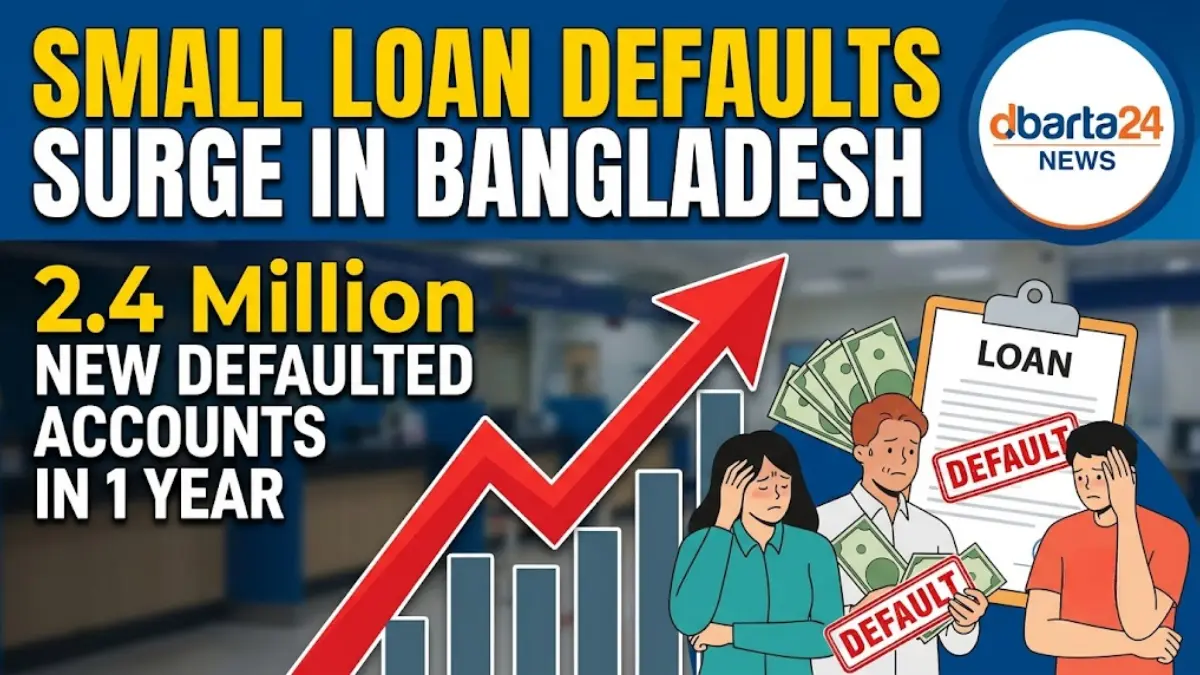
Md. Tareq; Dbarta24 — A deepening economic crunch in Bangladesh is hitting micro, small, and medium borrowers hard, driving a dramatic spike in defaulted small-scale loans across the banking sector.
According to recent data from Bangladesh Bank, the number of defaulted loan accounts under Tk 1 crore more than doubled in just twelve months.
By the end of March, the count of small defaulted borrowers rose to 4.54 million, up sharply from 2.16 million in the same period last year—marking an addition of over 2.4 million defaulted accounts.
Deteriorating Retail Credit Quality Signal Systemic Stress
While high-value non-performing loans (NPLs) usually account for the lion’s share of financial loss in absolute monetary terms, central bank analysts warn that the rapid rise in defaulted small accounts poses a distinct threat to systemic stability. It indicates a severe deterioration in overall retail credit quality.
The central bank attributes this sharp increase primarily to:
-
Relentless Cost-of-Living Pressures: Rising inflation and household debt burdens.
-
Economic Slowdowns: Sluggish activity across Cottage, Micro, Small, and Medium Enterprises (CMSMEs).
-
Diminished Debt Servicing Capacity: Reduced earning power in the agriculture and small business sectors.
Commenting on the trend, Dr. Masrur Reaz, Chairman of the Policy Exchange Bangladesh, noted that while the rise in small borrower defaults is deeply concerning, it is not unexpected given the prolonged economic stress, inflation, and rising energy and utility costs impacting both salaried workers and small business owners.
CMSME and Agricultural Sectors Under Heavy Strain
By the end of March, total bank disbursements stood at Tk 17.83 trillion, with an overall default rate of 32.7%.
Small loan disbursements under Tk 1 crore totaled approximately Tk 4.10 trillion. Although the default rate by total amount in this bracket stands at 15%, the exponential jump in individual defaulted borrowers reveals widespread distress at the grassroots level.
Sector-Wise Breakdown of Defaults:
-
CMSME Sector: Over 34% of total loans are non-performing. Cottage industries are the hardest hit, with a default rate reaching nearly 53%, followed by medium enterprises at roughly 38%.
-
Agriculture, Forestry, and Fisheries: Accounts for over 4% of total banking credit, with default rates climbing to nearly 30%.
-
Construction: Holds nearly 7% of overall credit, recording a default rate near 30%.
-
Trade and Commerce: Dominates total bank credit at 32%, with approximately 44% currently defaulted.
-
Consumer Loans: Represents about 9% of total bank credit, holding a relatively lower default rate of 7%.
Large Borrowers Continue to Hold Massive Default Volume
While small defaulted accounts have surged numerically, large-scale borrowers still account for huge sums of defaulted capital:
| Loan Amount Bracket | Total Default Rate | Key Observations |
| Tk 1 Crore to Tk 10 Crore | > 26.5% | Defaulted borrowers rose from 25,477 to 28,501 in one year. |
| Tk 10 Crore to Tk 20 Crore | 45.0% | Defaulted borrowers nearly doubled from 3,336 to 6,186. |
| Tk 20 Crore to Tk 30 Crore | ~ 36.0% | Defaulted borrowers increased from 1,125 to 1,574. |
| Tk 30 Crore to Tk 40 Crore | ~ 39.0% | Defaulted borrowers rose from 605 to 952. |
| Tk 40 Crore to Tk 50 Crore | ~ 45.0% | Defaulted borrowers grew from 392 to 669. |
| Over Tk 50 Crore | 42.5% | Total balance of Tk 5.76 trillion; defaulted borrowers rose from 1,478 to 2,035. |
Banker Responses and Recovery Initiatives
Commercial banks are intensifying branch-level monitoring and leveraging special central bank policies to restructure distressed accounts.
“Prior waiving of agricultural loans was not compensated by the government earlier, but we have recently received Tk 600 crore for the latest waivers. Currently, 38% of our loans are non-performing. We are activating all branches to make maximum recovery efforts.”
— Mohammad Nurul Amin, Chairman, Bangladesh Krishi Bank
“If S. Alam Group’s loans are excluded, our defaulted loans are lower than the industry average. While the overall sector’s default rate is around 30%, ours remains between 22% and 23%. We are working hard to recover and regularize these accounts.”
— Md. Altaf Hossain, Acting Managing Director, Islami Bank Bangladesh
“Along with large loans, agricultural and SME loans are also deteriorating. That is why monitoring has been stepped up at the branch level, and efforts are underway to regularize these loans under the central bank’s special policy.”
— Md. Mazibur Rahman, Managing Director, Janata Bank
“Out of our Tk 5,500 crore SME portfolio, defaulted loans stand at Tk 93 crore, mostly stemming from the COVID-19 pandemic. Small entrepreneurs face severe distress if timely support isn’t extended, which explains the overall rise in small loan defaults across the sector.”
— Kamrul Mehedi, Deputy Managing Director, City Bank
The rapid accumulation of non-performing accounts among small-scale borrowers signals that economic recovery measures must urgently reach micro-enterprises and retail consumers.
Without targeted policy support and debt-restructuring relief, the strain on small borrowers threatens to further weaken the financial resilience of the country’s broader banking framework.