


Aftab Islam; Dbarta24 – Bangladesh has secured official approval from China to export fresh jackfruit, opening a major international avenue for the nation’s secondary staple fruit.
However, fulfilling the strict phytosanitary and operational conditions set by China’s General Administration of Customs (GACC) poses an immediate structural hurdle.
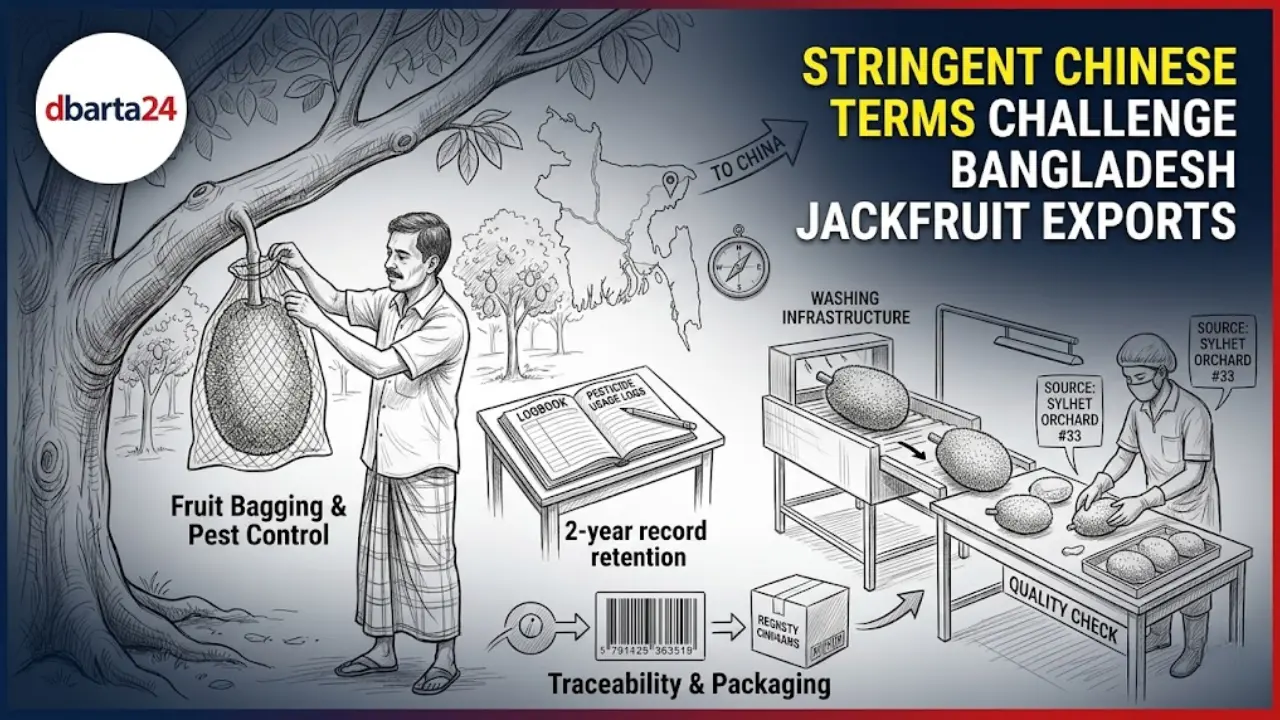
Meeting the import parameters will require nationwide shifts from traditional cultivation to standardized agricultural recording, regulated pest control, specialized packaging, and end-to-end supply chain traceability.
China’s GACC granted export clearance following earlier bilateral diplomatic engagements and a Memorandum of Understanding (MoU) signed between the two nations.
Despite ranking second globally in jackfruit production—yielding over 1.83 million metric tons in FY 2023–24—Bangladesh exported a mere 2,081 metric tons during that period, compared to India’s 26,660 metric tons.
While domestic harvests currently supply European markets through conventional setups, China mandates strictly audited supply chains.
Under the new directive, every exporting orchard and processing facility must adopt Good Agricultural Practices (GAP) and receive dual accreditation from the Bangladeshi government and GACC prior to shipment.
+-------------------------------------------------------------------------------+
|                      KEY CHINA EXPORT REQUIREMENTS                            |
+------------------------------------+------------------------------------------+
| Good Agricultural Practices (GAP)  | Mandatory registration of farms & packing|
|                                    | houses with Bangladesh govt & GACC  |
+------------------------------------+------------------------------------------+
| Chemical Usage Logs                | 2-year log retention of all pesticide,   |
|                                    | chemical, and application dates     |
+------------------------------------+------------------------------------------+
| Fruit Bagging & Pest Control       | Early-stage bagging to prevent fruit     |
|                                    | flies, mealybugs, and scale insects  |
+------------------------------------+------------------------------------------+
| Traceability & Packaging           | ISPM 15 compliance; cartons labeled with |
|                                    | farm ID, packing house, and region  |
+------------------------------------+------------------------------------------+
The regulations dictate that orchards maintain verifiable records of all chemical applications, active pesticide ingredients, and dosage dates for a minimum of two years.
Additionally, growers must perform early-stage fruit bagging to guard against fruit flies, mealybugs, and scale insects.
At the processing level, specialized packing houses equipped with pest-resistant netting, sorting systems, and washing infrastructure must handle the produce to eliminate trace soil, decay, or plant residues before export.
Experts stress that transforming traditional farming methods will require dedicated pilot zones and contract farming models. Abu Noman Faruq Ahmmed, Professor at Sher-e-Bangla Agricultural University, remarked:
“The government can establish a separate production system for exportable jackfruits through pilot programs in specific regions and orchards. Establishing traceability across thousands of smallholders is challenging, so starting with contract farming, assigned registration numbers, and targeted training for farmers and quarantine officers is key.”
Agricultural Economist Dr. Jahangir Alam noted that while GAP compliance will increase production costs—requiring capital for bagging, labor, safe pesticides, and sorting—it creates an opportunity to establish modern agricultural export infrastructure that could later support guava and mango exports.
Addressing these preparedness gaps, Agriculture Secretary Dr. Mohammad Emdad Ullah Mian affirmed that the government plans to select priority farming zones, register export-ready orchards, train growers, and enforce strict monitoring alongside private sector partners to capitalize on the Chinese market.