


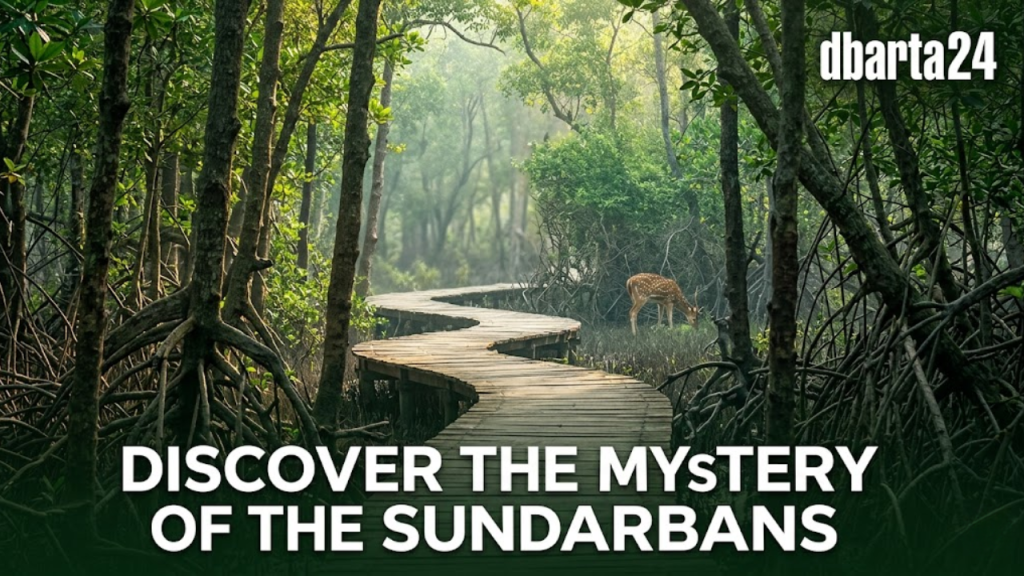
Khairul Alam ; Special Report –The Majesty of the Mangrove . The Sundarban is not merely a forest; it is a sprawling, living museum of biodiversity and the largest mangrove ecosystem on the planet.
Covering roughly 10,000 square kilometers, with a commanding 6,017 square kilometers situated within Bangladesh, this natural wonder was rightfully designated a UNESCO World Heritage Site in 1997. 

Named after the resilient “Sundari” tree, the forest is a labyrinth of 1,874 square kilometers of winding rivers and tidal canals.
For the adventurous soul, the Sundarban offers a rare glimpse into an untouched wilderness. It serves as the final stronghold of the majestic Royal Bengal Tiger and a sanctuary for spotted deer (Chitra), saltwater crocodiles, and over 270 species of birds.
From its 350+ plant species to the elusive reptiles that glide through its brackish waters, the forest presents an evocative landscape that defines the spirit of wild Bangladesh.
Seasonal Timing: When to Visit
To experience the Sundarban in its full glory, plan your expedition between November and February. This winter window is the “golden period” for tourism; the rivers and the Bay of Bengal remain calm, ensuring safe navigation for vessels into the deep forest. During these months, the weather is pleasantly cool, making the long treks through the mangroves much more comfortable.
Iconic Tourist Spots and Landmarks
- Karamjal: Located nearest to Mongla, this is a vital deer and crocodile breeding center. If your schedule doesn’t permit a deep-forest trek, Karamjal serves to “satisfy the craving”—offering wooden trails and close encounters with monkeys and deer.
- Harbaria: Situated 20 km from Mongla, Harbaria is famous for its shiver-inducing wooden trail that winds through dense thickets. The 30-minute walk leads to a serene lotus pond and a watchtower offering panoramic vistas of the emerald canopy.
- Katka & Katka Beach: A sanctuary for photographers, Katka is arguably the best place to spot herds of spotted deer grazing near the Keora trees. A short 15-minute walk leads to the pristine Katka Beach, where the shoreline is often decorated with the intricate “art” of thousands of red crabs.
- Jamtola Beach: Accessible via a 3-km hike from the Jamtola ghat, this area is known for its raw, untouched beauty. The observation tower here is a prime spot for those hoping to catch a glimpse of a Royal Bengal Tiger or wild boars.
- Hiron Point (Nilkamal): A favorite for deep-forest explorers, Hiron Point features elevated wooden paths where you can observe monkeys, monitor lizards, and crocodiles basking in the sun.
- Dublar Char: An island of cultural and economic significance. From October to February, it transforms into a massive hub for the dried fish (Shutki) industry, hosting a temporary settlement of nearly 10,000 fishermen. It is also the site of the sacred Hindu Rash Mela festival.
- Mandarbari Beach: Located in the Satkhira range, this “undiscovered” gem offers stunning, unobstructed views of both sunrise and sunset over the Bay of Bengal.
Logistics: How to Reach the Sundarban
Khulna and Mongla are the essential gateways. The completion of the Padma Bridge has been a total game-changer, slashing travel time from Dhaka to roughly 5 hours by road.
From Dhaka to Khulna/Mongla
For those heading to Mongla directly, specialized “Semi-Chair Coach” buses such as Comfort Line, Diganta, Rajdhani, and Arman offer direct service for 450–500 BDT.
| Transport Mode | Route/Name | Price Range (BDT) |
| Bus (Non-AC) | Dhaka to Khulna | 650 – 750 |
| Bus (AC) | Dhaka to Khulna | 800 – 1,400 |
| Train | Sundarban Express (08:00 AM) | 445 – 2,385 |
| Train | Chitra Express (07:30 PM) | 445 – 2,385 |
| Train | Jahanabad Express (08:00 PM) | 445 – 2,385 |
Pro-Tip: If taking a Khulna-bound bus but heading to Mongla, get off at Katakhali Junction. From there, a 26km ride via Mahindra, CNG, or motorcycle will get you to the Mongla port.
Travel Packages and Costs
Navigating the forest independently is complex due to strict permit requirements. Most travelers opt for tour operators who handle logistics, food, and armed security. Standard industry packages typically run for 2 nights/3 days or 3 nights/4 days.
Package Pricing
- Standard Ship: 6,000 – 14,000 BDT per person.
- Luxury Cruise Ship: 15,000 – 25,000 BDT per person (inclusive of AC cabins and gourmet meals).
Official Entrance Fees
If managing your own entry, be prepared for the following daily rates:
| Category | Sanctuary Area | Non-Sanctuary Area |
| Local Tourists | 150 BDT | 70 BDT |
| Students | 30 BDT | 20 BDT |
| Foreign Tourists | 1,500 BDT | 1,000 BDT |
| Researchers | N/A | 40 BDT |
Critical Fee Notes:

- Karamjal Entry: 46 BDT (Local) / 575 BDT (Foreign).
- Harbaria Entry: Specifically 172 BDT per person.
- Rash Purnima (Pilgrims): 50 BDT (3-day pass); Trawlers 200–800 BDT.
Mandatory Additional Fees
| Fee Type | Cost (BDT) |
| Guide Fee | 500 per day |
| Armed Security Guard | 300 per day |
| Launch Crew Fee | 70 per person |
| Telecommunication Fee | 200 |
| Video Camera (Local) | 200 |
| Video Camera (Foreign) | 300 |
Budget & Day Trip Options
For a low-cost “Day Tour” from Mongla, you can explore the forest’s edge. Strategic Advice: If you wish to visit both Karamjal and Harbaria in a single day, you must depart from the Mongla ferry ghat very early in the morning.
- Boat Rental (Karamjal): 1,000 – 1,500 BDT.
- Boat Rental (Karamjal + Harbaria): 3,500 – 5,000 BDT (Negotiable).
- Estimated Total Budget: 2,500 – 3,000 BDT per person (for a group starting from Dhaka).

Accommodation: Where to Stay
- On-board: The most immersive experience; you sleep in cabins on the ship while anchored in the middle of forest rivers.
- Forest Rest Houses: The Forest Department operates basic rest houses at Kachikhali, Hiron Point, and Katka (requires advance booking).
- Eco-Resorts: Several modern, eco-friendly resorts have emerged near Mongla, perfect for those who want nature without sacrificing comfort.
- City Hotels: In Khulna, Hotel Royal, Castle Salam, and City Inn are top-tier choices. In Mongla, the Parjatan Corporation Hotel is the most reliable option.
Essential Travel Tips and Safety Guidelines
- Pro-Tip: Connectivity: Most mobile networks fail in the deep forest. Teletalk is often the only provider with any signal; carry a Teletalk SIM for emergencies.
- Safety First: Never wander away from your group. In the deep forest, always ensure you are accompanied by armed forest guards.
- Health: Bring a personal first-aid kit and all necessary medications. Drink only bottled or filtered water provided by your ship.
- Documentation: Always carry multiple photocopies of your National ID (NID) for forest department permissions.
- Eco-Responsibility: The Sundarban is a fragile ecosystem. Do not litter, keep noise levels low, and strictly avoid harming any flora or fauna.
- Supplies: Buy all snacks, toiletries, and essentials in Khulna or Mongla before boarding your vessel.