


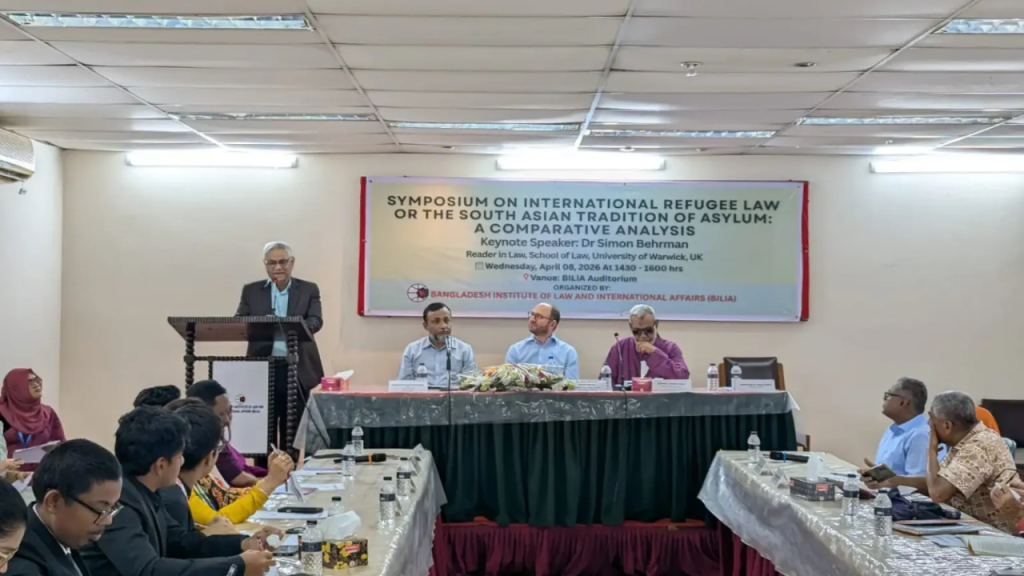
Special Correspondent ; Dhaka — The Bangladesh Institute of Law and International Affairs (BILIA) organized a symposium titled “International Refugee Law or the South Asian Tradition of Asylum: A Comparative Analysis” on Wednesday at the BILIA Auditorium in Dhanmondi, Dhaka.
The event brought together distinguished diplomats, academics, researchers, civil society representatives, and university students to discuss the evolving challenges and moral foundations of refugee protection in the contemporary world.
The symposium featured Dr. Simon Behrman, Reader in Law at the University of Warwick, as the keynote speaker. A recognized authority on asylum and refugee law, Dr. Behrman addressed the complexities of the global refugee protection regime and highlighted emerging challenges posed by climate-induced displacement.
In his keynote address, Dr. Behrman provided a comprehensive analysis of international refugee law and examined how South Asia’s longstanding traditions of asylum and hospitality have historically shaped responses to displaced populations.
He also reflected on the legal, political, and humanitarian challenges currently confronting refugee governance in the region
Welcoming the participants, Ambassador M. Maroof Zaman, Director of BILIA, emphasized the importance of examining refugee protection through both legal and moral lenses. In his remarks, he noted that modern refugee law—shaped largely by the post–Second World War international order and the 1951 Refugee Convention—represents a rules-based system of rights and state obligations.
In contrast, the South Asian tradition of asylum reflects a longstanding civilizational ethos grounded in humanitarian values, cultural norms, and moral responsibility.


Reflecting on Bangladesh’s experience, he noted that the country’s own history—particularly the mass displacement during the Bangladesh Liberation War—has shaped its humanitarian outlook. According to the latest data from the United Nations High Commissioner for Refugees (UNHCR), approximately 1.3 million Rohingya refugees are currently residing in Bangladesh.
This number has gradually increased, as they have been continuously seeking refuge in the country over an extended period including the Kutupalong Refugee Camp, the largest refugee settlement in the world.
Despite not being a signatory to the 1951 Refugee Convention, Bangladesh has extended protection to the Rohingya population on humanitarian grounds.
Ambassador Zaman observed that the global refugee protection system is currently under increasing pressure. Rising nationalism and populism in many parts of the world have reframed migration as a matter of sovereignty and identity, leading to more restrictive asylum policies and the securitization of refugee movements.
He also pointed to the growing tendency of externalizing asylum responsibilities and the emergence of selective humanitarian responses influenced by geopolitical considerations.
Ambassador Zaman further highlighted that Bangladesh itself faces significant vulnerabilities due to climate change, including rising sea levels and environmental degradation, which are increasingly contributing to displacement within the country and the wider region.
He underscored that while legal frameworks are essential for refugee protection, they must be complemented by compassion, political will, and shared global responsibility.
Also present at the seminar were Ambassador Abdullah Al Hasan, Vice Chairman of BILIA; Ambassador M. Zameer; and Ambassador Majeda Rafique Nessa. Distinguished members of various civil society organizations from across the country also participated in the event.

The symposium was attended by respected faculty members from different universities as well as students from various academic institutions. Their active participation and thoughtful contributions enriched the discussion and fostered a vibrant exchange of ideas.
The programme concluded with remarks by Dr. Muhammad Ekramul Haque, Honorary Secretary of BILIA and Dean of the Faculty of Law at the University of Dhaka, who emphasized the importance of continued dialogue and research on refugee protection in the South Asian context.