


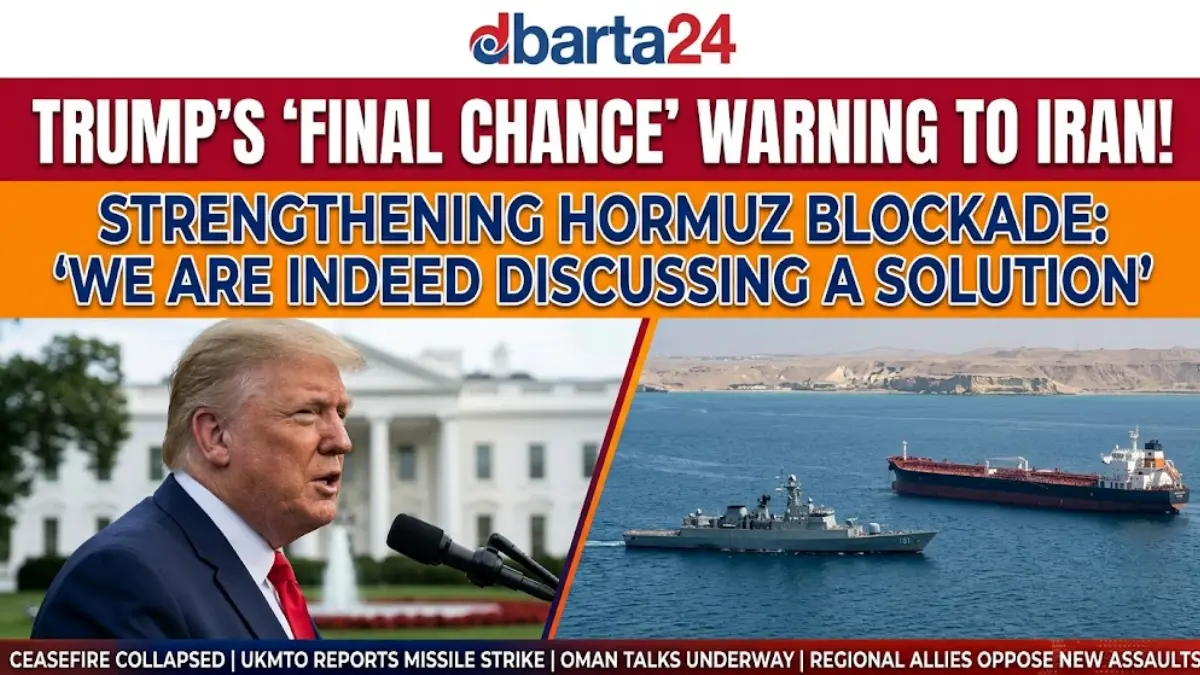
Dbarta24 International Desk — U.S. President Donald Trump has issued a stern ultimatum to Iran, calling ongoing diplomatic efforts a “final chance” to strike a deal before facing catastrophic military consequences.
Despite Tehran’s explicit denial of direct talks, Trump asserted that discussions are underway following requests from regional allies, including Saudi Arabia, the United Arab Emirates, and Qatar.
The warning comes more than five months after a joint U.S.-Israeli strike on Iranian targets on February 28 ignited an ongoing conflict, leaving key maritime choke points unstable and regional diplomacy on edge.
“This is their last chance to sign a good deal,” President Trump told reporters at the White House. “I want to give them one last opportunity before things turn extremely bad.”
Nuclear Demands and Maritime Standoff
According to Washington, the dialogue centers on two non-negotiable points: the immediate reopening of the Strait of Hormuz and the verifiable nuclear disarmament of Iran.
President Trump maintained that a naval blockade remains active around Iranian ports, warning that nothing will reach the country without a signed agreement or full surrender.
“Whether Iran admits it or not, we are indeed negotiating a solution to this crisis they created years ago,” Trump posted on social media. “Of course, Iranian nuclear disarmament must be ensured.”
Tehran, however, firmly rejected Washington’s claims of direct bilateral negotiations. Spokesperson Esmaeil Baghaei confirmed that Iran is instead negotiating with neighboring Oman to establish maritime safety mechanisms in the Strait of Hormuz rather than dealing directly with the United States.
“We are discussing with Oman to ensure the safe passage of ships through the Strait of Hormuz,” Baghaei stated in an interview with Iranian state television. “We are reaching an agreement acceptable to both sides, respecting sovereign rights, national interests, and security. However, even with an agreement, immediate reopening of the strait is unlikely.”
Escalation Danger in the Strait
The Strait of Hormuz remains a central friction point after a previous ceasefire collapsed.
Iran has tightened its transit restrictions, forcing commercial vessels to navigate closer to its coastline while attempting to levy transit fees—a move rejected by Washington and international maritime authorities.
Underscoring the danger, the UK Maritime Trade Operations (UKMTO) reported that a commercial cargo vessel was struck by an unidentified missile off the coast of Oman early Tuesday morning.
Investigations into the incident and damage assessments are currently underway.
Despite Tehran retaining significant missile and drone capabilities alongside stockpiles of enriched uranium, Western allies continue to press for a peaceful resolution.
President Trump noted aboard Air Force One that regional allies had urged him to hold off on launching fresh strikes, which he claimed would otherwise mark the largest military assault since World War II.