


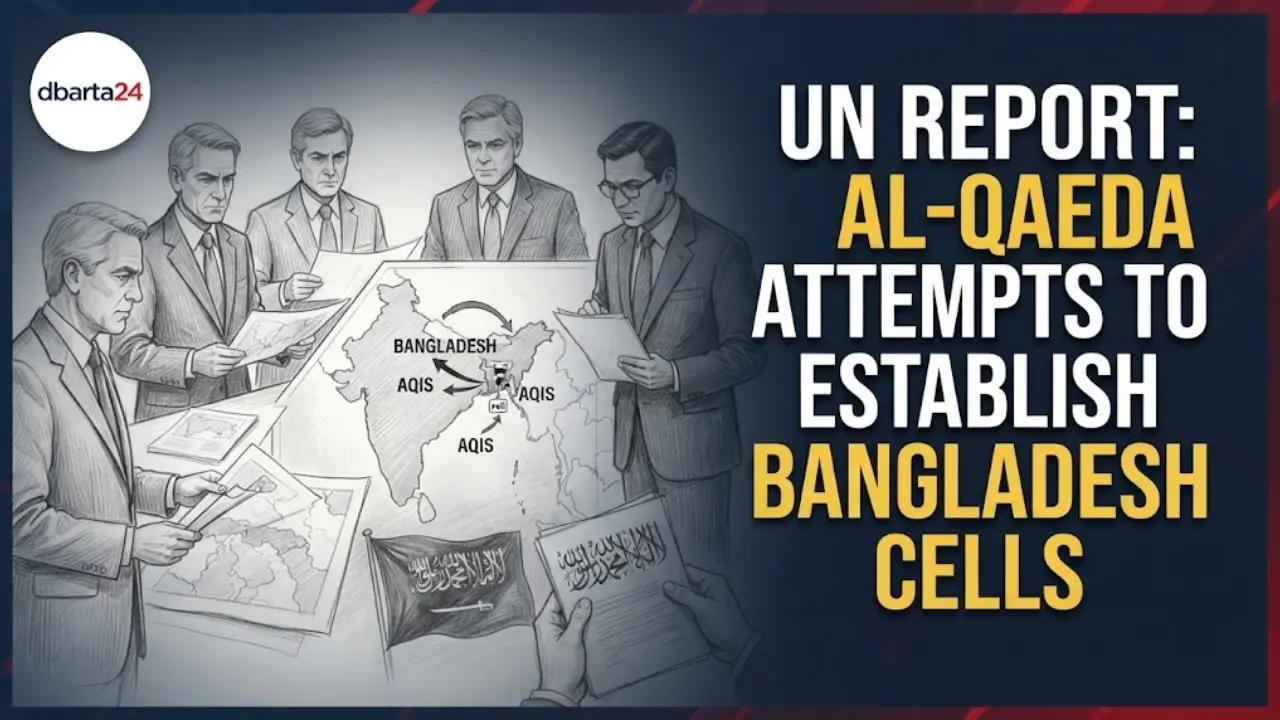
UN monitoring team warns that AQIS is shifting to a decentralized model, increasing security risks across South Asia.
By Staff Correspondent
A new report from the United Nations Security Council has sounded an alarm regarding the evolving threat landscape in South Asia, specifically highlighting attempts by Al-Qaeda in the Indian Subcontinent (AQIS) to establish operational cells within Bangladesh.
The findings were detailed in the 38th report of the Analytical Support and Sanctions Monitoring Team concerning ISIL (Da’esh) and Al-Qaeda, released on Monday, August 10.
The comprehensive report assesses the global security situation from December 16, 2025, to June 9, 2026.
A Shift to Decentralized Terrorism
According to the UN report, AQIS is undergoing a dangerous transformation. Transitioning from a fragmented group into a more cohesive regional terrorist organization, the group is now favoring a decentralized strategy.
Rather than maintaining large, vulnerable organizational units, AQIS is increasingly operating through small, isolated, and autonomous cells while simultaneously strengthening its logistical and financial networks.
Member states highlighted this development in the context of recent regional instability, including the November 2025 attack on the Red Fort in Delhi, for which the organization was officially held responsible.
The report warns that this shift toward smaller, covert units in neighboring countries—including Bangladesh—poses a complex challenge for counter-terrorism agencies.
Regional Instability and Border Tensions
The report underscores that while the overall threat from Al-Qaeda and ISIS remains relatively static on a global scale, the risks have intensified significantly in the Sahel region and South Asia.
Tensions remain high along the Pakistan-Afghanistan border, primarily driven by the surge in attacks by Tehrik-i-Taliban Pakistan (TTP).
Despite the Taliban authorities in Afghanistan publicly denying the presence of TTP, the UN monitoring team notes that logistical and material support for these militants continues.
The report specifically cited the devastating May 9 attack in Bannu, Khyber Pakhtunkhwa, where a suicide bombing and vehicle-borne explosive attack claimed the lives of 21 people.
Growing Capabilities of Militant Groups
The UN assessment also draws attention to the persistent threat emanating from Afghanistan, where numerous terrorist factions remain active.
Despite efforts by the Taliban to counter the Islamic State Khorasan Province (ISIL-K), the group has managed to reorganize and intensify its operations in Pakistan.
Alarmingly, member states reported that ISIL-K is increasingly utilizing modern military equipment, including drones, night-vision devices, and thermal imagers, bolstered by training in urban warfare.
Furthermore, the report reveals that Al-Qaeda’s media arm, As-Sahab, openly expressed support for the Taliban and—for the first time—the TTP’s anti-Pakistan operations on April 28.
Intelligence from member states also suggests that Al-Qaeda trainers have been providing instruction to members of both the TTP and the Balochistan Liberation Army (BLA).
As extremist groups continue to exploit regional vulnerabilities, the UN report serves as a stark reminder of the evolving nature of global terrorism.
By pivoting to decentralized, smaller cells and leveraging modern technology, organizations like AQIS and ISIL-K are diversifying their tactics, requiring heightened vigilance and robust international cooperation to maintain stability in South Asia and beyond.