


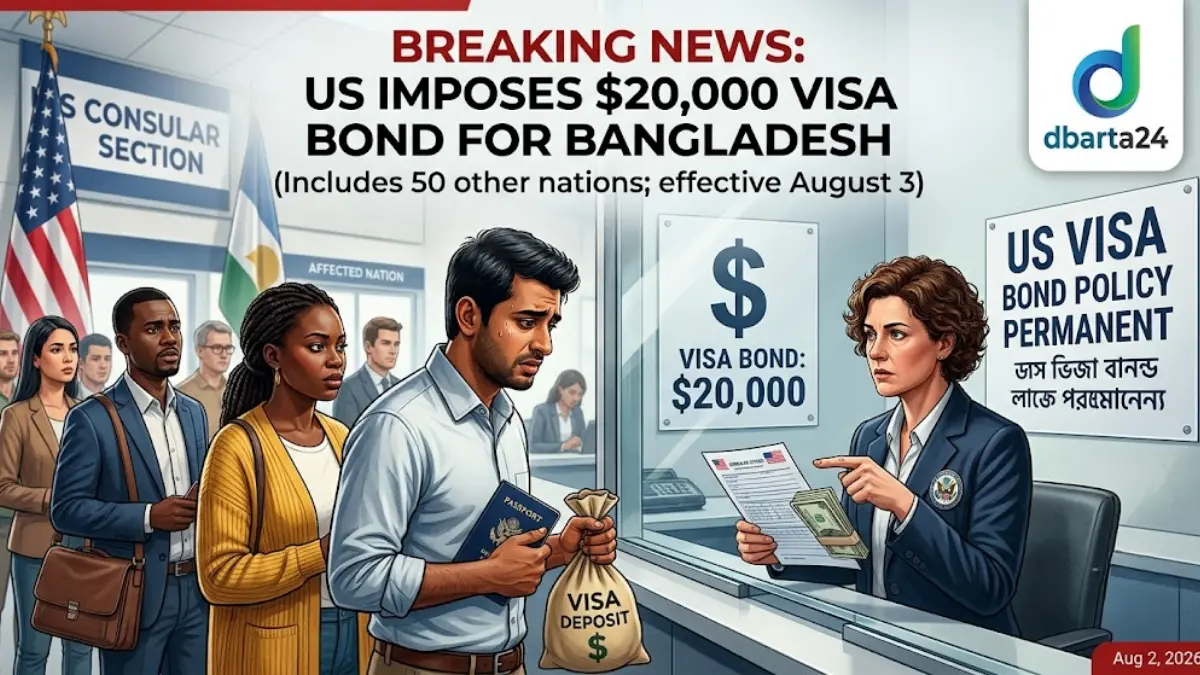
Diplomatic Correspondent; Dbarta24 – In a major overhaul of its immigration screening protocols, the United States State Department is permanently implementing a mandatory visa bond system requiring citizens from 50 countries—including Bangladesh—to deposit up to $20,000 (approximately 24 lakh BDT) to secure business or tourist visas.
Published officially via the Federal Register, the new policy takes effect on August 3, 2026. The sweeping mandate targets countries flagged for high rates of visa overstays and spans several regions, notably including South Asian nations like Bangladesh, Nepal, and Bhutan, alongside 30 African countries.
From Pilot Project to Permanent Mandate
The permanent policy builds upon a previous pilot program that allowed consular officers discretion to require bonds ranging from $5,000 to $15,000.
Under the finalized framework, the lower $5,000 threshold has been eliminated entirely, and the maximum financial penalty/deposit ceiling has been scaled up to $20,000.
According to State Department briefs, data compiled from the pilot initiative demonstrated that financial bonds serve as an effective mechanism to ensure compliance with temporary legal stays.
US administrative officials maintain that the strict measure is vital to curbing the growing trend of travelers remaining in the country past their authorized expiration dates.
Regional Impact and Affected Nations
The directive heavily impacts developing nations across multiple continents. Alongside Bangladesh, the 50-country roster features Algeria, Angola, Antigua and Barbuda, Benin, Bhutan, Botswana, Burundi, Cabo Verde, Cambodia, the Central African Republic, Côte d’Ivoire, Cuba, Djibouti, Dominica, Ethiopia, Fiji, Gabon, The Gambia, Georgia, Grenada, Guinea, Guinea-Bissau, the Kyrgyz Republic, Lesotho, Malawi, Mauritania, Mauritius, Mongolia, Mozambique, Namibia, Nepal, Nicaragua, Nigeria, Papua New Guinea, São Tomé and Príncipe, Senegal, Seychelles, Tajikistan, Tanzania, Togo, Tonga, Tunisia, Turkmenistan, Tuvalu, Uganda, Vanuatu, Venezuela, Zambia, and Zimbabwe.
Intensifying Debate and Legal Backlash
The rollout has drawn swift condemnation from human rights advocates and immigration attorneys, who argue that imposing such an exorbitant financial barrier severely penalizes legitimate travelers and prospective tourists.
Critics contend that the policy will price ordinary citizens out of valid travel opportunities and could introduce systemic vulnerabilities like racial profiling against specific nationalities under President Donald Trump’s broader restrictive immigration agenda.
Conversely, the Trump administration has robustly defended the move, framing it as an indispensable step toward fortifying national security and establishing tighter control over illegal immigration channels.
Observers point out that this bond requirement is part of a wider tightening of legal entry pathways into the United States, which has recently seen escalating visa application fees and rigorous social media vetting procedures implemented across various visa categories.
As the policy goes live, travelers and legal experts alike are watching closely to see how drastically application volumes shift in the affected nations.