


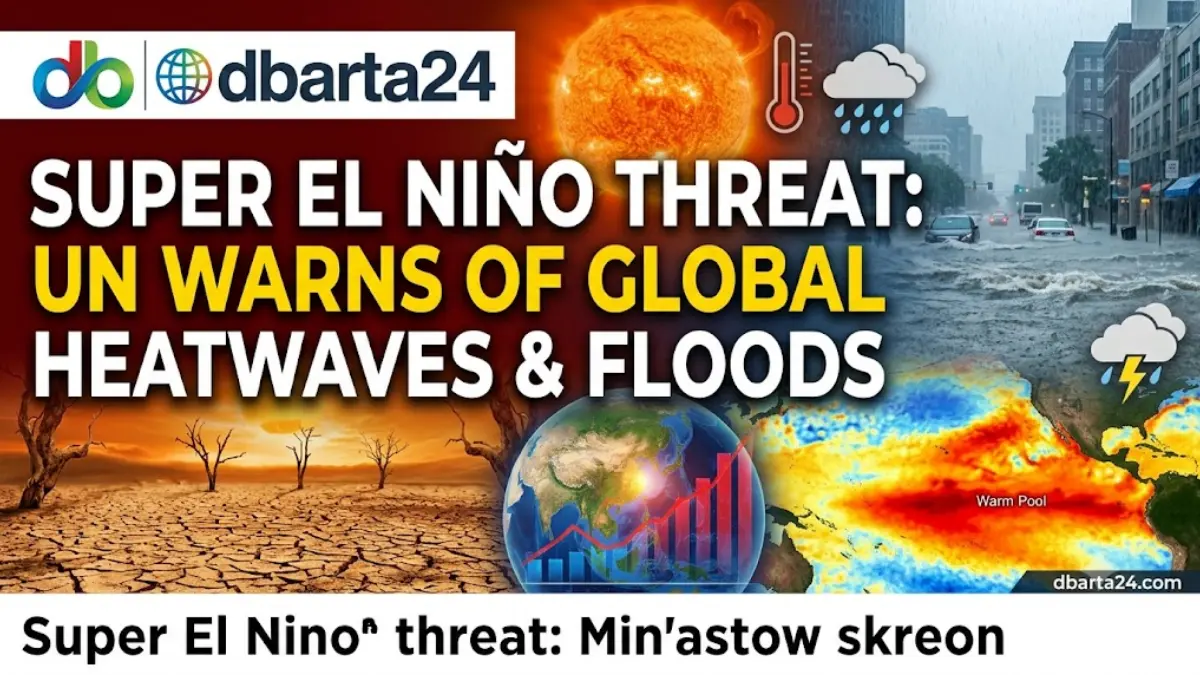
Khairul Alam; Dbarta24— The World Meteorological Organization (WMO) has issued a severe warning regarding a potential “Super El Nino” rapidly intensifying across the Pacific Ocean.
The UN agency cautioned that the phenomenon is far more than an isolated climate event, as it threatens to spark extreme heatwaves, prolonged droughts, torrential rain, and devastating floods globally over the coming years.
Beyond its immediate environmental toll, the impending atmospheric disruption poses a direct risk to global agricultural yields, food security, energy markets, inflation rates, and overall economic stability.
Surging Pacific Ocean Temperatures
According to the latest update published by the WMO, sea surface temperatures in the central Pacific Ocean could rise up to 2.9°C above normal levels.
This dramatic increase is expected to cause major shifts in global atmospheric circulation patterns, driving temperatures across most landmasses well above seasonal averages.
The WMO identified Africa, Southern Europe, the Indian subcontinent, East Asia, and South America as regions facing the highest risk of severe heatwaves.
Simultaneously, several parts of the world are bracing for long spells of drought alongside localized heavy rainfall and sudden flooding.
“El Nino is no longer just at our doorstep; it has already entered our home and is pushing temperatures higher,” warned UN Secretary-General António Guterres. “It is growing stronger and making an already overheated Earth even hotter.”
Guterres urged nations around the world to execute swift, aggressive climate actions.
Echoing these concerns, WMO Secretary-General Celeste Saulo emphasized that early warnings alone are insufficient.
“While we closely monitor the trajectory of El Nino, early warnings are not enough,” Saulo stated. “To protect vulnerable communities, governments and humanitarian agencies must take rapid, effective action based on these forecasts.”
Implies Unpredictable Climate Dynamics for Bangladesh
The warning holds critical implications for Bangladesh, where agriculture, food systems, water resources, and the rural economy remain heavily reliant on seasonal monsoons and international commodity markets.
Climate scientists emphasize that El Nino does not simply mean drought for Bangladesh.
Instead, the complex interplay between Bay of Bengal ocean temperatures, Indian Ocean climate shifts, and seasonal monsoons means the same El Nino event can cause prolonged dry spells in one region while triggering heavy rains and flash floods in another.
Historically, strong Eastern Pacific El Nino (EPE) events—such as those in 1982–83, 1991–92, and 1997–98—brought severe drought conditions to parts of Bangladesh.
Conversely, Central Pacific El Nino (CPE, or Modoki) events in 2015–16 and 2023–24 resulted in higher-than-average rainfall and sudden flood events.
Dr. Rashed Chowdhury, a climate scientist at Arizona State University, noted that while current ocean temperatures reflect Eastern Pacific characteristics, atmospheric reactions are showing Modoki features.
This explains why Bangladesh has experienced higher rainfall than normal so far this season.
“If El Nino reaches its peak intensity toward the end of the year, its impact on the current monsoon rain might remain relatively low,” Dr. Chowdhury explained. “Therefore, there is no immediate reason to fear a severe drought like that of 1997–98. However, we must strengthen our preparations now through efficient water management, early advisory services for farmers, strategic grain reserves, and contingency import plans.”
Threats to Agriculture and Coastal Ecosystems
Expert consensus suggests that the potential Super El Nino could hit Bangladesh’s agricultural sector the hardest.
Cultivation of the primary Aman rice crop depends heavily on monsoon rains; insufficient rainfall delays transplantation, while extended heatwaves strip soil moisture, escalating irrigation needs and production costs.
Dr. Golam Rabbani, Director at the Centre for Climate Change and Environmental Research, highlighted the dual threat facing the region.
“Based on past experience, heatwaves and drought-like conditions may arise in some parts of the country, while intense rainfall over short periods could trigger flash floods in others,” Rabbani warned.
Adding to the agricultural concerns, Rajib Kumar Saha, a researcher at Washington State University and Assistant Director at the Geological Survey of Bangladesh, pointed out coastal risks.
“Extended dry spells and reduced river flows will push salinity further inland along the coast,” Saha observed. “This risks reducing agricultural yields and triggering localized food shortages. Ensuring forecast-based guidance for farmers regarding planting schedules, irrigation, and seed selection is essential.”