


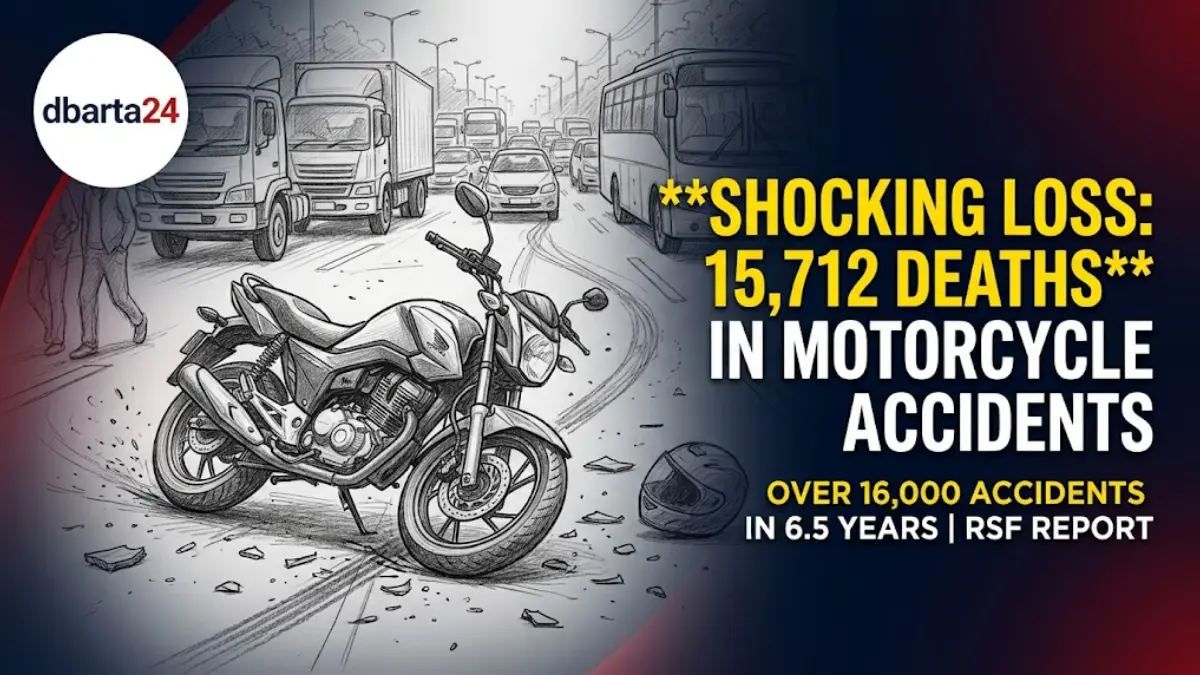
Special Correspondent; Dbarta24 — More than 15,700 people lost their lives and over 14,000 sustained injuries in motorcycle accidents across Bangladesh between January 2020 and July 2026, according to a staggering report released by the Road Safety Foundation (RSF) on Saturday (August 8).
The report recorded 16,065 motorcycle crashes over the six-and-a-half-year period, resulting in 15,712 fatalities and 14,143 injuries. The statistics underscore a alarming surge in two-wheeler crashes across national, regional, and rural thoroughfares.
Breakdown of Crash Dynamics and Responsibility
Analysis of the accidents revealed that the highest share of collisions—39.30% (6,314 crashes)—involved impacts caused by heavy vehicles.
Meanwhile, loss of vehicle control accounted for 34.21% (5,497 crashes), head-on collisions made up 22.08% (3,548 crashes), and other factors contributed to 4.39% (706 crashes).
In terms of primary responsibility, freight vehicles were blamed for 40.34% (6,481 crashes), closely followed by motorcycle riders themselves at 36.29% (5,831 crashes). Buses accounted for 13.47% (2,164 crashes), three-wheelers for 4.55% (732 crashes), and private vehicles—including cars, microbuses, and ambulances—for 2.72% (438 crashes).
Pedestrians and bicycles/rickshaws contributed to 1.84% and 0.76% of incidents, respectively.
Regional roads proved to be the deadliest setting, claiming 41.63% (6,689) of total accidents. National highways accounted for 29.71% (4,773), urban roads 16.47% (2,646), and rural roads 12.18% (1,957).
Youth Vulnerability and Structural Causes
Motorcycles now constitute 71 percent of all registered motor vehicles in Bangladesh. The RSF report highlighted that a significant portion of these vehicles are operated by teenagers and young adults, among whom reckless driving habits have sharply risen.
Furthermore, aggressive marketing and promotional language used by motorcycle manufacturers and distributors were identified as encouraging dangerous speed-seeking behavior.
Observational data from the foundation shows that 58 percent of all victims in motorcycle crashes were aged between 13 and 35. Research cited in the report stresses that motorcycles carry nearly 30 times higher risk than four-wheeled vehicles.
However, severe urban traffic congestion and the absence of reliable, affordable public transit continue to push commuters toward two-wheelers.
Non-standard or missing helmets significantly aggravated casualty figures. Standardized helmets alone can reduce the risk of death in a motorcycle crash by up to 48 percent, the report noted.
The RSF identified key drivers behind the high accident rate, including reckless driving among youths, disregard for traffic regulations, a political culture endorsing unruly bike rallies, lax enforcement of traffic laws, poor road infrastructure, lack of tech surveillance, and inadequate public transport alternatives.
Eight-Point Recommendation Plan
To combat the escalating crisis, the Road Safety Foundation issued an eight-point recommendation:
-
Integration of safety and monitoring technologies on motorcycles.
-
Mandatory enforcement of certified, standard-compliant helmets.
-
Strict execution of traffic laws and enforcement measures.
-
School and college-based awareness campaigns.
-
Social media safety campaigns executed via BTRC.
-
Reform of marketing and promotional strategies by bike manufacturers.
-
Construction and maintenance of safe road infrastructure.
-
Development of accessible, affordable, and passenger-friendly public transportation systems.
The RSF concluded that without combining strict law enforcement with youth-targeted awareness drives and systemic public transit overhauls, reducing motorcycle casualties in Bangladesh will remain an uphill battle.