


M K Alam, Dhaka – In recent years, economic and institutional reforms have become the most discussed policy agenda in Bangladesh. Development partners like the IMF, World Bank, and ADB have long been urging reforms in the banking sector, revenue system, subsidy structures, and state-owned enterprises.
A large section of local economists also agrees with this. The government is trying to reflect these reforms in its budget and policy steps.
However, a harsh reality is emerging. The accumulated cost of long-standing policy weaknesses and financial indiscipline in these sectors is now gradually becoming visible.
This pressure is going to fall heavily on taxpayers, consumers, businessmen, and the national treasury. The measures taken in the upcoming fiscal year 2026-27 budget will partially reflect this reality.
Even if the current IMF program changes, conditions regarding revenue increases, restoring discipline in the banking sector, and rationalizing subsidies will remain in place for any new agreement framework.
“The main objective of reforms is to strengthen the economy in the long run. But there will be short-term pain. The real question is which part of society will bear that pain and how the government will protect vulnerable groups through budgetary measures.”
— Dr. Zahid Hussain, Former Lead Economist, World Bank Dhaka Office


Therefore, the new budget is not just an account of income and expenditure; rather, it is being considered as a roadmap for correcting long-standing economic imbalances. However, economists warn that reforms never come for free.
The state will have to provide additional funds to restructure the banking sector, reducing subsidies will pressure consumers, expanding the tax net will increase taxpayers’ liability, and cutting government spending may impact development activities.
Major Challenges in the New Budget
-
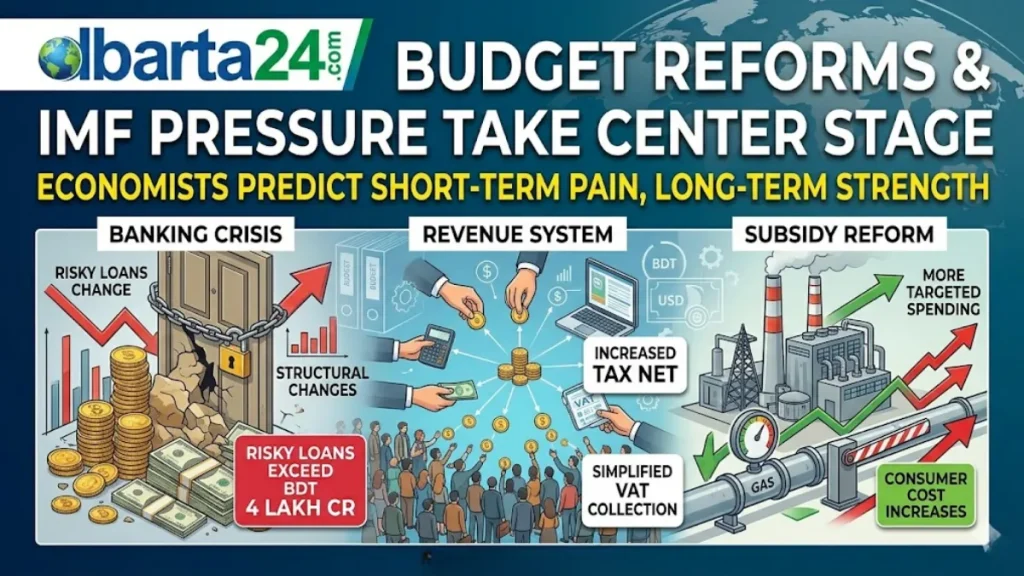
Banking Sector Crisis: The banking sector faces the highest pressure. Defaulted loans have reached nearly BDT 4 lakh crore. If loans stayed by courts and rescheduled loans are added, the amount of risky loans is much higher. The IMF is emphasizing increasing transparency, reducing default loans, restructuring weak banks, and strengthening central bank independence. Over the past 15 years, the government provided around BDT 40,000 crore in capital support to keep state-owned banks afloat. Experts say another BDT 25,000 to 35,000 crore may be needed from public funds to rescue troubled financial institutions.
-
Revenue and Tax Pressure: The country’s tax-to-GDP ratio is still hovering around 7%. Consequently, the IMF and World Bank are pushing to expand the tax net, reduce tax exemptions, and digitalize tax administration. There is also a condition to collect additional revenue equivalent to 0.6% of GDP every year beyond existing revenue. Furthermore, pressure remains to implement a uniform 15% VAT at all levels, which means more individuals and organizations will fall under the tax net.
-
Business Sentiment: Dhaka Chamber of Commerce and Industry (DCCI) President Taskin Ahmed stated that businessmen are not against reforms. However, policy consistency, predictability, and a level playing field must be ensured, or investments could be severely damaged.
-
Subsidy and State Enterprises: Subsidies in electricity, energy, and agriculture have been massive over the years. Development partners are now advising making these expenses more targeted, meaning users must bear a larger portion of the actual cost. This pain will be felt most by middle and lower-middle-class families. Additionally, a World Bank analysis shows that the government spent about BDT 88,200 crore from the public treasury on state-owned enterprises in a single year, posing a major fiscal risk.
The Finance Minister recently remarked in multiple events that long-term economic stability is far more important than short-term popularity. Finance Ministry officials also confirmed that maintaining the continuity of reforms will be a top priority in this year’s budget.