


Ifaz Ehtamad ; Dbarta24 Special Report – Amidst the global observance of World Day Against Trafficking in Persons under the theme “Caught in the Trap of Deception,” a harrowing reality surfaces in Bangladesh.
While criminal syndicates grow increasingly sophisticated by weaponizing digital tools, the country’s judicial system struggles to hold them accountable.
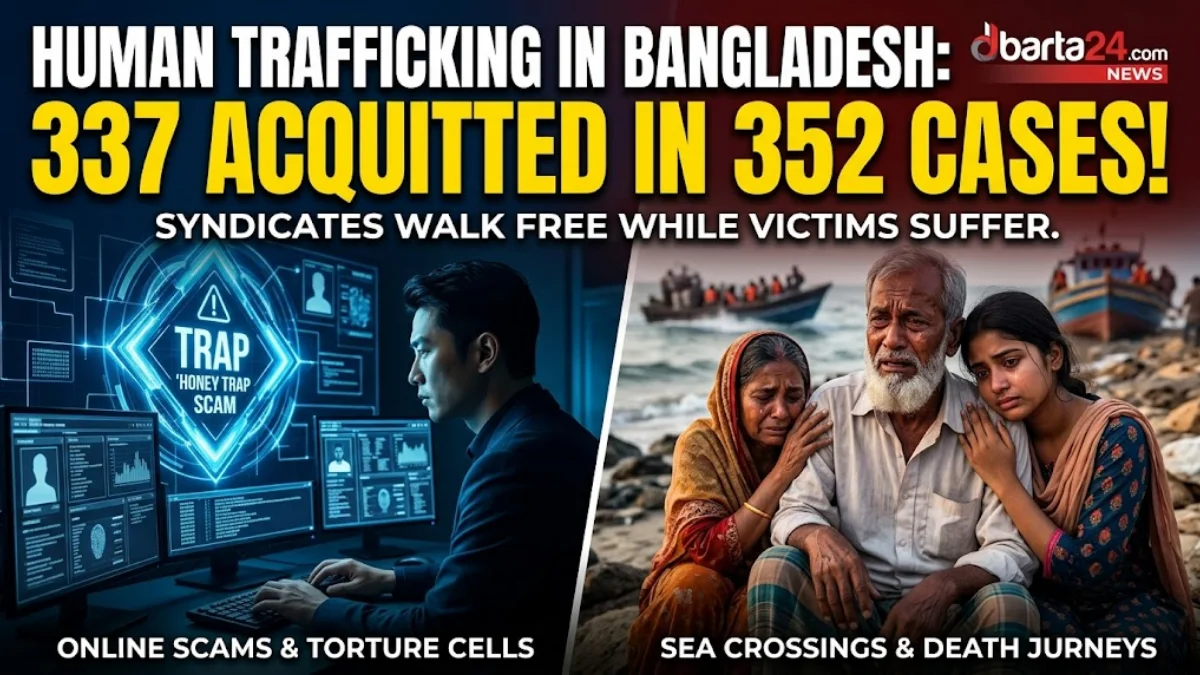
Official data reveals a disturbing trend: over a recent 15-month period (January 2025 to March 2026), 352 human trafficking cases were resolved in court, yet an overwhelming 337 cases ended with the absolute acquittal of all accused.
Only 15 cases yielded convictions for 39 individuals, leaving 1,259 suspects to walk completely free.
From Sweet Talk to “Honey Traps”: The Modus Operandi
The modern face of human trafficking has evolved past traditional border crossing methods. Today, international syndicates deploy artificial intelligence, deepfakes, fraudulent online job postings, and targeted apps to lure tech-savvy youth.
Tanvir Hossain, a computer engineering diploma graduate from Dhaka, fell victim to this digital trap. Promised a high-paying IT job in Cambodia by a close friend, Tanvir arrived in Phnom Penh only to be sold to Chinese nationals running a subterranean online scam center.
“My job was to create fake profiles for ‘honey traps’ to catfish and scam people out of money online,” Tanvir recalled. “When I refused, I was dragged to a torture cell known as the ‘Black Cell’ and brutally beaten.”
Tanvir’s ordeal only ended after a massive Cambodian police crackdown assisted by the US FBI forced the captors into hiding.
After being held in a jungle for three months, his family paid a 300,000 BDT ransom to secure his safe return to Bangladesh in March 2026.
Alarming Statistics and Chronically Low Conviction Rates
The scale of human trafficking in Bangladesh remains massive. According to data from Police Headquarters, between 2018 and May 2026, a total of 6,825 human trafficking cases were filed, implicating 30,295 suspects.
While law enforcement arrested 11,280 individuals and rescued 7,190 victims during this timeframe, the ultimate judicial outcomes remain staggeringly low.
In the first five months of 2026 alone, 500 new cases were recorded, involving 2,334 accused individuals. Yet, despite law enforcement efforts, the structural gap between arrests and actual convictions remains vast.
| Period | Cases Resolved | Convictions (Cases) | Convicted Persons | Acquittals (Cases) | Acquitted Persons |
| Jan – Dec 2025 | 245 | 9 | 28 | 236 | — |
| Jan – Mar 2026 | 107 | 6 | 11 | 101 | — |
| Total (15 Months) | 352 | 15 | 39 | 337 | 1,259 |
Note: While Ministry of Home Affairs data shows 49 convictions across 15 months, non-governmental legal aid organization Justice & Care argues that independent tracking indicates up to 116 individuals received sentences in the same period. Regardless of the discrepancy, both metrics confirm an acquittal rate exceeding 90%.
Why Are Traffickers Walking Free?
Legal experts and top law enforcement officials point to deep systemic issues inside the judicial process.
Khondokar Rafiqul Islam, Additional Inspector General (Crime & Operations) of Police Headquarters, addressed the issue candidly:
“Profiteering rings are actively putting citizens in danger via illegal migration routes. We are making arrests, but the conviction rate is terribly low. In many instances, victims are pressured or lured into out-of-court compromises with the accused. Consequently, they refuse to testify when the case finally goes to trial.”
Dr. Towhidul Haque, Associate Professor and crime expert at Dhaka University, emphasized that the lack of exemplary punishment perpetuates the cycle. “If the legal system cannot ensure strict punishments, altering this status quo is nearly impossible. Alongside strict enforcement, we must raise mass awareness and bring unauthorized recruiting agencies under direct legal accountability,” he stated.
The Tragic Toll of the Sea and Desert
For those who do not end up in Southeast Asian cyber-scam operations, the alternative routes are often fatal.
Traffickers regularly extort families by sending torture videos from detention camps in Libya, or force migrants onto unseaworthy vessels bound for Europe across the Mediterranean.
On March 25, 2026, 18 Bangladeshi migrants drowned in the Mediterranean Sea while trying to reach Italy. Their bodies were never recovered. Among them was Aminur Rahman from Sunamganj.
“My son fell for the ‘sweet talk’ of human brokers and left the country after we paid 1.1 million BDT,” said Aminur’s father, Habibur Rahman, a retired school teacher. “We never even got the chance to see his face one last time.”
This tragedy mirrors the infamous May 2020 Mizdah massacre in Libya, where 26 Bangladeshi migrants were systematically executed in a warehouse by traffickers.
Can the New 2026 Legislation Fix the System?
In response to changing criminal dynamics, the government has enacted the Prevention and Suppression of Human Trafficking and Migrant Smuggling Act, 2026, replacing the older 2012 framework.
The updated legislation explicitly classifies migrant smuggling as a distinct crime, introduces penalties for forced cyber crimes (scamming), criminalizes deceptive digital advertisements, and permits the seizure of crime-linked financial assets.
Crucially, it provides a legal safety net ensuring that victims forced into illegal acts by their captors are not automatically treated as criminals.
Mohammad Tariqul Islam, Country Director of Justice & Care, expressed optimism regarding the statutory overhaul. “Criminal tactics shift with time, and it is promising that the government has modernized the law.
We are hopeful that under the 2026 Act, both investigations and judicial trials for human trafficking and migrant smuggling will be significantly accelerated.”
As of late March 2026, 1,817 cases remain under active investigation while 3,278 cases await trial in various specialized tribunals.
Whether the new legal provisions can successfully convert these pending cases into meaningful convictions remains a critical test for Bangladesh’s justice system.