


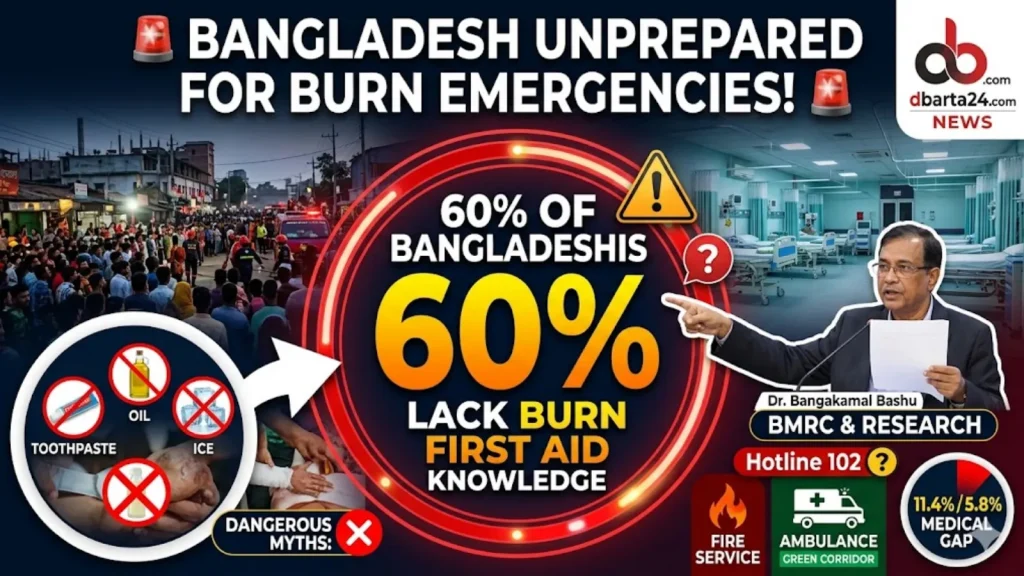
Monir Hossain From Khulna – Approximately 60 percent of people in Bangladesh have no formal training in first aid. Furthermore, over 62 percent of the population is completely unaware of how to safely transport a burn victim.
Instead, harmful traditional practices—such as applying toothpaste, oil, or ice to burns—remain deeply embedded in public perception.
These alarming statistics were revealed in a study titled “Immediate Response and Comprehensive Management After Mass Burn and Multidimensional Trauma Emergencies in Bangladesh.”
The research was conducted by the “CMN-Bashu Health Research Center” in Khulna, with cooperation and supervision from the Bangladesh Medical Research Council (BMRC).
The findings were presented during a press conference held at the Khulna Press Club Conference Hall on Sunday by Professor Dr. Bangakamal Bashu, the principal investigator and program head of the research center.
Key Findings from the Study:
-
62% of people lack awareness regarding the safe transportation of burn victims.
-
Awareness of the Fire Service emergency hotline number ‘102’ is virtually nonexistent among the general public due to a lack of promotional campaigns.
-
High-Risk Data Collection: Data for this mixed-method study was gathered from high-risk industrial zones and major hubs, including the Dhaka and Khulna City Corporations, Mongla, Savar, and Ashulia.
-
Critical Management Gaps: Most respondents demonstrated extremely limited knowledge about immediate actions to prevent airway burns or internationally recognized Advanced Trauma Life Support (ATLS) guidelines, significantly multiplying the risk of mortality in emergencies.
Institutional and Community Unreadiness
The study highlighted a severe disconnect between theoretical, on-paper emergency preparations and actual grassroots community or institutional readiness. Analysts determined that the single largest vulnerability in disaster management is the lack of social capability at the community level, which accounts for 27.2 percent of the overall systemic issue.
Medical capacity is also heavily constrained. The study found that only 11.4 percent of private hospitals and a meager 5.8 percent of the government healthcare system are fully capable of providing emergency medical care for such crises, underscores a glaring deficit in specialized burn and trauma services.
Additionally, a lack of coordination and delayed communication between various rescue agencies frequently disrupts timely patient transfers and critical care.
Urgent Policy Recommendations
To overcome this critical vulnerability, researchers have strongly urged the government to implement a unified Community-Based Burn and Multiple Trauma Disaster Preparedness and Emergency Response (CBPDPER) model.
The primary recommendations include:
-
Mapping local industrial zones to assess and tag nearby hospital capabilities.
-
Establishing a “Green Corridor” on roads to ensure the uninterrupted movement of fire service vehicles and ambulances.
-
Installing fire hydrants at critical urban junctures.
-
Forming CBPDPER coordination committees at city corporation and upazila levels.
-
Strengthening 24-hour emergency units at hospitals and introducing a standard triage system based on injury severity.
-
Making regular first-aid training and fire drills mandatory across schools, colleges, and industrial workplaces.
Given the rapid urbanization and industrialization expanding across Bangladesh, the risks of fires and earthquakes are mounting daily. Researchers concluded that adopting these policy recommendations into national guidelines is no longer optional, but an urgent demand of the times.