


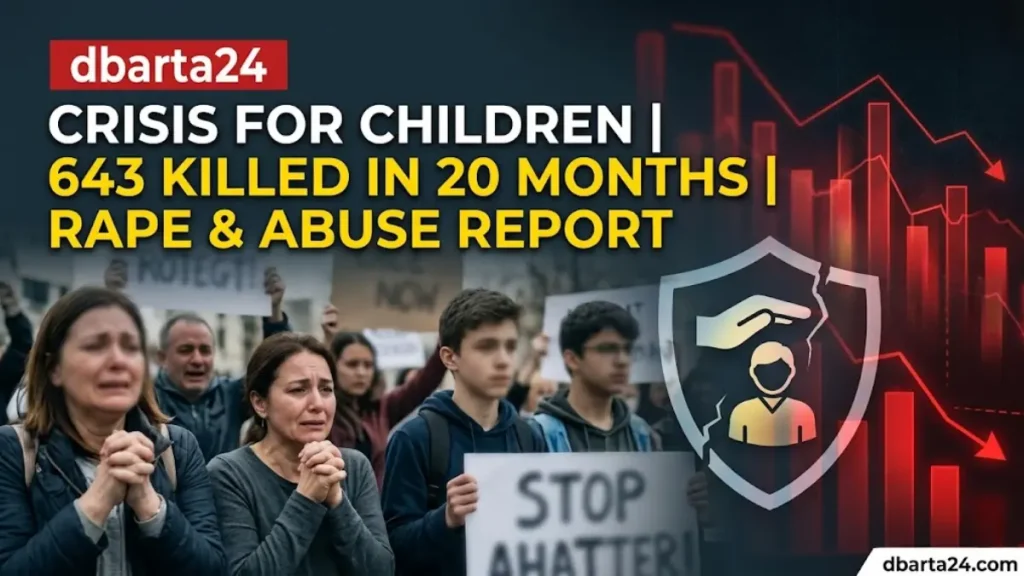
M k Alam ; Dhaka – Child fatalities following horrific instances of rape and torture are on a steep rise in Bangladesh. Statistics reveal that 643 children were killed due to rape and brutal abuse over a 20-month period spanning from September 2024 to April of this year.
This amounts to an alarming average of more than 32 child deaths per month. In the first four months of this year alone, 203 children lost their lives.
Among these, 478 child fatalities were recorded between September (post-August 5, 2024) and January of this year. These terrifying findings were published in a report by the human rights organization, Human Rights Support Society (HRSS).
Over 1,800 Children Abused in 16 Months
According to HRSS data, at least 1,890 children across the country faced various forms of abuse between January 2025 and April 2026. Within this cohort:
-
Physical and Mental Abuse: 1,407 children fell victim to severe physical and psychological trauma.
-
Fatalities: 483 children were killed during or following the abuse.
-
Sexual Violence: 580 children were subjected to rape, while 318 faced sexual harassment and assault.
The gravity of this crisis hit the national spotlight again last Tuesday in the capital’s Pallabi area. Ramisa, a young school student, was brutally murdered after being raped.
Police later recovered her body from the residence of the prime suspect, Sohel, who has since been arrested. The absolute grief, anger, and demands for justice from her parents have shaken the nation.
Further HRSS statistics for the first four months of this year highlight that 519 children were abused. Out of these, 324 experienced physical and mental torture, directly contributing to 195 child deaths in just four months.
Culture of Impunity and Judicial Delays
Experts, human rights activists, and legal professionals state that a lack of exemplary punishment, lengthy judicial processes, poor financial capabilities of marginalized victims to sustain lawsuits, and legal loopholes are fueling the rise of these heinous crimes.
While incidents that go viral on social media receive brief public attention, countless cases hidden in rural or underprivileged areas lie frozen in judicial archives for years.
Even highly publicized cases rarely see speedy justice. For instance, more than a year has passed since the widely discussed rape and murder of a child named Asia in Magura during the tenure of the previous interim government, yet the victim’s family is still waiting for a final verdict.
Alarming Data on Women and Minor Girls
The HRSS report further shows that during the tenure of the former interim government, at least 2,617 women and underage girls faced violence. Among them:
-
Rape Cases: 1,016 females were raped, out of which 550 (54%) were minor children under the age of 18.
-
Gang Rape & Death: 230 individuals fell victim to gang rape, and 33 were murdered post-rape.
-
Suicides: 11 victims committed suicide due to social trauma.
-
Sexual Harassment: 504 women and minor girls faced public harassment, including 270 children.
In April of this year alone, 294 women and girls faced abuse. This includes 68 rapes, where 30 victims (44%) were minors under 18. Additionally, 13 fell victim to gang rape and 79 faced sexual harassment, including 40 young children.
Over 2,300 Child Rapes in 5 Years
Recent statistics from another prominent non-governmental organization, Ain o Salish Kendra (ASK), present an equally grim picture of child safety in Bangladesh. Over the past five full years, a total of 2,339 child rape incidents have been recorded across the country.
The year-wise breakdown reveals:
-
2026 (Till April): 94 cases
-
2025: 456 cases
-
2024: 234 cases
-
2023: 314 cases
-
2022: 561 cases
-
2021: 774 cases
This indicates that between 2021 and 2025, Bangladesh witnessed an average of nearly 449 child rape cases every single year.
Similarly, attempted child rapes have escalated at a terrifying rate. The data shows 34 attempts in 2026 so far, 167 in 2025, 66 in 2024, 85 in 2023, 101 in 2022, and 185 in 2021—averaging about 121 attempted rapes on minors annually.
According to the General Register (GR) branch of the courts, there are currently around 3,000 pending child rape cases across various courts in Dhaka alone.
Until April of this year, at least 214 new cases regarding rape and attempted rape have been filed across 50 police stations in the capital.
What Legal Experts and Authorities Say
Human rights activists emphasize that the repetition of such monstrous acts against children is a direct consequence of a deeply ingrained culture of impunity.
Fahmida Akhter, a lawyer at the One-Stop Crisis Center (OCC) of Dhaka Medical College Hospital, listed key reasons behind the massive case backlog:
“The failure to complete investigations within the legally mandated timeframe is a primary reason. Investigative officers often do not receive medical reports on time. Furthermore, these officers handle regular law enforcement duties alongside handling sensitive rape cases. Additionally, many tribunals are overburdened with human trafficking or general children’s act cases alongside violence against women and children. The biggest obstacle, however, remains the inability to produce witnesses in court on time.”
She expressed hope that like Asia’s case in Magura, the state would expedite judicial proceedings for Ramisa’s murder in Pallabi across both the trial court and the High Court to set an example.
Addressing the legal bottlenecks, Omar Faruk Faruki, the Public Prosecutor (PP) of the Dhaka Metropolitan Sessions Judge Court, remarked:
“To ensure justice, we must follow mandatory legal procedures. Delays primarily occur in two phases: first, late submissions of police reports due to prolonged investigations, and second, securing the physical presence of witnesses. It is often incredibly difficult to bring witnesses to court, and once they are present, extensive cross-examinations and other legal protocols consume significant time.”
Ejazul Islam, Executive Director of HRSS, voiced grave concern, stating that the continuous cycle of child rape and murder proves that the current protective infrastructure for children is highly ineffective.
Responding to the crisis, Home Minister Salahuddin Ahmed stated that the main accused in the sensational Ramisa rape and murder case, Sohel, along with his accomplice wife, were arrested within 24 hours of the incident in Mirpur.
The prime accused has already given a confessional statement under Section 164 of the Code of Criminal Procedure. The minister assured that a thorough investigation would be concluded in the shortest possible timeframe to submit a formal charge sheet to the court.