


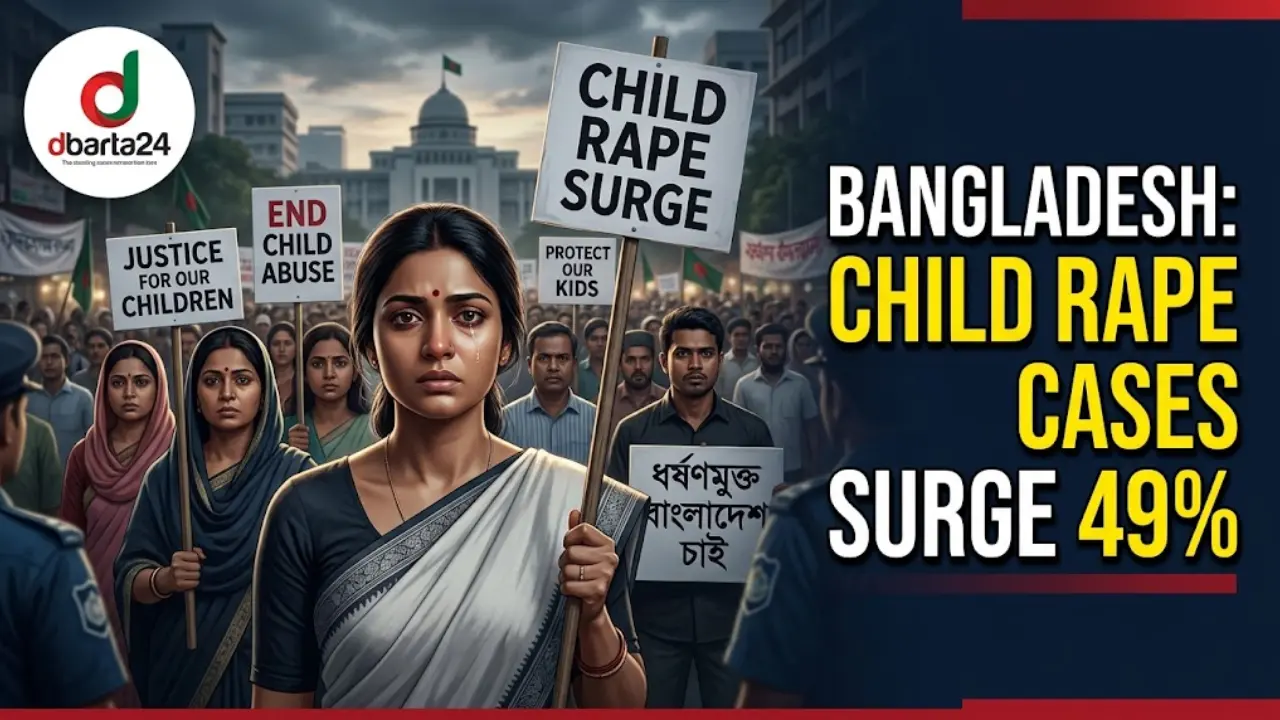
Muyabia Labony; Dbarta24 — Child rape cases in Bangladesh have seen a sharp upward trajectory this year, spiking by nearly 49 percent in the first seven months of 2026 compared to the same period in 2025, according to official data from Police Headquarters.
Statistics reveal that 1,485 child rape cases were registered across the country through July 2026. This marks a dramatic rise from the 998 cases reported during the same window last year, and nearly a 98 percent surge compared to the 751 cases recorded in the first seven months of 2024.
Overall, law enforcement registered 12,446 cases related to violence against women and children in the first seven months of this year, with 4,025 involving rape.
Victims Betrayed by Trusted Figures
Law enforcement officials emphasize that a significant portion of these crimes are committed by individuals known to the victims—including relatives, neighbors, and trusted acquaintances.
“Field-level police experience shows that a large share of child rape incidents are committed by familiar individuals, relatives, neighbors, or trusted persons,” said AHM Shahadat Hossain, Assistant Inspector General (Media) at Police Headquarters. “Many families attempt to hide incidents or delay reporting due to social stigma, fear, or various pressures, which creates major challenges in gathering crucial evidence for investigations.”
Hossain added that authorities are working to conduct testimony in victim-friendly environments, expedite legal proceedings, and coordinate across agencies.
However, he noted that effectively curbing these crimes remains difficult without collective awareness across families, educational institutions, and community organizations.
Local Pressure and Evading Justice: A Case Study
The grim reality of these statistics is illustrated by a recent case in Gafargaon, Mymensingh. An 11-year-old girl was lured to an abandoned site, assaulted, and filmed when she went to a store to break a 100-taka note on her way home from a madrasa.
The perpetrator continuously used the footage to blackmail her until she managed to escape a grab on June 18 and inform her mother.
Despite a case filed on June 19 under Section 9(1) of the Prevention of Oppression Against Women and Children Act 2000, the accused remains at large three months later.
The victim’s family reports living in fear and facing immense pressure from the accused’s relatives to settle the matter locally through an informal arbitration (salish) in exchange for money—an offer the family refused.
Moniruzzaman, Officer-in-Charge of Gafargaon Police Station, confirmed that the suspect fled after abandoning his mobile phone, which has been sent for forensic examination.
He reiterated that rape charges are legally non-negotiable and cannot be settled through village arbitrations.
Legal Backlog and Systemic Challenges
The spike in cases comes amid persistent structural hurdles in Bangladesh’s judicial process. Data from the High Court shows that as of December 31, 2025, a total of 132,107 cases were pending across 99 Women and Children Repression Prevention Tribunals nationwide, with over 30,000 cases lingering for more than five years.
Despite the backlog, swift legal action has occurred in high-profile incidents. Earlier this year, a tribunal sentenced a man and his wife to death just 19 days after the rape and murder of a child in Dhaka’s Pallabi.
In another case from Magura involving the rape and murder of a child by her sister’s father-in-law, the High Court recently upheld the death sentence of the convict.
“Child rape incidents have reached a level of grave public anxiety,” said Professor Muhammad Umar Farooq, Chairman of the Department of Criminology and Police Science at Mawlana Bhashani Science and Technology University. “To send a clear message regarding the consequences of rape, conviction must be ensured through proper prosecution of these cases. Preventing such crimes also requires building a foundation of moral education and respect toward women within families and educational institutions.”
As public outrage grows over the rising tide of violence against children, rights advocates continue to demand faster trial procedures, stricter enforcement, and comprehensive social reform to protect the nation’s youth.