


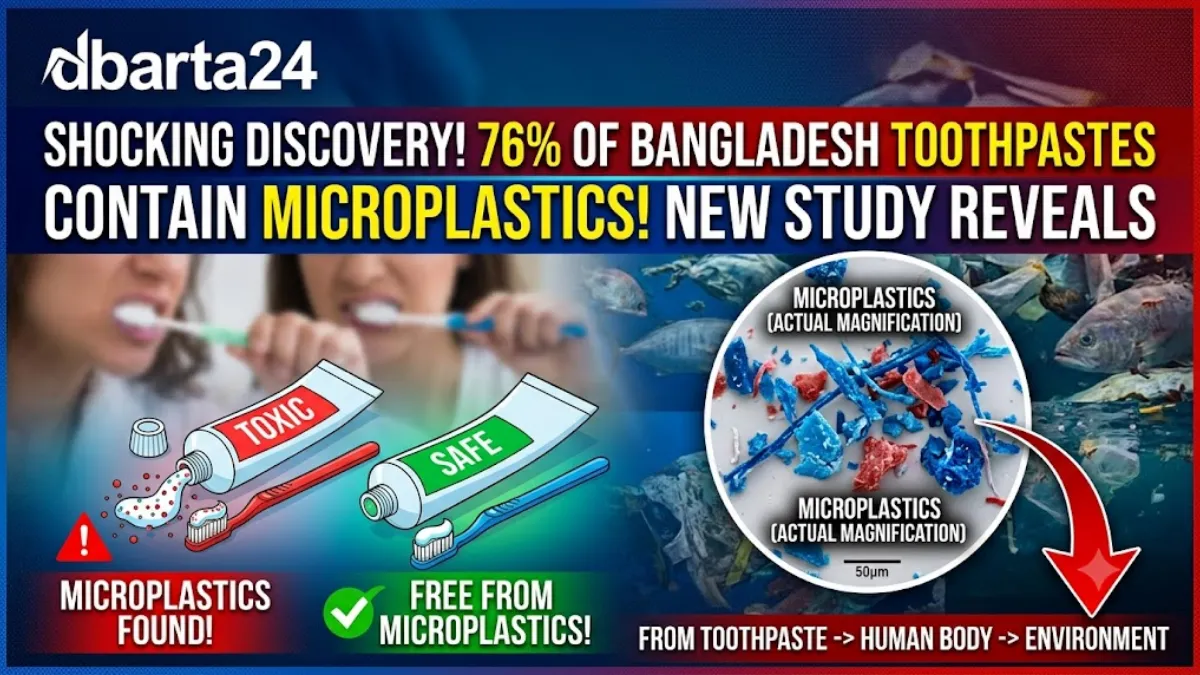
Dbarta24 Report – Nearly three out of every four toothpaste brands available in Bangladeshi markets contain alarming levels of microplastics, posing significant risks to public health and the environment.
A pioneering one-year study conducted by the Environment and Social Development Organization (ESDO) revealed that 76.5% of tested toothpaste samples—including products specifically marketed for children—contained these microscopic plastic particles.
Key Developments & Study Findings
The research, spanning from July 2025 to June 2026, analyzed 34 toothpaste samples from 19 local and imported brands collected from various retail markets, wholesalers, and superishops across Bangladesh.
Laboratory testing was executed at the Environmental Health and Ecotoxicology (EHE) laboratory under the Department of Environmental Sciences at Jahangirnagar University.
The study detected microplastic concentrations ranging from 20 to 320 particles per 100 grams of toothpaste.
Product Breakdown and Toxicity Rankings
The laboratory analysis brought forward striking disparities between domestic and imported products:
-
Local vs. Imported: Out of 25 Bangladeshi-manufactured samples, 22 tested positive for microplastics. Both samples imported from Vietnam contained the particles. Conversely, only one out of two samples from Thailand and one out of five from India showed contamination.
-
Highest Contamination: Mediplus Fluoride Gel topped the list with the highest density, recording 320 particles per 100g.
-
Other Affected Popular Brands: Closeup Red Hot and Closeup Menthol Fresh both recorded 160 particles; Kodomo Ultra Shield Formula carried 140 particles; Signal Green Tea contained 120 particles; while Pepsodent Advance Salt and Himalaya Complete Care each registered 100 particles per 100g.
-
Microplastic-Free Exceptions: Out of the 34 samples, only 8 were completely free of microplastics, including Genfresh, Parachute Just For Baby (Mango), Closeup Red-Hot Zinc Fresh Technology, Parodontax Expert Gum Care, Sensodyne Fresh Gel, Colgate MaxFresh, Colgate Active Salt, and Kodomo Orange.
Children’s Products Vulnerable
Alarmingly, the threat extends to pediatric oral care. The study included six toothpastes manufactured for children, discovering that 67% of the samples contained microplastics. Kodomo Ultra Shield Formula led the children’s category with 140 particles per 100g, followed by Meril Baby Strawberry (60 particles), Meril Baby Orange (40 particles), and Pepsodent Kids Orange (20 particles).
Consumer Awareness and Market Reality
As part of the study, ESDO conducted a comprehensive survey involving 2,760 consumers across the country. The survey highlighted a massive awareness deficit:
-
41.9% of respondents had never heard of microplastics in oral care products.
-
31.3% had heard the term but lacked any detailed understanding.
-
Only 26.9% expressed active awareness of the issue.
The study further pointed out that none of the tested toothpastes disclosed the presence of synthetic polymers or microplastics on their packaging labels, keeping consumers entirely in the dark.
“All samples were sourced directly from retail markets and supershops, ruling out any possibility of counterfeit products interfering with our data,” stated Dr. Shahriar Hossain, Secretary General and Senior Technical Advisor of ESDO. “Most consumers are completely unaware that a product they use daily could contain microplastics. It is critical to mandate ingredient labeling, boost public awareness, and enforce regulatory oversight immediately.”
Regulatory Loopholes & Health Hazards
Currently, Bangladesh lacks national guidelines, legal safety limits, standard testing protocols, or mandatory labeling laws regarding microplastics in dental hygiene products.
Addressing the press conference, Md. Monzurul Karim, Deputy Director (Chemistry) at the Bangladesh Standards and Testing Institution (BSTI), acknowledged the gravity of the situation.
“National standards for toothpaste currently allow 40 approved ingredients and specify particle size limits. However, some manufacturers might use microplastics as a cost-effective way to increase product weight, which is an unacceptable practice,” Karim stated. He added that BSTI has been tracking microplastic usage since 2019, having already revised standards for face washes and face packs, and will now actively consider similar standard revisions for toothpaste.
Environmental and Health Risks
Microplastics rinsed away during brushing travel through wastewater systems directly into rivers, water bodies, and the broader marine ecology. These non-biodegradable particles smoothly infiltrate the food chain.
Global medical research links sustained microplastic exposure to potential dysfunctions in the respiratory, digestive, and reproductive systems, alongside cardiovascular complications and immune system suppression.
As the first-ever scientific inquiry into microplastics within Bangladeshi oral care products, the ESDO study serves as a critical baseline for environmental policy.
Syed Marghub Murshed, Chairman of ESDO, emphasized the path forward: “Effective public policy must rely on credible scientific evidence. This study aims not to target individual brands, but to establish a robust framework that assists regulators in upgrading national standards, ensuring rigorous market monitoring, and safeguarding public health and the environment.”