


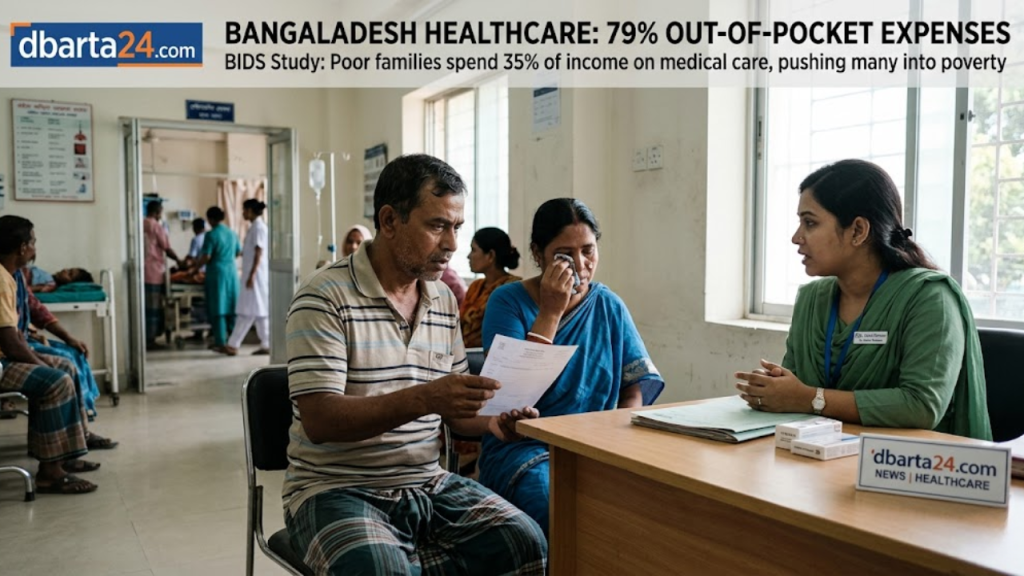
Labonnya Liza ; DHAKA – The healthcare system in Bangladesh is facing a significant crisis as affordable medical services remain out of reach for the masses.
According to a recent study by the Bangladesh Institute of Development Studies (BIDS), a staggering 79% of total healthcare expenses are borne by individuals out of their own pockets.
The report, titled “Revisiting Unmet Healthcare Needs and Out-of-Pocket Payments in Bangladesh,” was unveiled on Thursday at the BIDS conference room in Agargaon.
The study highlights that the burden is heaviest on the poor, who spend approximately 35% of their total income on medical treatment. In contrast, wealthy families spend only 5% of their income on healthcare.
Rising Costs and Poverty Risks
The research indicates a worrying trend: in 1997, out-of-pocket (OOP) expenditure was 55.9%. By 2020, this rose to 68.5%, and the latest findings now place it at 79%. High costs for catastrophic illnesses like cancer and kidney disease are driving many families below the poverty line.
On average, cancer treatment in a hospital costs 224,000 BDT, while heart disease costs 100,000 BDT, and kidney ailments cost 63,000 BDT.
Unmet Healthcare Needs
The survey, which covered 62,387 individuals, found that 65% of people could not meet their healthcare needs due to high costs, lack of knowledge, or absence of support. Regional disparities are also stark:
Rajshahi Division: Highest rate of unmet medical needs (73%).
Narail District: A staggering 81% of needs go unmet.
Feni District: Best performing, with only 18% unmet needs.
Government Plans: Health Cards and Reforms
Speaking as the chief guest, Rashed Al Mahmud Titumir, Adviser to the Prime Minister on Finance and Planning, stated that the government is considering the introduction of Health Cards for citizens to streamline nutrition and medical services.
He emphasized the need for governance, monitoring, and ensuring that at least 5% of the national budget is effectively spent on health.
Economist Dr. Wahiduddin Mahmud, who chaired the seminar, remarked that development in health and education should not be measured by “beautiful buildings” but by the quality and accessibility of services.
Key Statistics Summary
| Category | Cost / Percentage |
| Out-of-Pocket (OOP) Share | 79% |
| Average Monthly Family Health Spend | 3,454 BDT (11% of total spend) |
| Poor Families’ Income spent on Health | 35% |
| Cancer Treatment (Average) | 224,000 BDT |
| Heart Disease Treatment (Average) | 100,000 BDT |
| Unmet Healthcare Needs (National) | 65% |