


Khairul Alam: Dhaka, the capital city of Bangladesh, has been grappling with air pollution for an extended period. Despite various measures taken by the government to combat pollution, the problem remains unabated.
Consequently, air pollution poses a significant threat to public health, leading to a rising number of casualties every year. Alongside this, climate change is also exacerbating the risks.
Air pollution and climate change share a common thread, with air pollution accelerating the pace of climate change. Environmentalists believe that air pollution plays a pivotal role in global warming.
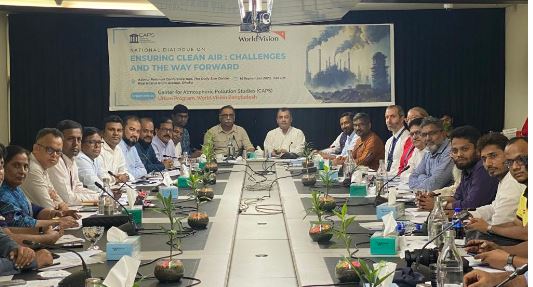
On Thursday, September 14th, a discussion titled “Ensuring Clean Air: Strategies for Prevention and Mitigation” was held at the Karowayanbar Daily Star Building.
The event was organized jointly by the Center for Atmospheric Pollution Studies (CAPS) and World Vision Bangladesh.
During the discussion, speakers emphasized that air pollution and climate change are intricately connected. They noted that complex interactions within the atmosphere link the two issues.
Substances like black carbon, carbon dioxide, methane, nitrous oxide, chlorofluorocarbons, and ozone are released into the air due to activities like biomass burning and industrial processes.
These pollutants are not only responsible for air pollution but also contribute to short-lived climate pollution, also known as short-lived climate forcers (SLCFs). These gases and pollutants are interlinked, affecting both air quality and climate change.
Saber Hossain Chowdhury, Chairman of the Parliamentary Standing Committee on Environment, Forest and Climate Change, stated, “Air pollution is an issue where we cannot compromise at all. It is a matter of zero tolerance.
Just as we advocate zero tolerance in terrorism and extremism, we must have a zero tolerance policy in air pollution.”
He further stressed that addressing air pollution requires a comprehensive approach involving all stakeholders because the environmental department alone cannot solve the problem. Air pollution is a silent killer, and its adverse effects are not always immediately visible.
In his keynote address, Professor Dr. Ahmad Kamruzzaman Majumder highlighted that failure to address air quality improvement would significantly increase health risks in the future.
To combat this, we need to harness renewable energy sources as an alternative to burning biomass. He outlined four recommendations for air quality improvement in the country.
The event, which was presided over by Professor Dr. Mohammad Ali Naqvi, Vice President of the Institute of Architects Bangladesh (IAB) and Founding Director of the Center for Atmospheric Pollution Studies (CAPS), was attended by other dignitaries, including Barrister Shameem Haider Patwari, Member of Parliament, Climate Parliament Bangladesh;
Ahsan Adelur Rahman Adel, Member of Parliament, Climate Parliament Bangladesh; Rana Mohammad Sohel, Member of the Parliamentary Standing Committee on Environment, Forest and Climate Change; Daniel Novak, First Secretary of Health, Embassy of Sweden in Bangladesh; Mohammad Hossain, Chief Engineer of the Power Cell; and Mohammad Fazle Reza Sumon, President of the Bangladesh Institute of Planners (BIP).