


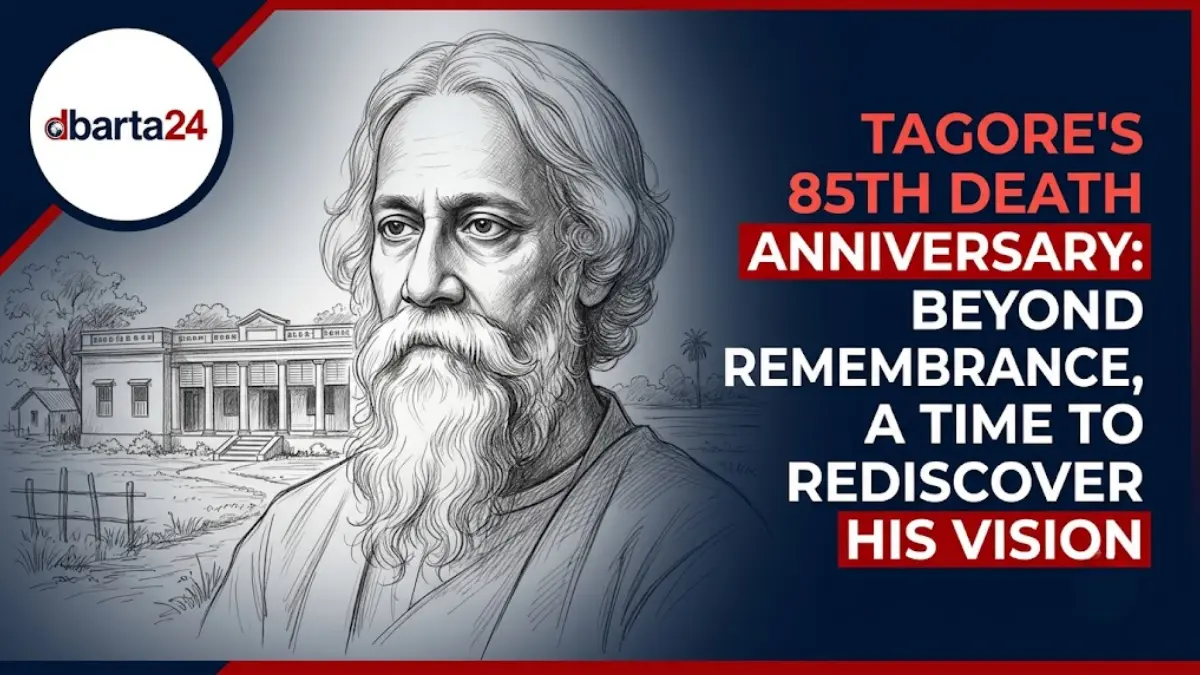
Khairul Alam; Dbarta24 — Today marks Baishe Srabon, the 85th death anniversary of Asia’s first Nobel laureate, Rabindranath Tagore.
On this day in 1941, the revered poet passed away at his ancestral home, Jorasanko Thakurbari in Kolkata.
Eight and a half decades later, the occasion remains far more than a solemn date of mourning for Bengalis—it serves as an enduring opportunity to re-evaluate his timeless philosophy and contributions.
Reducing Tagore’s expansive lifetime merely to a list of dates—his birth, literary masterpieces, Nobel Prize, and death—leaves a vast portion of his legacy unexplored. Born on 25th Baishakh, 1268 (Bengali calendar), Tagore transcended the boundaries of a poet.
He left an indelible mark as a lyricist, short story writer, novelist, playwright, essayist, social reformer, and educational thinker.
Though formal schooling failed to hold his interest in childhood, the rich intellectual environment of his family nurtured his creative genius, which eventually radiated across multiple mediums throughout his mature years.
The East Bengal Turning Point
A crucial turning point in Tagore’s life was his deep connection to East Bengal (present-day Bangladesh). Managing his family’s estates brought him regularly to Shilaidaha in Kushtia, Shahjadpur in Sirajganj, and Patisar in Naogaon.
His time at the Shilaidaha Kuthibari, in particular, grounded his literature in the intimate realities of rural Bengal’s landscape and human struggles. His short stories vividly reflect the joys, sorrows, and relational dynamics of ordinary people.
Beyond his literary pursuits, Tagore approached his estate management with a humanist spirit. He spearheaded practical initiatives for his tenant farmers, improving access to education, healthcare, clean drinking water, rural infrastructure, and micro-debt relief.
Demonstrating his commitment to rural self-reliance, he established an agricultural cooperative bank in Patisar and invested a significant portion of his Nobel Prize money into it.
Redefining Education and Nationalism
Dissatisfied with the rigid, colonial educational framework, Tagore envisioned a learning model rooted in nature and freedom. In 1901, he founded a school in Santiniketan with just five students—an institution that later evolved into the renowned Visva-Bharati University.
For Tagore, education was not about rote learning; it was a pathway to understanding humanity’s deep relationship with nature and the world.
In 1913, Tagore achieved global renown when he was awarded the Nobel Prize in Literature for Gitanjali. The Nobel Foundation highlighted the profound sensitivity and beauty of his translated poetry.
Despite his international fame, Tagore remained deeply tied to the socio-political realities of his homeland. Honored with a knighthood by the British Crown in 1915, he courageously renounced the title in 1919 in protest of the horrific Jallianwala Bagh massacre.
An Enduring Presence in Bangladesh
In his final years, amid personal grief and global conflict, Tagore’s reflections turned increasingly toward human freedom, the crisis of civilization, and moral dignity.
Every generation continues to discover Tagore in unique ways—through love, heartbreak, nature, solitude, and the collective aspiration for human liberation.
His presence in Bangladesh’s cultural identity is foundational: “Amar Sonar Bangla” serves as the national anthem, while the historical sites of Shilaidaha, Shahjadpur, and Patisar remain cherished monuments to his creative spirit.
Tagore was not merely a literary icon; his pioneering ideas on rural poverty alleviation, cooperative banking, and holistic education laid early foundations for modern social development. As the nation observes Baishe Srabon, his life stands as a beacon guiding contemporary thoughts on art, humanity, and progress.